Looking for a Private Carer: How to Find Reliable Help – Without an Agency & Without the Stress

You are standing in your parents’ kitchen and notice that the refrigerator is empty. Your mother smiles it away, but you sense it: She can no longer manage on her own. The thought of letting a stranger into your family’s most intimate space makes your throat tighten. You do not want a rigid, anonymous agency that sends you just anyone. You want someone with heart, someone you can choose yourself. noracares gives you exactly this freedom.

Searching for a private caregiver can feel overwhelming at first. Online, you will find classified ads, platforms, agencies and Facebook groups – but hardly anyone clearly explains which path really fits your situation and what you absolutely need to pay attention to before making a decision. This is exactly where we come in.
In this guide, we show you step by step how to find a suitable caregiver, what options you have, and which typical mistakes you should avoid. You will also learn what private care really costs, how to recognize reputable offers, and when another solution might make more sense.
This way, you receive not only information – but clear guidance so you can make a decision that truly feels right for you and your family.
You are looking for a private caregiver because someone important to you needs more support in everyday life. Perhaps you notice that your mother or father can no longer manage everything alone – or that you, as a relative, are eventually reaching your limits. In this situation, many questions arise at once: Where can you find a reliable caregiver? Whom can you trust? And how do you make sure everything remains fair, legal and affordable?
Searching for a private caregiver can feel overwhelming at first. Online, you will find classified ads, platforms, agencies and Facebook groups – but hardly anyone clearly explains which path really fits your situation and what you absolutely need to pay attention to before making a decision. This is exactly where we come in.
At a glance – Which path is right for me?

Are you looking for a private caregiver? These are your options
If you are looking for a private caregiver today, you have three main options. Depending on how much time you want to invest and how much security you need, a different model may be suitable:
Finding private caregivers through platforms
Specialized care platforms such as noracares use modern matching systems to connect you directly with suitable caregivers. You can specifically compare profiles that have already been filtered according to your requirements (e.g. experience with dementia or language skills).
- Benefits: You benefit from verified profiles, easy contact and a quick overview of available caregivers in your region. It is the safest path for direct employment.
Finding caregivers through classified ads or marketplaces
Many families search through general portals such as classified ad sites, digital flea markets or specific Facebook groups. Caregivers often advertise their services independently there.
- Benefits: There is a huge selection of offers, and contact is usually extremely quick and informal.
- Warning: There is a higher risk here. You must check qualifications, references and legal status (avoid undeclared work!) completely on your own.
Finding caregivers through placement agencies
Traditional agencies act as intermediaries. They search their own pool for a caregiver and provide that person for you, often under posting models.
- Benefits: The agency handles most of the organization and administration for you.
- Drawbacks: This is usually associated with higher costs because agency fees are charged monthly. In addition, you have less direct choice over exactly who comes into your home.
A private caregiver can be like a personal anchor in everyday life. They provide individual support, adapt flexibly to your needs and are often a more affordable alternative to traditional agencies. This is an invaluable advantage, especially for people who feel comfortable in familiar surroundings: You receive help exactly where it is needed – at home, in a familiar atmosphere.
Private caregivers often also meet the legal requirements placed on professional care staff. With noracares it becomes easy to find the right caregiver who is not only professionally competent, but also provides personal and trustworthy care.
Why are so many people looking for a private caregiver?
- More personality: Direct, personal contact instead of anonymous placement
- More say: You decide who comes into your home
- More affordable: No high agency costs, often flexible pricing
- Faster & less complicated: You often find suitable care more quickly
This makes care at home not only professional, but also warm and individual, precisely tailored to the people who need it.
Private or agency? The big comparison
When you have to choose between a direct private caregiver and a caregiver placed through an agency, it is like deciding between a handpicked companion and a standardized service:
To make your care system stable and safe, you need to clarify a few legal points – this is not an annoying bureaucratic burden, but your safety net:
Legal employment or self-employment:
- You can employ a caregiver as an employee or hire them as a self-employed person.
- For self-employment, the person needs a trade license for “personal care” (e.g. under the Home Care Act).
Contract:
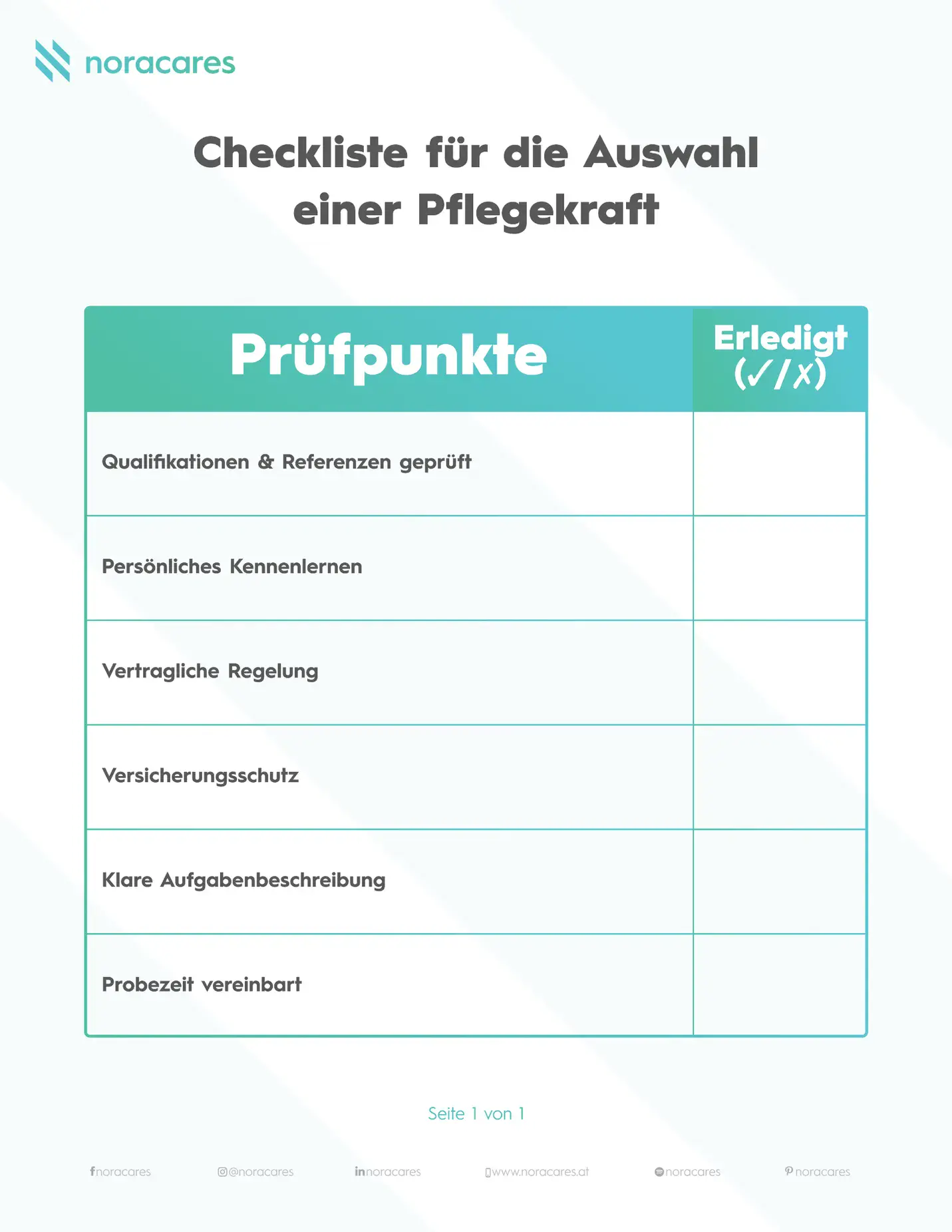
- A written care contract is absolutely important. Clearly agree on working hours, breaks, tasks, trial period and termination conditions.
Insurance:
- Make sure that the caregiver’s health, accident, and liability insurance are arranged – especially essential for 24-hour care models.
Taxes & social insurance:
- For employees: health & social insurance must be registered.
- For self-employed workers: social insurance (e.g. through SVS) and, if applicable, VAT must be clarified.
Imagine you are building a small ship that navigates you through the often stormy waters of care costs: the private caregiver is your trusted sailor, with whom you hold the rudder together. But without the right sails (subsidies), the navigation instrument (clear contracts), and the insurance (insurance & legal matters), the course can become dangerous. Done right, this ship will bring you safely to shore – with financial relief, personal care, and security for you and your family.
Finding a private caregiver can be challenging, but there are clear steps you can follow to find the right person for your needs.

Qualifications and requirements
Think about which qualifications the caregiver should have. Does she have experience caring for seniors or special conditions such as dementia? Also pay attention to good German skills and additional certificates that underline her competence.
Personality also plays a major and important role: empathy, patience, and good communication skills are some of the qualities the caregiver should bring.
Training and certification of caregivers
Depending on the area of responsibility, it is important that the caregiver has the required training and suitable certificates. Ask to see certificates and proof to verify the information and ensure that the qualifications meet the requirements.

Here you can download a checklist for choosing a caregiver.
Looking for a private caregiver is more than looking for support: it is about finding the right person who accompanies a loved one with heart, respect, and attentiveness. When you open the door to your home, someone should enter who not only makes everyday life easier but also brings warmth, trust, and security.
With noracares, this process becomes easier and safer. Our platform connects you directly with qualified caregivers who are precisely matched to your family member’s individual needs – simple, transparent, and reliable.
We show you step by step how to quickly and purposefully find the right caregiver so that your home remains a place where everyone feels well cared for.
Benefits of noracares when searching for a caregiver
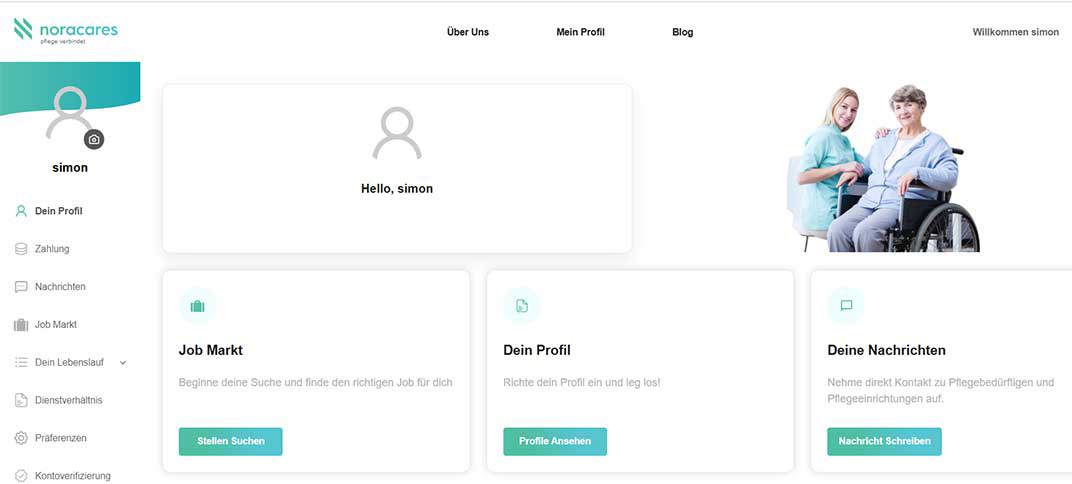
Using noracares makes your search for a private caregiver much easier. With a user-friendly platform, verified caregivers, and flexible solutions, noracares offers many benefits that optimize the caregiver search process and make it safer. We have summarized the most important benefits for you:
- Time savings and easy use: The platform offers intuitive search and filter functions that help you quickly find suitable caregivers without a long search.
- Quality assurance and trust: All caregivers are reputable and trustworthy. Reviews and feedback from previous families give you additional confidence when making your selection.
- Flexibility and customization: Caregivers with different availabilities and qualifications can be found in a targeted way – from full-time caregivers to hourly support.
- Individual care: The platform enables you to choose caregivers who can respond precisely to the specific needs of your family member or members – whether medical care or everyday support.
- Cost savings: If you find your caregiver through noracares and hire them privately, you save quite a bit in costs that would otherwise go toward an agency .
- Direct communication: You can contact potential caregivers directly through the platform to clarify questions and hold initial conversations.
With noracares, finding a suitable caregiver becomes not only more efficient but also safer and more flexible, so you can find the best possible support for your loved ones – tailored entirely to individual needs.
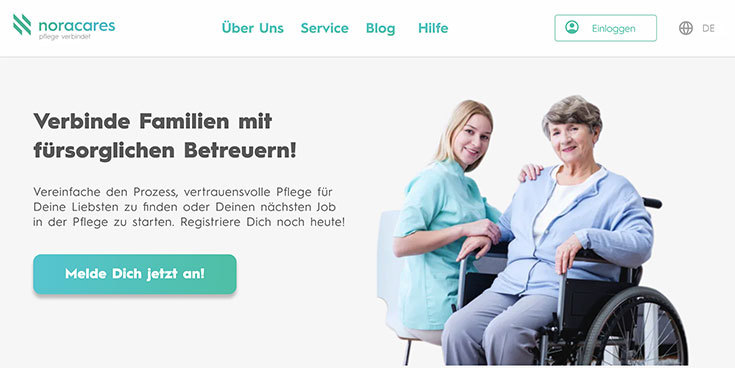
Finding a private caregiver is a decisive step that can fundamentally change everyday life for you, your family member, and the whole family. With noracares, this path becomes not only manageable but also purposeful. We accompany you every step of the way!
Step 1: Registration and profile creation
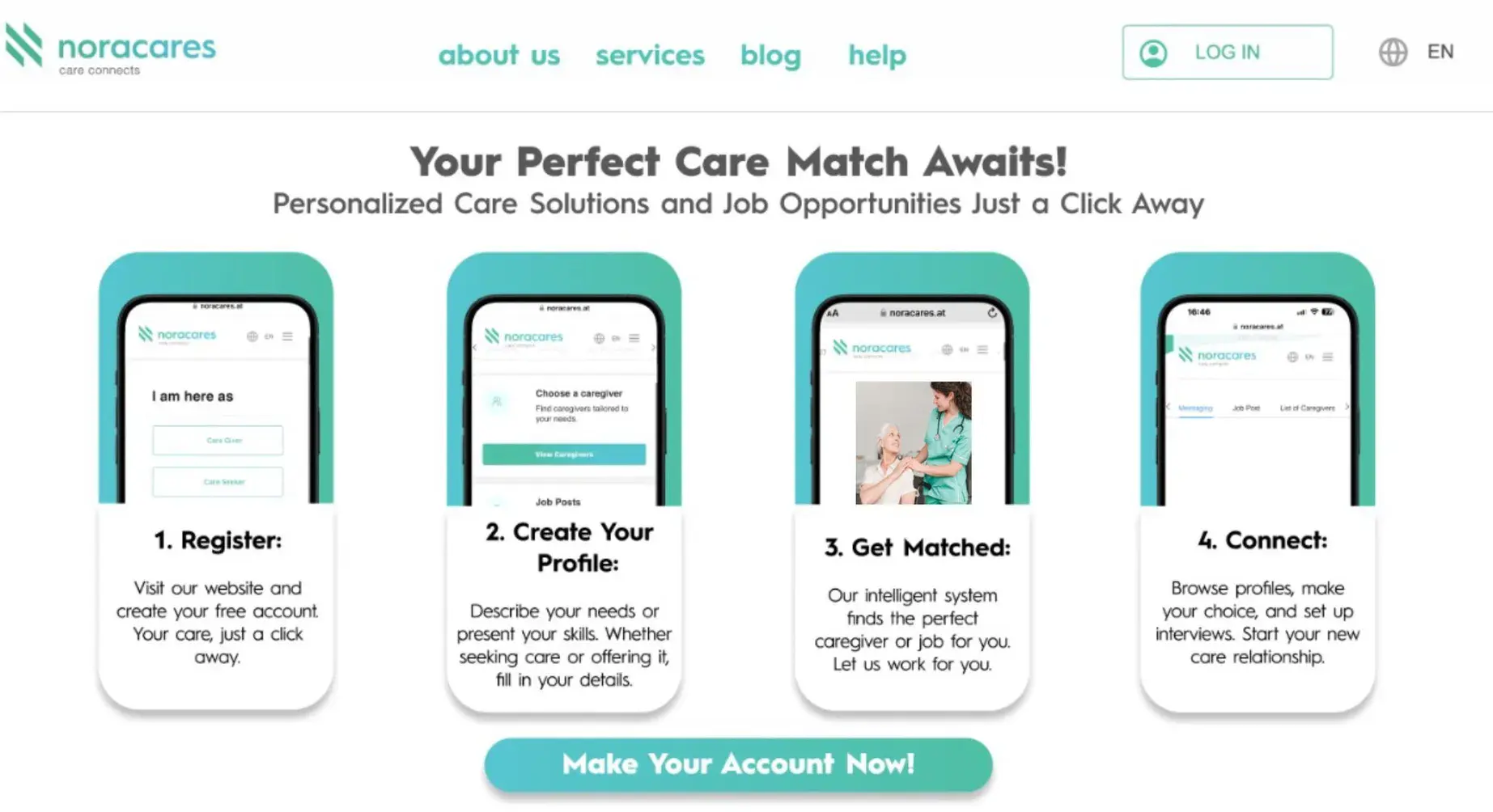
The starting point of your journey is simple registration with noracares. Imagine laying the foundation for support that will enrich the life of your family member. After you have signed up, you create a detailed search profile that maps out all wishes and requirements like a precise map. You have the opportunity to record important details:
- What type of care does your family member need? Is it about daily support in the household, medical care, or perhaps empathetic companionship in everyday life?
- When and how often should the caregiver be available? Maybe you are looking for someone for the whole day or only for certain hours.
- Are there personal preferences, such as a particular communication style or special skills that the caregiver should have?
The more precise and personal you make the profile, the greater the chance that the private caregiver who is exactly right for your family member will feel addressed – like a tailor-made suit that fits the needs perfectly.
Step 2: Filter options and targeted search
Once your profile is ready, you can take the compass in hand and begin the journey – with noracares’ versatile filter options. Here you are in control: you can filter by qualifications, specific experience, or special skills that you and your family member need. For example, if you need someone who is familiar with dementia or already has experience with wheelchair users, the filters allow you to find exactly these people.
Another advantage is the ability to search by regional criteria, so you can find caregivers who are not only professional but also near you.
Step 3: Compare and select profiles

Now you have reached the point where you can compare the different caregiver profiles – it is as if you are putting together a valuable mosaic. Each profile is a story in itself and gives you insights into:
- The caregiver’s qualifications and certificates – like puzzle pieces that show you the overall picture of their professional suitability.
- Experience reports and reviews from previous families – these act like little lighthouses that guide your way and build trust.
- A personal description of the caregiver, which shows you how much heart and dedication they bring to their work.
Based on these criteria, you can already filter out potential caregivers in order to get to know them better afterwards.
How to recognize a reputable caregiver: Your 5-point check
Fear of dubious offers is understandable, but with the right checking system you can dispel it. Use this checklist as your personal safety filter:
Nora’s advice for you: Trust is good, but maximum control over your budget is better. Do not leave the selection to chance or to an expensive agency. Decide for yourself who fits your family.
Step 5: Initial conversation and getting to know each other

The first meeting with the potential caregiver is like a cautious approach – a moment in which you sense whether the chemistry is right and whether the caregiver truly suits your family member. In an open conversation, the aim is not only to clarify professional details but also to explore the interpersonal side. How does the caregiver respond to your questions? How does she or he envision the care? Here you can clearly express expectations and needs:
- What tasks come up in everyday life?
- What special requirements does your family member have – physically, emotionally, or socially?
- How flexible is the caregiver regarding working hours?
Imagine walking through a house that is currently being built and checking every room for functionality and harmony. The initial conversation helps determine whether the caregiver not only fits into your “house,” but also helps fill it with warmth and care.
Step 6: Contract Design and Legal Aspects
Once you have found the right private caregiver, the next step is employment. The final step on the way there is like setting a firm anchor: legal protection creates trust and security for both sides. A well-thought-out contract is like the blueprint that ensures every detail is taken into account.

When designing the contract, you jointly define working hours, areas of responsibility, and salary. Perhaps you need support around the clock or only at certain times – all of this should be regulated clearly and precisely. Arrangements for vacation periods or substitutes in the event of illness should also be discussed from the beginning to avoid misunderstandings.
The legal framework should not be forgotten: registration with the responsible authorities and the consideration of tax aspects ensure that everything proceeds legally and correctly. It is like putting up signposts on a new road – you create a clear and secure foundation for long-term, trusting cooperation.

After employment begins, the focus is on settling into everyday life. Successful collaboration with a caregiver is based on more than just a clear task description. It is about building a harmonious and trusting relationship that forms the basis for effective and empathetic care. Here are some important tips for shaping this collaboration as well as possible:
Clear Communication and Expectations

Open and clear communication is the key to successful collaboration. You should formulate your expectations precisely from the beginning and provide regular feedback. It is like creating a detailed map for your shared journey: the more accurately the route is described, the smoother the path will be. Clear agreements about tasks, working hours, and special needs prevent misunderstandings and ensure that both sides know what is expected.
Getting to Know Each Other and Building Trust

Building a trusting relationship between the caregiver and the person in need of care is essential for successful collaboration. This relationship is like a delicate plant that needs time and care to thrive. Make sure the caregiver is empathetic and patient and makes an effort to build a personal connection. If your relative feels comfortable and respected, this will significantly improve the quality of care and overall well-being.
Regular Check-ins and Flexibility
The care situation can change over time, and it is important to regularly coordinate tasks and care needs. Imagine sailing a ship on the open sea – regular course corrections are needed to reach the destination safely. Arrange regular meetings or conversations to review the current situation, make adjustments, and respond flexibly to new developments. This keeps care dynamic and adaptable, and you ensure that your relative’s needs are always met as well as possible.
Choosing a private caregiver is a big step. For the model to work in the long term, it is important to know the reality. Here are the most common stumbling blocks and how you can elegantly avoid them:
Misunderstanding: 24-Hour Care Does Not Mean 24/7 Work
A widespread misconception is that the caregiver can be on duty around the clock. This is neither legally permitted nor humanly possible.
- The problem: Overtiredness leads to mistakes, impatience, and burnout in the caregiver.
- Your solution: Plan fixed break times and nightly rest periods. If genuine 24-hour monitoring is necessary, you need to consider a team model (e.g. two caregivers alternating) or supplementary technical aids (home emergency call system, fall sensors).
Unclear Tasks Often Lead to Conflicts
“Could you quickly clean the window too?” Sentences like these are the beginning of the end of good collaboration.
- The problem: When the boundaries between care, household work, and being a “girl Friday” become blurred, frustration arises.
- Your solution: Create a weekly schedule. Define clearly: What are the core tasks? Is gardening included? Who does the shopping? The more precise the “blueprint” of your collaboration is, the more harmonious the atmosphere in the home remains.
Lack of Substitute Planning Can Become Expensive
What happens if your caregiver wakes up with a fever tomorrow or a family emergency forces them to travel home?
The problem: Families panic when care suddenly collapses from one day to the next.
Your solution: Build yourself a safety net before an emergency occurs.
- Use platforms like noracares to quickly access a pool of substitute caregivers.
- Keep the number of a local outpatient care service ready to bridge the gap.
- Clarify with other relatives or neighbors who can step in for 24 hours in an absolute emergency.
It is important to be honest with yourself: private care at home is a wonderful solution for many families – but it has its limits. There are situations in which safety and medical care must take priority over the familiar environment.
In These Situations, Private Care Is Often Not Enough
Imagine care as a building. When the foundation develops cracks that one person can no longer repair, it becomes dangerous. In the following cases, you should examine the situation critically:
- Severe, aggressive dementia: If there is a risk of self-harm or harm to others, or if the caregiver reaches their physical and psychological limits, a specialized facility is often safer.
- Extremely high care needs: If one-to-one care is no longer sufficient because, for example, two people are needed for lifting or nighttime monitoring, the private single-caregiver model becomes unstable.
If you notice that private care alone is not enough, you can consider moving to a care home or organize a second private caregiver or an outpatient care service.

How to Find a Private Caregiver You Can Truly Trust
When you are looking for a private caregiver, it is rarely just about organization or costs. Usually, it is about something much more important: the safety and quality of life of someone you care about. That is exactly why it is so important not to rush the decision – but to proceed step by step.
The good news is: today you have several ways to find a suitable caregiver – through platforms, agencies, or private advertisements. What matters is not only where you search, but how you choose. If you clarify the actual care needs beforehand, compare several candidates, ask the right questions, and pay attention to qualifications and trust, your chances of finding care that truly fits increase enormously.
At the same time, it is worth honestly examining whether a private caregiver is truly the right solution for your situation. In some cases, a combination of outpatient care, day care, or other support may make more sense. What matters is that the decision not only works practically – but also feels right for you and your family.
So if you are unsure, simply approach the search step by step:
✔ First clarify the actual need.
✔ Compare several caregivers or care models.
✔ Pay attention to experience, references, and open communication.
In the end, this allows you to make a decision that not only works organizationally, but also creates trust – for you, for your family, and for the person being cared for.
Start your search on noracares today and find the perfect caregiver for your loved ones! Register now and experience how simple and stress-free this journey can be.


- Basic care: The non-medical, everyday activities that are part of self-care, such as help with personal hygiene, dressing, serving food, and mobility.
- Home nursing care: Medical nursing services (e.g. wound care, administering medication) that are provided at home by qualified nursing professionals and go beyond basic care assistance.
- 24-hour care: A form of home care in which a caregiver lives in the household of the person being cared for and provides support around the clock.
- Contract for work and services: A form of contract in which a private caregiver works as a self-employed person and is responsible for social insurance and taxes themselves (common in 24-hour care in Austria).
- Care benefits in kind: Services that are provided directly by outpatient care services and billed to the long-term care insurance fund (relevant for Germany).
- Deposit: A sum of money (usually 2–3 months’ rent) deposited as security when renting an apartment for the caregiver.
- Respite care: A benefit from the long-term care insurance fund that covers the costs of a substitute caregiver when the regular caregiving person (usually a relative) is unavailable due to illness or vacation.
- Quality assurance: The process of reviewing and improving care quality. When searching for a private caregiver, this is often ensured through references, certificates, and direct contact.
- Matching system: A feature of digital platforms (like noracares) that brings potential caregivers and families together based on their individual criteria and needs.

