Private care services in Germany: How to find the right support for your loved ones

Many relatives suddenly find themselves facing the question: What is a care service? How much does it cost? And how do I find a good one? We answer exactly these questions in the following article.

Perhaps you are currently facing one of the greatest challenges of your life: A loved one suddenly needs support, and you are wondering how this will work. What exactly does a care service do? What services are available, how much does it all cost, and who covers the expenses?
We know how overwhelming these questions can be. In this situation, you don’t need complicated legal texts, but clear answers, real-life examples, and above all the feeling: You are not alone.
That is exactly what you will find here. In this article, we explain step by step,
- what a care service is and what types exist,
- what services you can expect,
- how costs and financing work,
- how to find the right service – with a checklist, testimonials, and practical tips.
This gives you everything you need to make good decisions during this difficult time – transparent, understandable, and focused on what truly matters: more humanity in care.

Care often only becomes tangible when it is suddenly needed – after a fall, surgery, or when age quietly begins to leave its mark. In these moments, a care service creates structure and security. It supports, explains, relieves the burden – and ensures that people can manage everyday life again without completely losing their independence.
Definition & Meaning
A care service is like a supportive safety net that catches people in their everyday lives when health, age, or illness make many things difficult. It steps in where relatives reach their limits and ensures that those affected can live as independently as possible.
An outpatient care service (often called a “mobile service”) comes directly to the home and takes over medical, nursing, and sometimes household tasks. These include, for example, help with washing and dressing, preparing medication, wound care, or support in daily life.
This makes care more than just “provision”: it provides safety, dignity, and participation — while at the same time relieving the burden on the family.
Outpatient care service = Care at home
The core idea: People should be able to remain in their familiar surroundings — with professional support only when and where it is truly needed.
Differences compared to other services:
Types of care services
Care is not all the same. Depending on the life situation, health condition, and wishes of those affected, there are different forms of support. Some services come to the home, others provide round-the-clock protection in a facility, and still others complement each other. An overview helps to find the right solution.
Outpatient / Mobile
The care service comes to your home at prearranged times.
Services range from basic care (e.g., personal hygiene) to doctor-prescribed measures such as injections or dressing changes. Flexible, individual, and ideal when independence should be preserved for as long as possible.
Inpatient / Nursing home
Here, people in need of care live permanently in a facility.
There is round-the-clock care, medical supervision, therapies, activation programs, and social contact. Particularly suitable for high care needs or dementia, when safety and constant supervision are important.
Community care center (church/non-profit vs. private)
- Church/non-profit: often strongly oriented toward the common good, frequently closely connected with counseling centers and volunteers.
- Private care services: usually more flexible, sometimes offering a broader range of additional services, and more customer-oriented.
Both operate under the same legal requirements — quality and costs depend less on the provider type and more on structure, team, and organization.
Care services support people in very different life situations: after illness, with chronic conditions, in old age, or when in need of care. The goal is always to shape everyday life safely, with dignity, and as independently as possible. Services range from compassionate everyday support to medically complex care.

Basic care (personal hygiene, dressing/undressing, eating, mobility)
This includes everything that is important for daily well-being: washing, showering or bathing, help with dressing and undressing, support with eating and drinking, or going to the toilet. Safe standing up, repositioning, and walking are also part of it.
Basic care provides comfort, safety, and dignity and helps prevent falls, skin problems, or inadequate care.
Treatment care (medication administration, injections, wound care)
These services are prescribed by a doctor and require professional qualifications.
They include, for example, preparing and administering medication, injections and insulin, measuring blood pressure or blood sugar, changing dressings, and treating chronic wounds.
Goal: Avoid complications, promote healing, and reliably implement therapies.
Household-related services (cooking, cleaning, shopping)
When strength declines, even familiar tasks become obstacles. Care services therefore support with shopping, cooking, light cleaning, laundry, or organizing the household.
This keeps the home tidy, hygienic, and livable, and noticeably relieves the burden on relatives.
Support & relief for relatives
Care often involves great responsibility. Care services therefore offer accompanying support, counseling, shared activities, memory training, or walks.
At the same time, they advise relatives, coordinate appointments, handle documentation, and step in when breaks are needed. This prevents overload and strengthens togetherness.
Special care needs (dementia, Alzheimer’s, palliative care)
Some situations require special expertise and sensitivity:
- Dementia/Alzheimer’s: structured daily routines, orientation aids, calm communication, activation without overwhelming.
- Palliative care: Relief of pain and symptoms, support in severe phases of illness, accompaniment for those affected and their relatives – with respect for wishes and quality of life.
Here, care services often work closely with doctors, therapists, hospice services, and counseling centers.
Sometimes there is no time for lengthy research. A fall, a hospital stay, or the sudden realization that managing alone is no longer possible — and suddenly you need immediate support. At that moment, searching for a care service often feels like a race against time.
The good news: Even if it is stressful, you are not helpless. With a clear plan, you can quickly get an overview and take the first steps in a targeted way.

The short answer when things are urgent:
If you urgently need help, focus on four things:
- Contact the care insurance fund or care support center – they know the regional services.
- Register with noracares and search directly for caregivers nearby.
- Bridge the short term, for example with the relief amount or household help.
- Check alternatives if waiting lists are long.
Your immediate plan – doable in about 30 minutes
Imagine working through a small emergency checklist – step by step:
1. Call the care insurance fund or care support center
This is your first point of contact. Here you receive free guidance, specific contacts in your area, and often tips on which care services currently have capacity. You don’t have to decide anything yet – it’s about getting an overview and reassurance first.
2. Register with noracares and contact caregivers
Instead of laboriously calling many individual care services, you can use noracares to request several suitable caregivers at the same time. This saves valuable time, especially when things need to move quickly.
On the platform, you can see at a glance who is available, which services are offered, and from when support is possible. While traditional care services often have waiting lists, you can often find a caregiver more quickly via noracares who fits your situation exactly.
3. Clarify the most important questions – directly via noracares
A clear checklist also helps when making contact via noracares. You can ask these questions directly in the chat or clarify them in the first conversation:
- Do you currently have capacity? When could you start?
- Which services can you take on specifically? (e.g., personal hygiene, medication reminders, household tasks)
- How does billing work? Can it be billed via the long-term care insurance fund, the relief amount, or privately?
- Will you be my dedicated contact person?
Feel free to jot down the answers briefly or save the profiles. Especially in stressful situations, it helps to keep track and be able to compare calmly later.
If no one is available right now – your alternatives
Sometimes, despite all the calls, you only get rejection after rejection. That’s frustrating, but it’s not the end.
- Use the relief amount: You are entitled to 131 euros per month, which you can use for recognized support services or help with household tasks. This can at least provide some short-term relief.
- Check short-term or respite care: Especially after a hospital stay or when relatives can’t provide care, this can be an important temporary solution.
- Organize a temporary solution: For example, through a caregiver, family support services, or local volunteer programs until a home care service has availability.
Even if everything feels overwhelming right now: you don’t have to solve this perfectly—just take the next step. Every call, every small temporary solution brings you closer to stable support.
When you imagine hiring a home care service, the question often comes up: How much does it actually cost? Care at home can be a fine line between loving support and a noticeable financial burden. Depending on care needs, place of residence, and selected services, the amount varies—and it is made up of several components, which we explain here clearly and vividly.

Support by care level (Germany)
In Germany, support from long-term care insurance is based on the recognized care level. The higher the care level, the more money the long-term care fund provides—whether as benefits in kind for professional care or as cash benefits to support care provided by relatives or combination models.
Here is an overview of the most important benefits (as of 2026):
Source: bva.bund.de
Benefits in kind = money that goes directly to the home care service. Care allowance = payout to those affected/relatives to organize care themselves.

Think of a home care service’s services like a modular kit: each month, you decide together with the provider which building blocks you need.
One block is the “large morning care,” another is “help with shopping,” or the “travel flat rate.” Each of these blocks has a fixed price. At the end of the month, all blocks are added up. The long-term care fund covers the costs up to your budget cap (e.g., €796 for care level 2) — everything beyond that, or anything that is not part of the standard modular kit of long-term care insurance, becomes payable as an out-of-pocket share.
Here is an overview of what the individual blocks typically cost:
Typical price items (guideline values)
What you should also know about this list:
- Service bundles (SB): In almost all federal states (except, for example, Bavaria, where there are time modules), home care services bill using fixed “packages.” A “full-body wash” package then costs the same amount whether the caregiver needs 15 or 25 minutes.
- Point values: Prices are determined by “points.” A home care service in Munich has a higher point value (e.g., €0.058 per point) than one in Brandenburg (e.g., €0.052 €). That’s why prices vary so much by region.
- Investment costs: These (as discussed above) are often added on top as a percentage or as a daily flat rate (usually 5–15 percent of the total sum).
- Surcharges: For visits at night, on Sundays, or on public holidays, a surcharge of 25 to 100 percent is often charged on the basic fee.
Example calculations
Here are two vivid scenarios of how the real on-site costs can add up, because the total and out-of-pocket share depend very heavily on actual care needs.
Scenario: Care level 2 in a rural area / small town
A senior still lives fairly well alone, but regularly needs help with personal hygiene, dressing changes, and some household tasks. An outpatient home care service comes three times a week.
- Benefits-in-kind budget, care level 2: 796 €
-
Average monthly bill from the home care service: approx. €400 to €650
(depending on whether, for example, medication administration or more extensive help is also needed) - The long-term care fund can cover all costs in full and often there is even a remaining amount left over, which can be used, for example, for additional small visits or support services.
Scenario: Care level 2 in Munich
An elderly woman in Munich has care level 2 and gets daily support from a home care service. The services could include, for example, basic care, mobilization, household help, and medication administration.
- Benefits-in-kind budget (long-term care fund): 796 €
- Home care service bills approx. €1,300 to €1,500 for services depending on effort (typical for Munich, where staffing costs are higher) plus investment costs.
- Out-of-pocket share: Between €500 and €700 per month that must be paid out of pocket—depending on how many services are actually needed and billed.
Scenario: Care level 3 in Berlin
In Berlin, a man with care level 3 lives and receives multiple care visits per day:
- Benefits-in-kind budget Long-term care fund: 1.497 €
- Home care service bills, for example, €1,800–€2,200 for services (more visits + additional treatments).
- Out-of-pocket share: Between €300 and €700 per month, depending on how many services are used, plus investment costs.
Scenario: Home care service 3× daily
Three visits per day are often expensive and often lead to out-of-pocket shares—even with higher care levels.
- 3 visits/day × 30 days = 90 visits/month
-
If one visit costs an average of €15–25 (depending on service/region):
90 × €15–25 = €1,350–€2,250/month - Care level 3 benefits in kind: €1,497/month
- Out-of-pocket share: €0–750, depending on the actual bill
For this reason, many people look for alternatives when several daily visits become necessary, e.g.:
- Combination with relatives: In the morning, the service comes (heavy lifting/washing); at midday and in the evening, relatives take over (meals/medications).
- Day care: Bringing the senior to a facility during the day. The budget for this is a separate pot (for CL 3 an additional €1,298) that does not reduce the outpatient budget!
- 24-hour care: A caregiver in the home, which is often more economical when care is needed 3 times a day (financed via care allowance + out-of-pocket share).

To make sure the math works out in the end, you should keep two often-forgotten points in mind:
- The “hidden” investment costs: In addition to care services, outpatient services charge so-called investment costs (for vehicle fleet, rent, IT). These are not covered by the benefits-in-kind budget (e.g., the 796 euros). They almost always have to be paid privately and, depending on the federal state, amount to between 50 euros and 150 euros per month.
- Medical treatment care (SGB V): Services such as medication administration, injections, or dressing changes are usually prescribed by a doctor. The good thing: these costs are covered by the health insurance 100 percent. So they do not count against your care budget (benefits in kind).
- The relief amount (131 euros): Everyone (from CL 1) receives this amount in addition. It can be used to pay, for example, a household helper from the home care service without touching the actual care budget.
Pro tip: Use the combined benefit
If you only use the home care service for 500 euros (at CL 2), the remaining 296 euros of your budget don’t simply expire. You then receive a proportional care allowance (in this case about 37 percent of the full care allowance) paid into your account.
How to calculate your proportional care allowance
If you use the home care service for only part of the budget, you are entitled to the remainder as a proportional care allowance. The long-term care fund calculates this using the following formula:

A simple example (care level 2): You have a budget of 796 €. The home care service uses 398 € of it (i.e., exactly 50 %).
- Calculation: 100%−50%=50%
- Result: You will additionally receive 50% of the full care allowance (for CL 2 that would be 50% of 347 € = 173.50 €) paid into your account.
Out-of-pocket shares & hidden costs
Long-term care insurance only pays up to a certain amount—those affected or relatives often have to pay the rest out of their own pocket. This includes:
- Additional surcharges: Some home care services charge additional surcharges, e.g., for vehicles or administrative effort, which are not covered by long-term care insurance.
- Travel costs & visit flat rates: Travel between care visits can be billed separately, depending on the contract with the home care service.
- Additional services: Extras like private support, weekend services, particularly long visits, or requested add-on services are usually not fully insured and increase the out-of-pocket share.
Funding options
So that the costs do not rest solely on the shoulders of those in need of care, there are several support options:
The decision to choose a care service feels like a first step into unfamiliar territory — with many questions, hopes, and the desire for security. So that you can take this path confidently and well informed, you will find here a practical guide, a checklist of the most important quality features, and clear distinctions between the different types of providers.

How do I recognize a good care service?
A truly good care service is reflected not only in paperwork and certificates, but above all in everyday care – in how people are treated, how reliably appointments are kept, and how transparently everything is organized.
Quality criteria of a good care service
Checklist: 10 questions for the initial consultation
Before signing a contract, you should clarify these points in a conversation (or via chat with noracares):
- Availability: From when exactly can you take over care and at what times (time windows) will staff come?
- Continuity: Do you work according to the principle of primary nursing? (So does the same person come whenever possible, or is staff constantly changing?)
- Qualifications: Do the deployed staff have state certification or special additional qualifications (e.g. for dementia or wound care)?
- Accessibility: How can the service be reached in emergencies outside of operating hours? Is there a 24-hour on-call service?
- Billing: Do you bill directly with the care fund? What costs will I incur as a private contribution (e.g. investment costs)?
- Flexibility: How short notice can appointments be canceled or additional services (e.g. in case of acute deterioration) be added?
- Scope of services: Do you also take on household tasks or purely support services via the relief amount?
- Documentation: Where is the care documentation kept? As a relative, do I have access to the reports at any time?
- Contractual matters: What is the notice period for termination if the chemistry between caregiver and relative is not right?
- References: Can you give me examples of how you ensure care in crisis situations (e.g. sudden staff shortages)?
Do you want everything at a glance? Then download your practical checklist here.(nora’s helpful)
Differences between private, church-based and non-profit providers
Care is organized by different providers, each with its own philosophy, structure and focus. By consciously choosing a provider, you can specifically influence services, costs, flexibility and personal support. The following overview shows at a glance how private, church-based and non-profit providers differ and what advantages each approach offers.
Choosing a care service means listening to both heart and mind: It’s not only certificates that count, but the overall feeling, the people behind it, and transparency in working together.
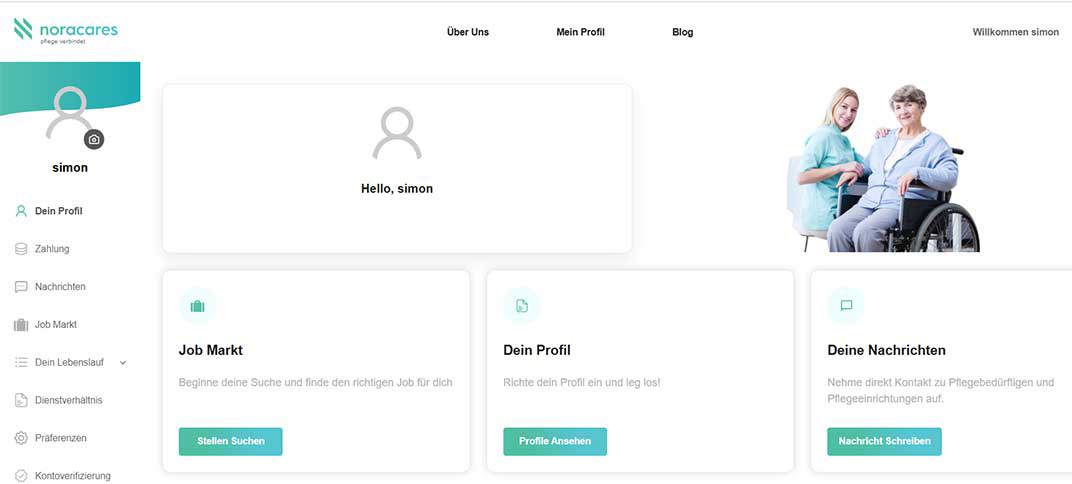
Imagine you are looking for someone who is there for your loved ones with heart and hands – not just a number, but a true companion in everyday life. This is exactly where noracares comes in: not as a traditional agency, but as a smart matching network that brings together care needs and suitable caregivers like a delicate puzzle.
With noracares, it’s not about anonymous placements with endless waiting loops and opaque costs. Instead, a digital platform opens up that works on two sides: for families, it searches for the right caregiver; for caregivers, it finds the right assignment and connects them through an intelligent matching system.
How it works:
You register, specify your needs and requirements – such as desired care times, qualifications or special situations like dementia or 24-hour care – and the system searches in the background for suitable profiles. Afterwards, you can calmly review the suggested caregivers, check their qualifications, experience and references, and even get to know them personally in advance via video chat.
What makes noracares special is the transparency and humanity in the process:
- You clearly see which care services are possible and how they match your requirements – without hidden placement fees, because noracares is not a traditional agency but works with low-cost subscription plans and direct contact.
- You have the opportunity to communicate directly with caregivers before making a decision – via chat or video call – and thus get to know the person behind the profile.
- And because trust is so important in everyday care, you can also reflect via the platform on whether the collaboration is a good fit or find a new caregiver if needed.
In short: noracares is like a personal guide through the jungle of care – digital, empathetic, efficient. The platform helps turn what is often an overwhelming selection process into a clear, structured and human decision in which needs and skills come together perfectly.

When care at home is needed, the first step is usually not the care service itself, but applying for a care level with the care fund. Without a care level, you receive no or only very limited benefits from long-term care insurance. This section guides you through the process – from the first steps to choosing the care service.
Application & requirements
Before a care service can come regularly and services are reimbursed by long-term care insurance, a care level must be applied for. The care insurance then checks how much support someone needs in everyday life. Depending on the result, a care level from 1 to 5 is assigned.
Requirements:
- The person is permanently dependent on support due to illness, disability or age-related limitations.
- The need for care is expected to last for at least six months (German Care Advisor).
Step-by-step guide
The path from application to receiving care services can be divided into clear steps:
- Submit application: Call your care fund or send an email/letter stating that you would like to “apply for long-term care insurance benefits.” You will usually receive a form that you must fill out.
- Assessment: After receiving the application, the MDK will contact you and arrange an assessment appointment, usually at home.
- Receive care level decision: After the assessment, the care fund will send you a written decision stating the determined care level. Benefits are granted retroactively from the date of application.
- Select care service: Once the care level is confirmed, you can choose a suitable care service and make use of services such as outpatient care, household assistance or support.
If things need to move quickly, e.g. after a hospital stay, an urgent application can be submitted in special cases so that the assessment is accelerated.
Important documents & contacts
To ensure the application is well prepared and the assessment runs smoothly, it is best to gather the following documents:
- Insurance card and personal details of the person in need of care.
- Medical documents such as medical reports, hospital discharge summaries, or diagnoses.
- Medication plan and, if available, existing care documentation or care diaries.
- If available: Documents regarding care services already provided and care reports.
Important contacts
- Long-term care insurance fund of your health insurance: Responsible for the application and assessment.
- Medical Service of the Health Insurance (MDK): Conducts the assessment.
- Care support centers or independent care counseling services: Can help with filling out forms and provide practical tips.
- Family doctor: Can provide additional information or reports that confirm the need for care.
(An important point that many recognize too late)
An outpatient care service is a great help – but not designed for every situation. It comes, completes clearly defined tasks, and leaves again. This can become a problem when care requires more than short visits.
At the latest, when constant presence becomes more important than individual tasks, so-called visit-based care reaches its limits.

Typical warning signs you should take seriously
You may recognize one or more of these signs:
- Nighttime restlessness or recurring emergencies: You sleep with one ear open because something could happen at any time.
- Frequent falls or severe mobility limitations: Even short distances become dangerous – being left alone is no longer an option.
- Severe dementia or tendency to wander: The affected person needs not only help, but constant orientation and supervision.
- Permanent supervision is required: Not because something specific is being done – but because something could happen at any time.
- Three or more care service visits per day: This quickly becomes extremely expensive, organizationally stressful, and exhausting for everyone involved.
If you notice that your day consists only of waiting for the next visit, this is often a clear sign: A traditional care service alone is no longer sufficient.
Fortunately, there are solutions that are better suited to such situations – often also as a combination.

24-hour care
A caregiver is permanently present in the household, supports daily life, provides safety, and is there if something happens. With 24-hour care there are no constant goodbyes, no dangerous being alone – but rather calm and reliability.
Care services & everyday companionship
Ideal for relieving family members. Support with daily life, structure, and companionship – often financed through the relief amount.
Day care
Well cared for during the day, back home in the evening. This brings structure, social contacts, and noticeably relieves family members.
Combination models
Often the best solution:
- Care service for medical tasks (e.g., medications, dressings)
- Caregiver for daily life, presence, and safety
This way, care is not only organized – but truly livable.
Challenges & future of care services
Care services balance daily between heartfelt work and structural constraints. Ringing call buttons, full schedules, and exhausted caregivers – everyday life is often a race against the clock, while humanity requires time that the system does not pay for.
Staff shortages & overload
In many regions, caregivers are lacking while demand is rising. Care staff rush from house to house, struggling with physical and emotional strain. The result: less time for conversations, closeness, and small moments that make care truly humane.
Financing problems & insolvencies
Long-term care insurance is under pressure, deficits are growing, care services struggle with rising costs and low reimbursements. Some services must close, others reduce services – an alarming look at the economic reality of care.
Reform ideas & prevention
New approaches focus on “prevention before rehabilitation before care”: fall prevention, mobility promotion, and health programs for older people can delay the need for care and increase quality of life. In addition, fair working conditions, better pay, and more career opportunities in nursing are needed. This creates a care system that remains sustainable and worth living for everyone.

A care service means more than just care by the minute – it means trust, support, and humanity.
You have now seen what a care service can do for you and your family: from basic care and medical assistance to relief in everyday life. We talked about costs, financing through long-term care insurance or social welfare, and how you can find the right service with a simple checklist.
In the end, it’s not just about numbers and contracts, but about people. Every person in need of care wants to be treated with dignity, and every family member needs the reassurance of having made the right decision. That is exactly what a transparent, reliable care service is there for.
Your next steps:
- Check your care level or that of your relative.
- Obtain several offers from care services near you.
- Use a checklist to compare quality and transparency.
- Trust your gut feeling: The right care service is not only competent, but also humane.
If you keep these points in mind, you will find the service that truly suits you and everyday life will become a little easier again.
Because a good care service means more than care by the minute – it means trust, humanity, and a clear cost structure. With a checklist, examples, and transparency, you will find the right service for your situation.

- Outpatient care service: A mobile service that visits people in need of care directly in their familiar environment. It takes on nursing, medical, and often also household tasks.
- Treatment care: Medical measures prescribed by a doctor (e.g. giving injections, preparing medications, or wound care). These costs are fully covered by health insurance and therefore do not affect your care budget.
- Care service: These services focus on social participation and relief in everyday life – for example through reading together, walks, or accompaniment to appointments.
- Relief amount: Every insured person from care level 1 is entitled to 131 € per month. This money is earmarked and can be used for household help or recognized everyday companions.
- Basic care: This includes the “major” and “minor” daily assistance tasks, such as washing, showering, brushing teeth, dressing and undressing, or support with eating.
- Investment costs: A kind of “overhead costs” of the care service (for cars, office rent, etc.). These are often not covered by the long-term care insurance fund and must be paid privately as a co-payment.
- Combination benefit: A smart model for families: Part of the care is provided by a professional service (benefits in kind), the rest by relatives. The remaining budget is then paid out proportionally as care allowance.
- MDK (Medical Service): The assessors of the long-term care insurance fund. They come to the home to assess the person’s independence and recommend the appropriate care level.
- Care allowance: Money paid directly to the person in need of care if the care is organized entirely privately (e.g. by children or a partner).
- Care level: The classification (from 1 to 5) that determines how much financial support one receives monthly from the long-term care insurance fund.
- Benefits in kind: The budget that the long-term care insurance fund provides directly to pay for a professional care service.
- Social station: A care service with a church or non-profit background (e.g. Caritas, Diakonie, or Red Cross).
- Inpatient care: Full inpatient care in a nursing home when care at home is no longer possible or safe enough.
Further sources:

