Childcare allowance in Austria 2026: A guide for parents

Elias' world is colorful and full of challenges. Thanks to care allowance for children, his family can provide him with the best possible care. Your child is entitled too! So start your care allowance application now and secure a better future for your child.

Imagine watching your child discover their world full of curiosity – a smile on their lips, their eyes shining. But sometimes these little adventures are connected with challenges that demand more than a family can manage alone. In such moments, it becomes clear how important support is.
In Austria, there is valuable help for parents whose children need special care: care allowance. It not only ensures that necessary therapies, aids, or care can be financed, but also gives families the opportunity to focus on what really matters – time with their child.
This article is more than just a guide. It accompanies you step by step, explains who is entitled to care allowance, how to apply for care allowance, and which rights and options are open to you. Together we will find out how your child can receive the support they deserve and how you as a parent can manage everyday life with strength.
Let us pave the way together – for a more carefree future for you and your child.
Care allowance is like a safe anchor for families whose children need more support in everyday life than most others. Your child is a little adventurer who overcomes special challenges on their journey through life.
So that you as a parent do not have to fight wind and waves alone, there is care allowance. It offers financial help so that you can give your child the care they deserve. Whether for special therapies, aids, or additional care – care allowance stands by your side to help give your child the best possible everyday life.
Relevance for families: More than just a financial benefit
Care allowance is far more than a mere transfer into the bank account. For families, it means room to act and appreciation. In an everyday life often shaped by appointments, therapies, and special care, it fulfills three essential functions:
- Relief in everyday life: It enables parents to purchase support – whether through professional caregivers or relief services – so they themselves can breathe for a moment and recharge their batteries.
- Compensation for additional effort: Life with special challenges often brings higher costs. Care allowance helps cushion these financial peaks without reducing the quality of life of the whole family.
- Self-determination: Families can decide flexibly how to use the money. Whether for converting the child’s room, specific support measures, or as compensation for the reduced working hours of one parent – the decision-making power remains with the family.
To receive care allowance for your child, certain requirements must be met. You can imagine this like two different kinds of keys: one determines whether you are basically eligible (Who?), and the other measures how much support is needed in everyday life (How much?).

Who is entitled to care allowance?
Before your child’s individual situation is looked at in detail, there are some basic framework conditions that make access to care allowance possible:
- The center of life: Your child must have their habitual residence in Austria.
- Long-term nature: The health challenge – whether physical, mental, or psychological – must be expected to last at least six months. So this is about long-term support, not temporary illnesses.
- The basis: As a rule, receiving the (increased) family allowance is an important indicator and often the prerequisite for starting the application process.
Necessary care needs
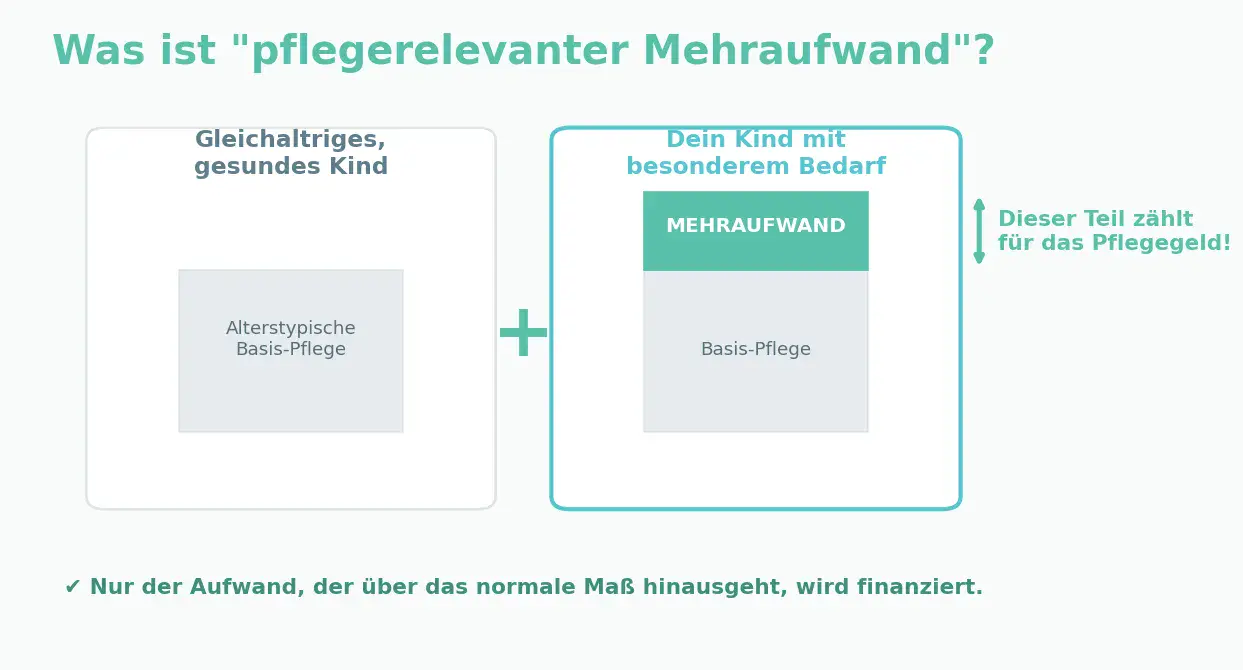
Unlike adults, a special standard is applied when assessing care needs for children and adolescents up to the age of 18. The required extent of care of same-age, non-disabled children is used as the comparison value. Only the additional effort that exceeds this natural level is considered care-relevant.
- Comparison with peers: The decisive criterion is not the diagnosis alone, but how much more help your child needs compared with a healthy child of the same age. While a two-year-old naturally needs help getting dressed, this need in a ten-year-old is clearly “additional effort.”
- The 65-hour hurdle: In order for entitlement to exist, this additional effort must amount to more than 65 hours per month.
- The medical assessment: An expert (usually a doctor or nursing specialist) visits you at home. This conversation is the compass for classification. They look at how much support is needed with the “activities of daily living” – these include:
- Personal hygiene and body care
- Dressing and undressing
- Preparation and intake of meals
- Using the toilet
- Mobility and safety in everyday life
- Support for development: Especially in children, consideration is given to how strongly the impairment affects child development. The need for motivating guidance or constant supervision is also included in the assessment.
Each of these requirements is a building block for the bridge that supports your child. It helps a great deal if, before the assessor’s appointment, you note down which tasks in your everyday life are especially time-consuming. This ensures that no detail of your valuable care is overlooked.
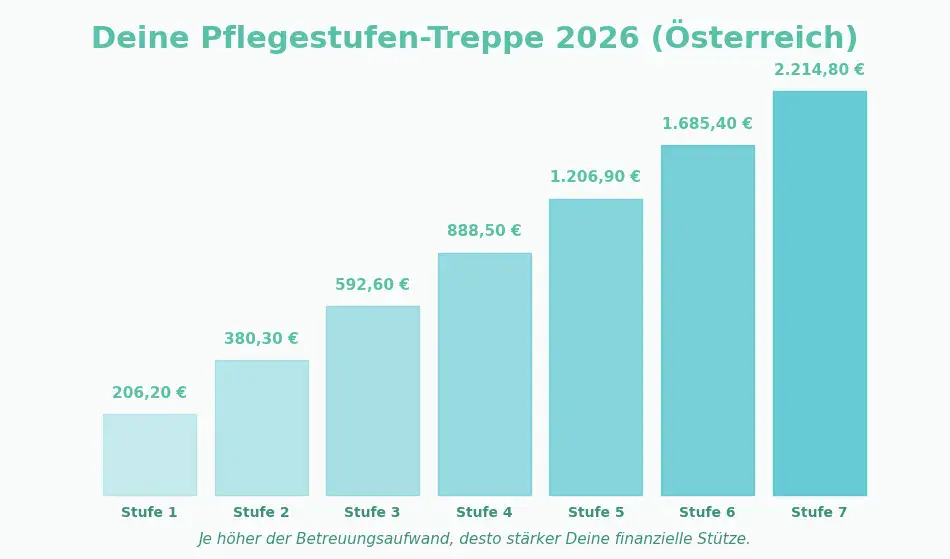
You can imagine care levels for children like steps on a staircase. Each level stands for a certain amount of care that your child needs in everyday life. The more time and care the assistance requires, the higher your child climbs on this staircase – and the higher the financial support that keeps your backs free.
Overview of care levels
Classification is not arbitrary, but based on the monthly additional effort in hours. Here you can see how the staircase is structured:
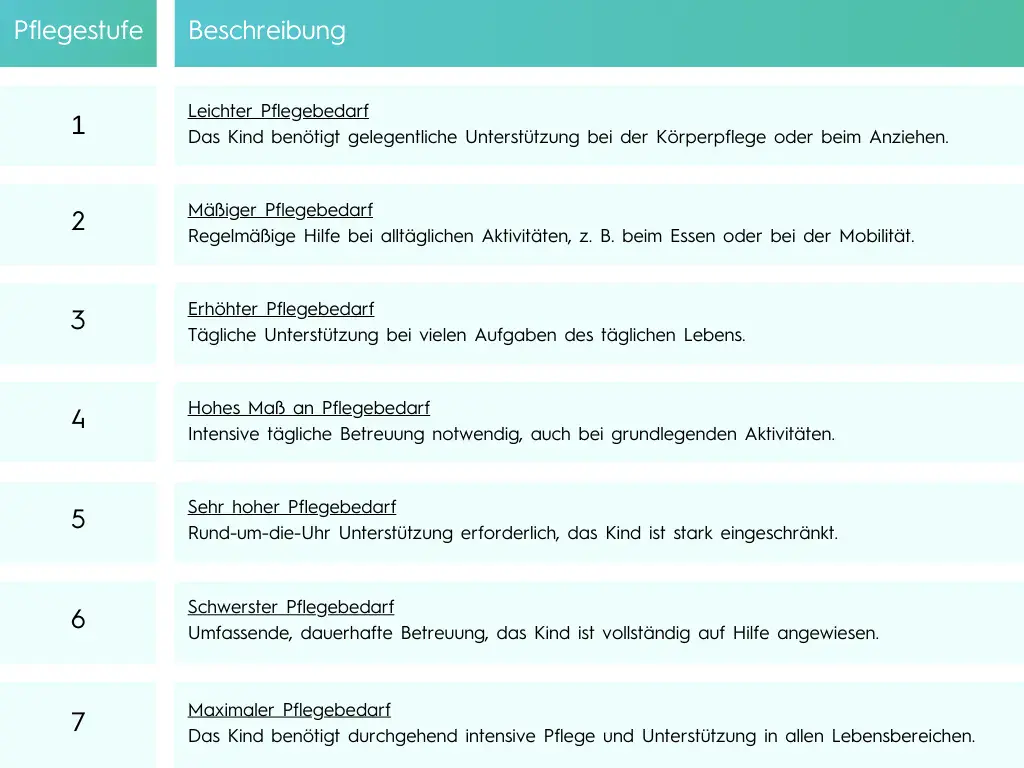
For example, Elias can still play independently, but with many everyday things like getting dressed or eating he needs help. That is why he was placed in a middle level. A child with more severe impairments who must be cared for around the clock, on the other hand, will be in a higher level. Each level helps tailor financial support precisely to your child’s needs – so they receive the best possible care every day.
Benefits by care level for children
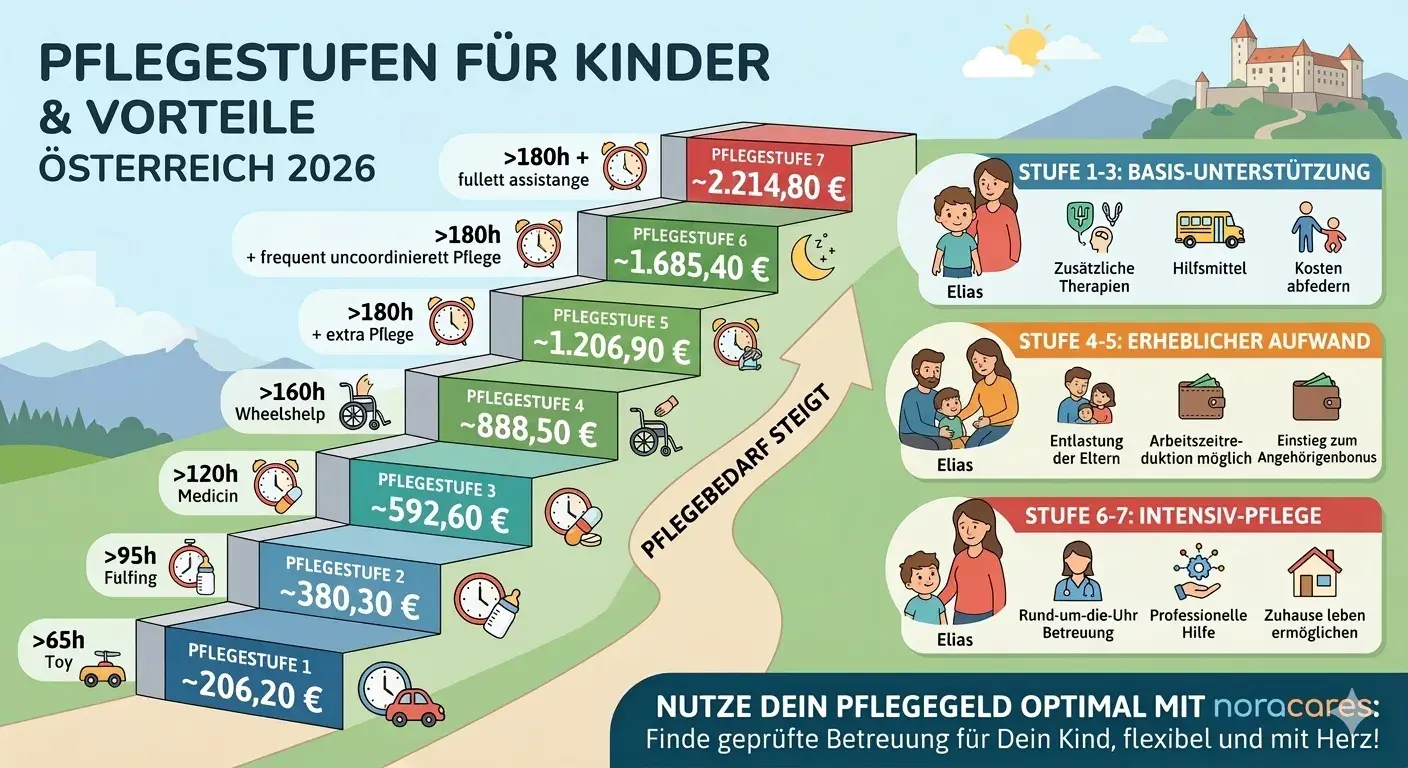
Care allowance is paid monthly in arrears (12 times a year) and is tax-free. Since it is not earmarked for a specific purpose, you have full freedom: as a parent, you decide yourself what relief you “purchase” for your child with it – whether for support through noracares, special aids, or therapies.
The care levels table 2026
Source: pv.at/web/pflegegeld
- Level 1 to 3: These levels cover the basic additional effort. They help finance extra therapies or small forms of support in everyday life.
- Level 4 to 5: This already involves a considerable care effort. For example, the money can be used to reduce the parents' working hours without endangering the family's financial security.
- Level 6 to 7: These levels are reserved for children who require intensive around-the-clock care. They make professional support possible in the home environment.

Applying for care allowance can feel like an exciting expedition where you have to find the right path step by step. To master the journey successfully, it is important to be well prepared and have the right tools in your bag. Here is a step-by-step guide to help you overcome the hurdles of the application.
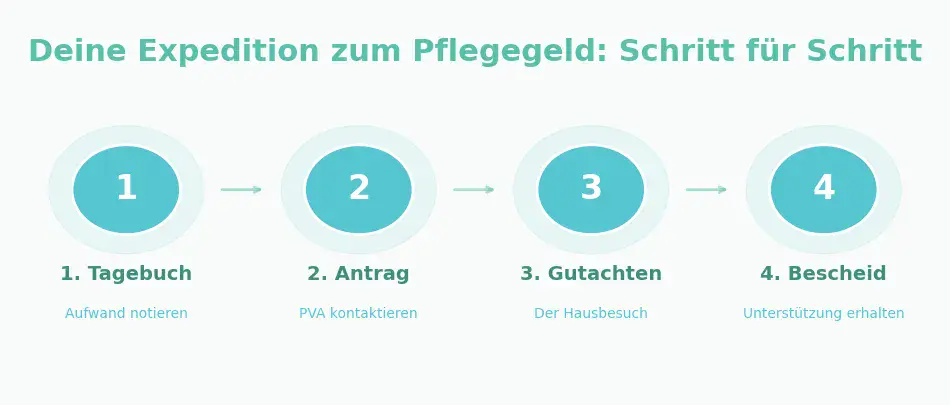
Step 1: Gather information
Before you submit the application, it is important to gather all necessary information about your child's care needs. Think about what your child's daily life looks like and what special support services they need.
Step 2: Fill out the application
The next step is filling out the application form. This can be done online or on paper. Make sure you answer all questions clearly and completely – like a painter creating a precise picture.
You can get the form from the Pensionsversicherungsanstalt (PVA) or online at pv.at. Since your child does not yet receive their own pension, the PVA is almost always responsible.
- Important: The care allowance is paid from the month of application. So it is better to submit the application today rather than tomorrow – even if some documents are still missing, you can submit them later.
Step 3: Submit important documents
To complete your expedition successfully, you need certain documents to support your application. Since care allowance in Austria is independent of income, you do not need to provide payslips or proof of income. Instead, focus entirely on your child's health situation.
The required documents include:
- Current medical findings and diagnoses: Collect all doctors' letters, hospital reports, and diagnoses documenting the care needs. (Important: You do not need to bring an official care allowance assessment – this will only be commissioned by the PVA itself in the next step).
- Therapy and development reports: Documents from speech therapy, occupational therapy, or physiotherapy, as well as reports from kindergarten or school, help provide a better understanding of your child's everyday life.
- Care diary: Your personal notes about the daily extra effort are a valuable addition to the medical records.
Step 4: Submit the application
Now it is time to submit your application. Check everything one last time before sending it to the responsible authority. This helps ensure that you do not forget anything important.
[Here you can download your own checklist for applying for care allowance for children.]
Tips for the process
To make the application process more efficient, keep all documents well organized and within easy reach. A digital filing system can help you stay on top of things. Set realistic time goals for completing the various steps, and do not hesitate to seek help from professionals or counseling centers if you have questions.
Mistakes can easily happen during the application process – like stumbling blocks along the way. Make sure all information is stated clearly and plainly, and ensure that you attach all required documents. A common mistake is not obtaining the medical assessment in time. To avoid this, plan for it early.
If you follow all the steps carefully, you lay a solid foundation so that your care allowance application is successful and your child receives the support they deserve.
Once the application has been submitted, the next stage of your journey begins. The assessment procedure is the moment when the theoretical lines of your application meet the reality of your daily life. You can think of it like the visit of a “scout” who reads the map of your child's needs together with you.
How the assessment works: a look into your everyday life
In most cases, this appointment takes place directly in your home – where your child feels most comfortable. An expert (often a doctor or nursing professional) comes by to get an impression.
- Getting to know each other: The assessor will talk with you and observe your child. It is not about “testing” your child like at school, but about understanding where everyday life runs into difficulties.
- The example of Elias: Let us take little Elias again. When the assessor arrives, they may see a cheerful boy proudly showing his building blocks. But in the conversation, you as his mother explain that Elias may be great at playing, yet when it comes to putting on socks or holding a spoon, he still needs a lot of guidance and patience – much more than other children his age.
- Time measurement: The assessor compares your descriptions with the legal requirements. They note down the extra minutes you spend on personal care, meals, or accompanying your child to therapies.
Preparing for the appointment: your toolbox
To help you feel confident when the doorbell rings, you can pack your “toolbox” for the conversation:
- The care diary: This is your most important tool. For a few days in advance, write down every minute you invest “extra.” We often no longer notice the many small tasks because they have become routine – but for the care allowance, they count!
- Honesty instead of bravery: As parents, we are programmed to emphasize our children's progress (“He can almost do that on his own already!”). During the assessment, however, it is important to describe the reality on bad days. Explain what does not work and where you have to step in and help.
- Folder of medical reports: Have all current reports ready so that the assessor can review them directly if needed. This saves time and supports your descriptions.
- Get support: You do not have to go through this appointment alone. A trusted person who knows your child well (e.g. grandma, grandpa, or a mobile care worker) is welcome to be there and support you emotionally.
Sometimes, during a brief visit, an assessor does not see the full picture of your everyday life. In that case, you can challenge the decision notice.
- The deadline for filing a claim: In Austria, after receiving the written decision, you generally have four weeks to file a claim with the competent Labour and Social Court.
- Free procedure: The court procedure in social law matters is generally free of court fees for you as the claimant. So there are no fees for the court itself.
- Get support: You do not have to go down this path alone! Organizations such as the Chamber of Labour (AK) or the Austrian Disabled Persons Association (ÖZIV) offer free advice and often even represent parents in court.
- The new assessment: As part of the claim, a court-sworn expert is usually appointed. This person often examines the situation again in much greater detail. Quite often, this route leads to a correct upgrade to a higher level.
Special regulations for children with disabilities
The world of a child with a disability is often more complex than that of an adult. That is why Austria has special rules to ensure that not only the “stopwatch” counts, but also the actual burden on the family. These rules are like an additional safety net that steps in where minutes alone are not enough.
Hardship supplements: Recognizing the invisible burden
Some challenges cannot simply be expressed in care minutes. If, for example, a child has a severe intellectual or psychological disability, care is often particularly intensive, emotionally demanding, and unpredictable.
“The particularly intensive care of children and adolescents with very severe disabilities is taken into account through an additional flat-rate hardship supplement if at least two independent, severe functional impairments are present due to the disability.” – oesterreich.gv.at
This is where the hardship supplements come into play:
- What is it? It is a time bonus (in hours) that is added as a flat rate to the calculated care need.
- Why does it exist? It acknowledges that caring for a child with a high need for orientation or behavioral issues (e.g. in cases of severe autism or genetic particularities) represents an extreme psychological burden.
- The value: In many cases, this supplement leads to a higher care level because it recognizes the “invisible” effort of constant emotional presence and supervision.
Children’s Classification Regulation (Kinder-EinstV): The fair standard
So that the assessment does not become guesswork, the Classification Regulation under the Federal Care Allowance Act serves as the binding set of rules.
- Fixed values vs. time values: On the one hand, the regulation provides fixed time values for certain activities (such as washing or eating). On the other hand, time values for individual care measures are determined individually in order to reflect the actual care needs of children as realistically as possible.
- Age groups: Since a healthy child is constantly developing, the comparison values also change. A three-year-old child naturally needs more help than a ten-year-old. The regulation takes these developmental steps into account precisely.
- Special features in severe cases: It also regulates how to proceed in the case of children with the most severe intellectual or physical disabilities who, for example, require ventilators or special tube feeding.
A look back at Elias: In Elias’s case, for example, it was taken into account that because of his developmental delay, at the age of six he still needs the same intensive guidance when getting dressed as a toddler. Without the Children’s Classification Regulation, this time difference might perhaps be overlooked – but in this way it is recognized as a clear additional effort.
Care allowance is a strong foundation, but everyday life with a special child often resembles a large puzzle. So that all the pieces come together into a stable picture, Austria offers additional financial aids and signposts that can ease the burden on you.
Further financial assistance: Expanding the net
In addition to care allowance, there are supplementary benefits that often go hand in hand and increase your family’s financial flexibility:
- Increased family allowance: This is often the first step. If your child has a significant disability (at least 50 percent), you receive an additional supplement of 189.20 euros per month on top of the regular family allowance (as of 2026).
- School travel subsidy: If Elias or your child cannot take the bus because of the disability and you have to bring him/her to school yourself, there is financial support for the travel costs – often even if the school route is shorter than two kilometers.
- Subsidies for aids & modifications: Whether it is a disability-adapted car seat, ramps for the home, or special communication devices – the Social Ministry Service or the provincial governments often offer one-time grants to help cover these expensive purchases.
- Tax advantages: Many additional expenses (e.g. for medical treatments, therapies, or medication) can be claimed as “extraordinary burdens” in your tax adjustment.
Advisory centers and resources: Signposts in the jungle of bureaucracy
You do not have to find the way alone. There are experienced guides who help you understand applications and enforce your rights:
- Social Ministry Service: The central contact point for the disability ID card and many forms of support.
- Early intervention centers: Especially for little adventurers like Elias, organizations offer early intervention that comes directly to your home.
- Parent networks: No one understands your worries as well as other parents in the same situation. Associations like “Balance” or local self-help groups offer valuable exchanges of experience.
- PVA advice: The Pension Insurance Institution often offers consultation days to clarify questions about care allowance directly and in person.
Each of these resources is like an extra basket of provisions on your expedition. Do not hesitate to make use of them – these supports are there so that you can devote your energy fully to your child.

When the challenges of everyday life roll over you like high waves, noracares is the reliable lighthouse that shows you the way to the right support. We understand that care allowance only unfolds its full effect when it is invested in human closeness and real relief.
Finding the right companion
noracares is more than just a platform – it is the bridge to qualified caregivers who bring not only expertise, but also heart.
- Tailored: Whether you are looking for support for a few hours a week so you can attend appointments, or you need long-term support for your child – you will find people who specialize exactly in your needs.
- Security: Transparent profiles let you see qualifications and experience at a glance, so you know your child is in good hands.
Investing care allowance wisely
Care allowance gives you the financial freedom to “purchase” exactly the help that makes your everyday life easier.
- Individual use: Use care allowance specifically for relief during peak times, support with special activities, or to promote your child’s mobility.
- Transparency: You retain full control over how and for whom the funds are used.
Simple, direct, and stress-free
In an everyday life often shaped by bureaucracy, the search for help should not become an additional burden. Thanks to the digital solution from noracares, arranging support becomes easier than ever:
- Search: Browse profiles in your area with just a few clicks.
- Contact: Get in touch directly with potential caregivers – without lengthy detours through agencies.
- Save: Since noracares relies on direct placement, you save yourself high agency fees and stress, which you can instead invest in time with your child.
Your advantage: noracares becomes a valuable partner on your journey. We make sure that you find the best care for your child so that you can face the challenges of everyday life with confidence and renewed strength.
Care allowance is a great support, but it also comes with a certain responsibility. So that the financial assistance continues permanently and lawfully, there are clear ground rules. You can think of them like maintaining a ship: if you take care of it, the journey remains safe and stable.
Responsibilities: Ensuring care
As the recipient of the care allowance (or as your child’s legal representative), you are responsible for ensuring that the money truly benefits its intended purpose.
- Ensuring care: The care allowance is intended to finance the necessary care and assistance. Whether you provide this care yourself, involve relatives, or seek professional help through platforms like noracares, is your decision. The only important thing is that care in the child’s best interest actually takes place.
- Appropriate use: The money must be used for care-related expenses. This can include paying caregivers, but also additional expenses for aids or special needs arising from the disability.
Reporting obligations: Keeping the compass up to date
So that the insurance is always up to date, there is certain information that you must actively report. This prevents misunderstandings and protects against repayment claims.
- Significant changes: If your child’s health condition changes fundamentally – whether it is a clear improvement or unfortunately also a deterioration – this must be reported to the insurance. In the event of deterioration, this can even be the key to a higher care level!
- Stay in hospitals or rehab facilities: If your child is admitted for more than one month as an inpatient to a hospital or rehabilitation facility whose costs are covered by a social insurance provider, the care allowance is suspended from the second day. This is important to report in order to avoid overpayments.
- Change of residence: Since care allowance is tied to residence in Austria (or certain EU regulations), a move – especially abroad – must be reported immediately.
Care policy is constantly changing. The goal of the most recent reforms was to reduce bureaucratic hurdles for families and adapt financial security to rising costs.
Annual valorization (adjustment)
Since 2020, all care levels in Austria have been automatically valorized every year. This means that the amounts are adjusted each year on January 1 to the inflation rate.
- Your security: You do not need to submit a new application to receive more money – the increase happens automatically. This ensures that the purchasing power of the care allowance is maintained in order to offset rising costs for care and therapies.
The family caregiver bonus
One of the most significant new developments in recent times is the relatives' bonus, which is available to relatives under certain conditions.
- What is it? Family caregivers, who provide most of the care at home and therefore may not be able to work full-time, receive additional financial support under certain conditions.
- Relevance for parents: If your child is at least care level 4 and you are primarily devoted to caregiving, you are entitled to this bonus (currently around 1,500 euros per year, often paid out in monthly installments).
Simplified assessment for children
In recent years, the guidelines for assessing children have been further clarified.
- Specialist medical expertise: More attention is being paid to ensuring that experts involved in the assessment of children have pediatric training (pediatrics). This ensures that the developmental stages of children like Elias are assessed even more fairly.
- Digital support: Submitting medical reports and communicating with the PVA is now almost entirely possible digitally, which significantly reduces the "paperwork battle" for families.
Expansion of mobile services and relief weeks
The law now increasingly provides that families can more easily access not only money, but also in-kind benefits. These include subsidized relief days on which professional caregivers take over support so that parents can take a break. Platforms like noracares ideally complement this government service by helping families quickly and unbureaucratically find private support.

The journey to supporting your child can be challenging, but also full of possibilities. The care allowance provides valuable help that enables you to find the best possible care for your little treasure and give them the freedom to flourish in their colorful world. With every level you reach and every step you take toward support, you create a solid foundation for a better future.
Sign up with noracares now and make sure your child receives the help they deserve! Together, we can make a positive difference in your lives.
*Planning note: The amounts mentioned in the article for 2026 are based on the current calculations for annual valorization. Since the care allowance is legally linked to the inflation rate, these values represent the expected financial support that will be available to you and your child.


- Relatives' bonus – Additional financial support (approx. 134 euros/month) for family caregivers if the child is at least care level 4 and the caregiver is primarily devoted to caregiving.
- Increased family allowance – A monthly supplement to the regular family allowance (2026: 189.20 euros/month) for children with a significant disability of at least 50 percent.
- Hardship supplement – A flat-rate time bonus that is added to the calculated care need in cases of severe intellectual or psychological disability. For children under 7 years: 50 hours/month, between 7 and 15 years: 75 hours/month.
- Children's Classification Ordinance (Kinder-EinstV) – The legal framework that determines how care needs for children and adolescents up to age 18 are calculated. It takes into account age-appropriate developmental stages and the additional effort compared with healthy peers.
- Additional effort – The time required for care that goes beyond the age-appropriate level of a healthy child and serves as the basis for care allowance classification.
- Pension Insurance Institution (PVA) – The central point of contact in Austria for applying for care allowance for children. The application can be submitted online, by post, or in person.
- Care diary – A written record of the daily additional care effort, which serves as important evidence at the assessment appointment. It is recommended to keep one for at least two weeks before the home visit.
- Expert – A doctor or qualified nursing professional who conducts a home visit on behalf of the PVA and officially assesses the child's care needs.
- Social Ministry Service – An Austrian federal authority that supports people with disabilities and their families with applications, counseling, disability passes, and grants for aids or home adaptations.
- Valorization – The annual automatic adjustment of care allowance amounts to the inflation rate, which takes effect each year on January 1. No separate application is required for this.
- Activities of daily living – The legally defined catalog of everyday activities such as personal hygiene, dressing and undressing, meals, and mobility, on the basis of which care needs are calculated in hours.
- Healthcare proxy – A legal document that allows parents or guardians to act on behalf of the child when dealing with authorities, submitting applications, and signing contracts.
- ÖZIV (Austrian Civilian Disabled Persons Association) – An advocacy organization for people with disabilities in Austria that offers free counseling and legal support with care allowance applications and court proceedings.

