The magical power of humor in Care: Your shield against stress and burnout

Did you know that laughter not only lifts your mood but also heals your body? Discover the amazing effects of humor in caregiving and how to use it professionally in your daily routine.
Humor in caregiving does not mean telling jokes or downplaying serious situations. It’s about consciously adopting an attitude that relieves, connects, and strengthens your professionalism. Used correctly, humor can help you reduce stress, strengthen relationships, and make difficult moments more human in the demanding daily care routine – without compromising the dignity of your patients or residents.
You may know these situations: The mood is tense, a conversation is about to turn sour, or your team comes exhausted from a demanding shift. In such moments, humor can build bridges – or cross boundaries. This raises the crucial question: When is humor helpful? And when is it out of place?
"Humor is when you laugh anyway." Especially in a profession where you face human suffering daily, humor is one of your most important tools – to cope with stress, prevent burnout, and simultaneously create genuine connection.
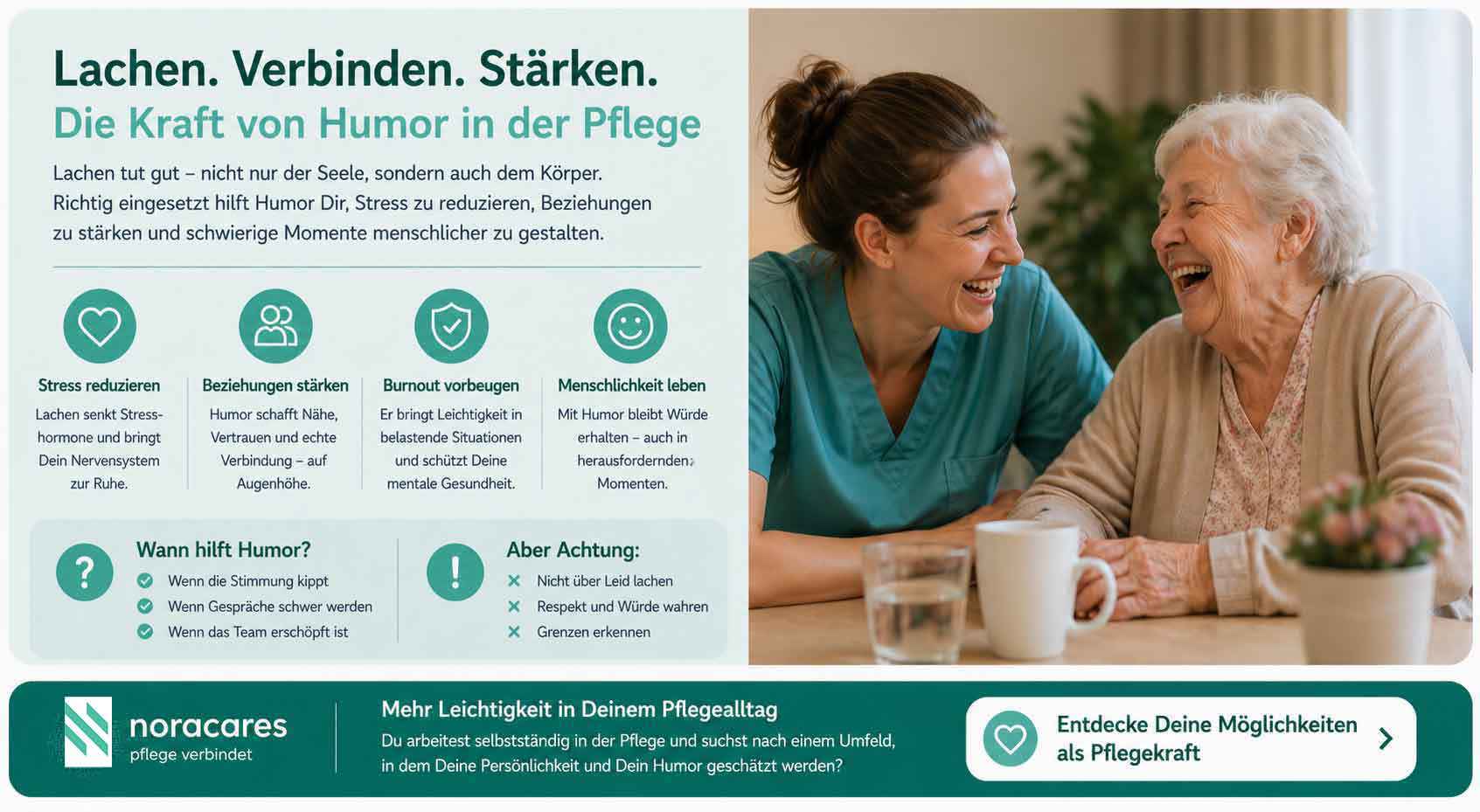
More ease in your daily care routine
Do you work independently in caregiving and are looking for an environment where your personality and humor are appreciated? At noracares you will find families that really fit you – directly, fairly, and without the pressure of an agency.
🎙️ Welcome to our podcast!
No time to read? No problem! Listen to the key points of the article conveniently as audio and always stay up to date.
The magical power of humor in caregiving
How consciously applied humor protects caregivers from stress and burnout, strengthens relationships, and makes daily care easier – with practical tips, rituals, and inspiring stories.
Subscribe on Spotify
The word Humor is inseparably linked to the concept of health and balance – as it originates directly from medicine. Etymologically, it derives from the Latin word humor, which means “moisture” or “fluid.”
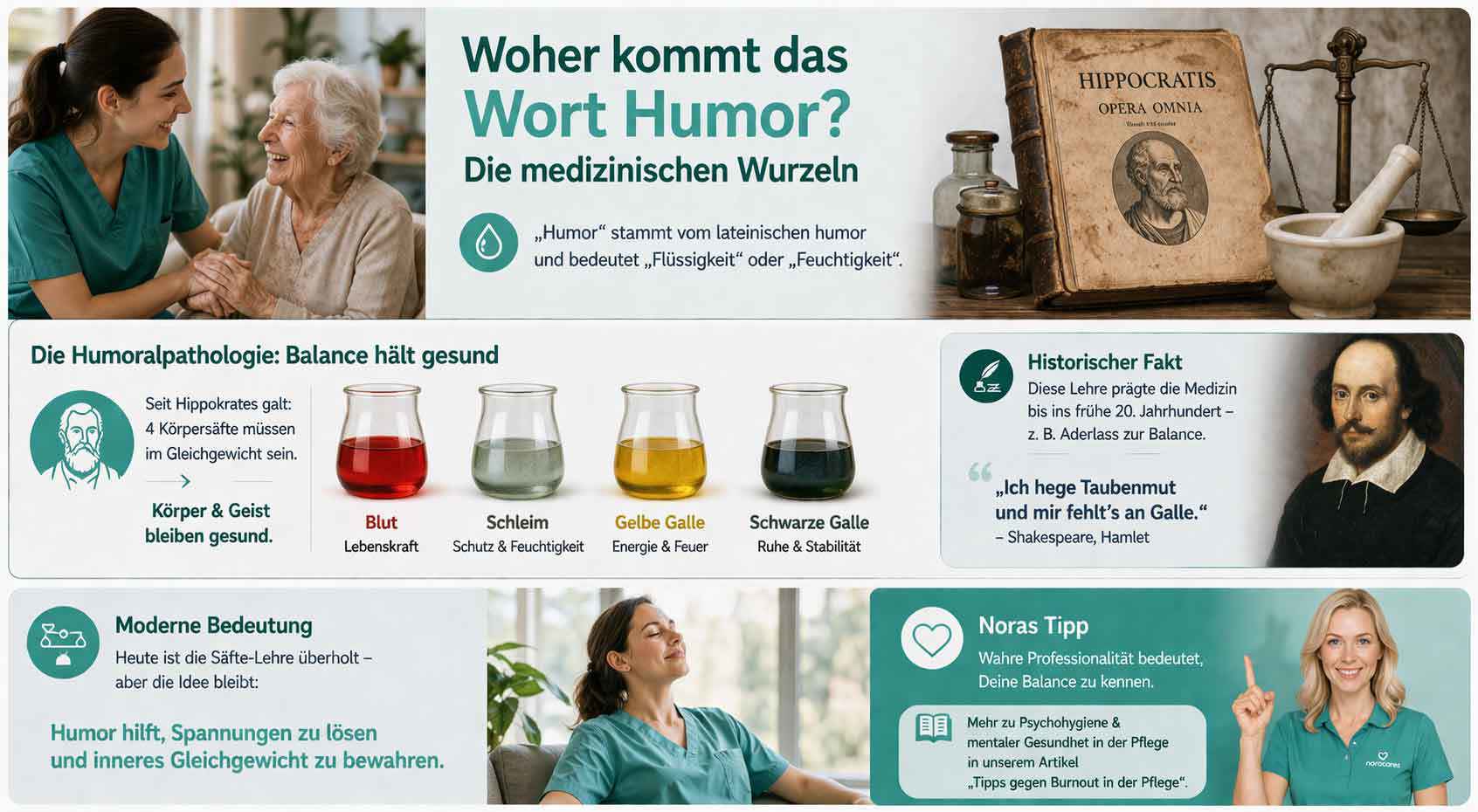
Humoral pathology: Balance as health
The term comes from humoral theory, which was largely shaped by Hippocrates. The belief was that four main fluids – blood, phlegm, yellow bile, and black bile – must circulate in balance within the body. Only when these humors were balanced were body and mind considered healthy.
This theory influenced medical practices until the early 20th century. Measures like bloodletting were based on the assumption of restoring the body to balance. Humoral pathology directly led to temperament theory – the classification into choleric, sanguine, melancholic, and phlegmatic.
Modern significance for caregiving
Although the humors theory is now considered outdated in modern medicine, the deeper meaning of humor remains: being “well mixed” or “internally balanced.”
Humor serves as a release to resolve tension and maintain inner balance in an emotionally demanding environment – exactly what you need as a caregiver every day to stay healthy.
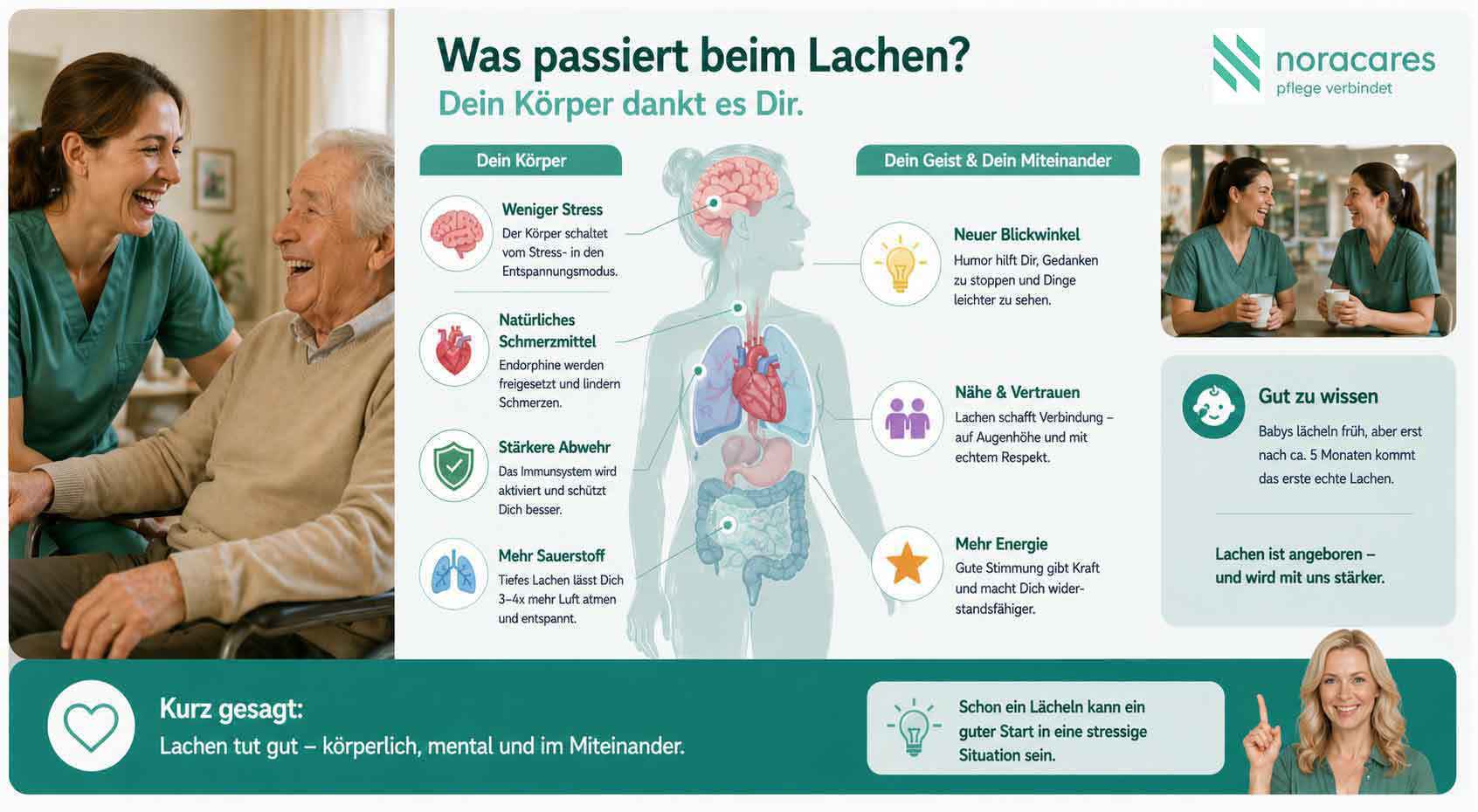
What exactly makes us feel as if a huge weight has been lifted off our shoulders after a hearty laugh? Humor is not just a distraction, but a measurable therapeutic resource. Current research (including MedUni Graz) confirms "gelotology" (laughter research) as an established part of modern caregiving science.
Laughter reduces the production of stress hormones adrenaline and cortisol, strengthens the immune system, and acts like a natural painkiller.
Physical benefits: Your biological update
- Stress relief: Laughter activates the parasympathetic nervous system (your “rest nerve”). Studies from 2025/2026 show that even short, intense laughter episodes significantly lower cortisol levels. This helps you regain emotional balance more quickly after a crisis on the ward.
- Pain relief: Laughter triggers the release of endogenous endorphins. These act like a natural opiate. In pain therapy in 2026, humor is used specifically to raise patients' pain threshold and reduce the need for as-needed medication.
- Immune system: Laughter is a booster for immune defense. It increases the activity of T-cells and immunoglobulins. Those who laugh actively strengthen their resistance to infections – a crucial factor in the stressful caregiving environment.
- Breathing & oxygen: When you laugh, you process three to four times more oxygen than normal. The lungs are deeply ventilated, which promotes muscle relaxation and sustainably calms the heart rate after laughter.
Emotional and social benefits
- Change of perspective: Humor interrupts “rumination”. It allows you to observe a stressful situation from the outside for a moment without denying the seriousness of the situation.
- Building trust: Humor breaks down hierarchies. When you laugh with a resident, you meet at eye level. They feel seen as a person, not just as an “object of care.”
- Motivation: As Matthias Prehm aptly says: “Humor is the fuel in a caregiver’s tank.” It forms the foundation for your resilience (psychological resistance).
Dr. Patch Adams & the Gesundheit! Institute
The American physician Hunter Doherty “Patch” Adams revolutionized medicine with a simple conviction: Healing should be a loving, creative interaction – not just a business. Adams founded the Gesundheit! Institute in the USA and demonstrated that a patient’s emotional state directly affects their physical healing process.
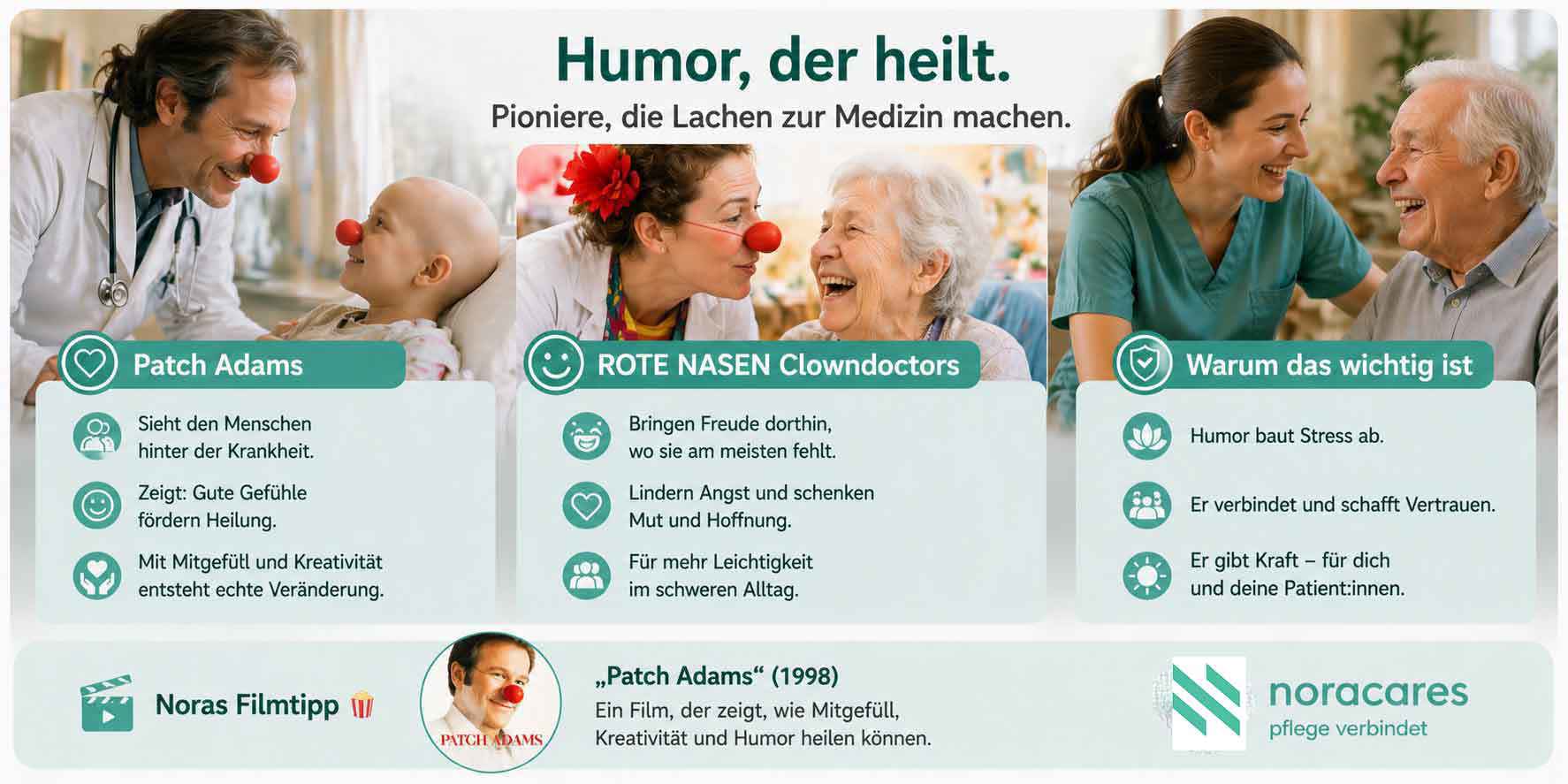
His philosophy inspired organizations worldwide such as the ROTEN NASEN Clowndoctors – specially trained hospital clowns who bring joy to the lives of people in hospitals and nursing homes, whose daily lives are marked by fear, uncertainty, or pain.
The pilot project “Humor in Nursing" – ROTE NASEN & AOK PLUS
A concrete example of the scientifically grounded recognition of humor is the pilot project “Humor in Nursing – for Mental Health", conducted together with ROTE NASEN Germany e.V. and AOK PLUS in inpatient care facilities in Saxony and Thuringia. The motto: “Humor as an attitude – to keep the joy alive!"
The project follows three approaches: regular clown visits, the intensive training program ROTE NASEN HumorAgenda® for nursing and caregiving staff, as well as family evenings.
Maria Gundolf from ROTE NASEN e.V. explains: “The HumorAgenda is a relationship builder – it connects everyone in the care facility through humor and helps develop a new culture: partnership-based, appreciative, and on equal footing."
Prof. Dr. Tabea Scheel (Europa-Universität Flensburg) confirms: “Humor is an excellent indicator of the psychological state of an organization."
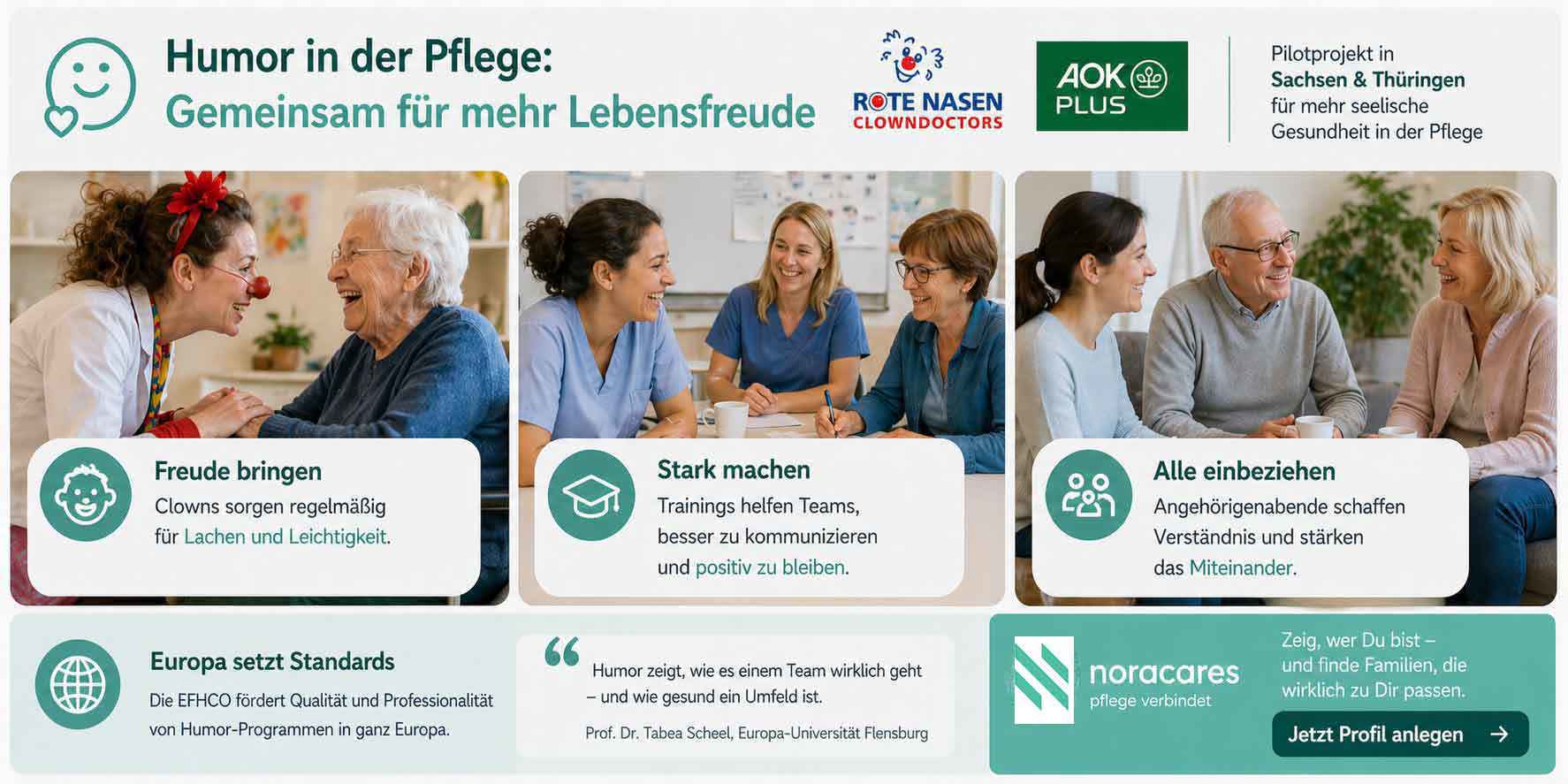
The EU level: EFHCO
At the European level, the European Federation of Hospital Clown Organizations (EFHCO) sets quality standards for professional humor interventions in hospitals and care facilities across the EU.
As an independent caregiver, you know: the best care happens where personalities match. At noracares you show who you are – and families choose you. Directly, fairly, without a placement fee.
Not only patients benefit from the healing power of laughter. In a profession where you face human suffering and high time pressure every day, humor is one of your most important tools for self-care. It is not a luxury, but a necessary survival strategy.
The Inner Buffer Against Compassion Fatigue
Nursing is “high-intensity” emotional work – you absorb the pain and grief of others every day. Humor creates a healthy distance: it does not mean indifference, but a shift in perspective. It allows you to view a difficult situation from another angle for a moment, without losing empathy or becoming emotionally numb.
Current data from the ZQP (Center for Quality in Nursing) from 2025/2026 show: Nurses who use humor as a professional tool are statistically significantly less susceptible to compassion fatigue. Humor acts as a vent to release heavy emotions before they build up into burnout.
The Team as a Laughing Community
A shared laugh during break or handover acts like a “reset button” for the brain. It interrupts the spiral of chronic stress and immediately releases chemicals that strengthen team cohesion. In stressful shifts, this social glue often protects the mental health of the entire team.
Nora's Knowledge: A good indicator of a healthy work atmosphere is how much laughter occurs in a facility or family. Humor is a valuable “diagnostic tool” for team culture. At noracares we help you find exactly the environment that truly values your personality and mental health.
Not all humor is the same. For professional use in nursing, we distinguish between forms that heal and those that harm.
Your Humor Matrix for Practice
Affiliative Humor – The Bridge
This form connects people. It is inclusive, warm, and never at the expense of others. A friendly wordplay or loving observation creates the feeling: “We are in the same boat.” This is the safest and most valuable form of humor in nursing.
Self-Humor – Showing Humanity
If a mishap happens and you say: “Well, today must be the day of flying objects!”, you break down rigid hierarchies. You show that you are not perfect either. This reduces patients' fear of making mistakes and creates a safe atmosphere.
Situational Humor – The Spontaneous Moment
Much humor arises from the moment. The art is to respond lightly to the unexpected. A phrase like “Shards bring luck!” is not a prepared joke, but an empathetic response to a human moment that immediately relieves pressure.
Team Humor – The Line to Gallows Humor
Gallows humor among colleagues can be healing to process the incomprehensible. It serves as an emotional vent. But beware: The line to cynicism is fluid.
Professional gallows humor remains private and is never directed against patients or their relatives. As soon as jokes are made about residents' weaknesses, it is no longer a shield but a warning signal for impending compassion fatigue.

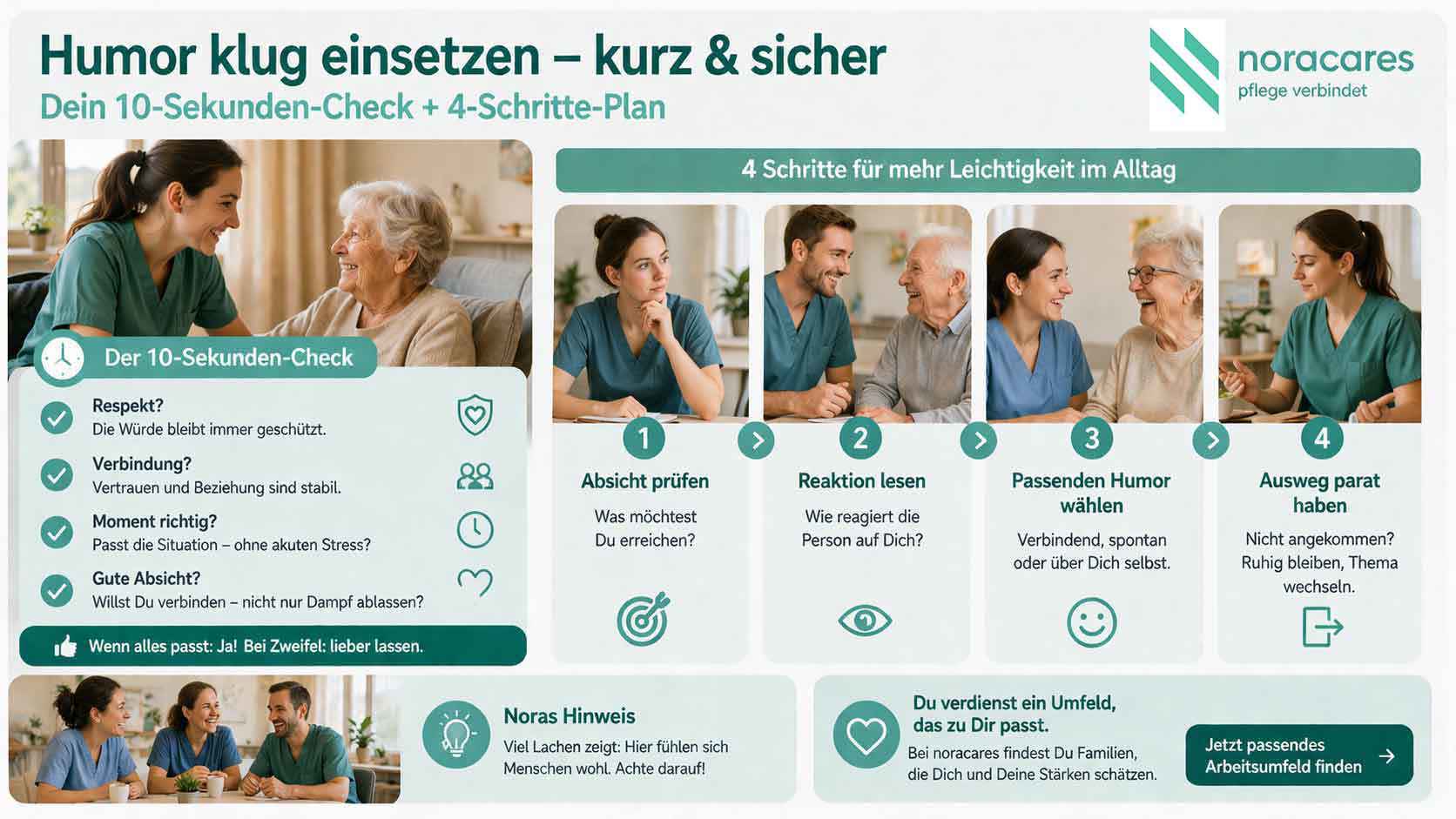
Theory is good, but in practice, seconds count. To ensure humor underscores your professionalism rather than endangers it, you can rely on these two tools.
The 10-Second Check
Before making a humorous remark, quickly ask yourself these four questions:
- Dignity: Is the person's dignity fully preserved?
- Relationship: Is our trust relationship stable enough for this moment?
- Timing: Is the moment right, or is the person in acute pain/stress?
- Goal: Do I want to create a connection or just release my own tension?
The Result: If you feel an inner “yes” everywhere: Go. If you hesitate: instead choose an empathetic, factual response. This check protects you from missteps in a hectic daily routine.
The 4-Step Model for Safe Use
For a reflective application of humor in the care process, this procedure helps:
- Clarify Goal: What is your intention? Do you want to de-escalate a tense situation or deepen a relationship? Without intention, humor becomes a gamble.
- Check Reaction: Watch your counterpart’s non-verbal signals. Does the person open up (smile, eye contact) or withdraw? Humor is a dialogue offer, not a monologue.
- Choose Humor Form: Depending on the situation, choose affiliative humor (connecting), situational humor, or self-humor.
- Have an Exit Strategy: If your humor does not land as intended – stay calm. Apologize briefly if needed, and immediately return to the empathetic factual level. Humor is an offer that may also be declined.
Nora's RESOURCE
Your Free Companion for Daily Nursing
Do you want to always have the 10-second check and the 7 humor rituals at hand – even in stressful shifts?
Download our free checklist now, print it out, and hang it in your break room or put it in your lab coat pocket.
Just click, save, go.
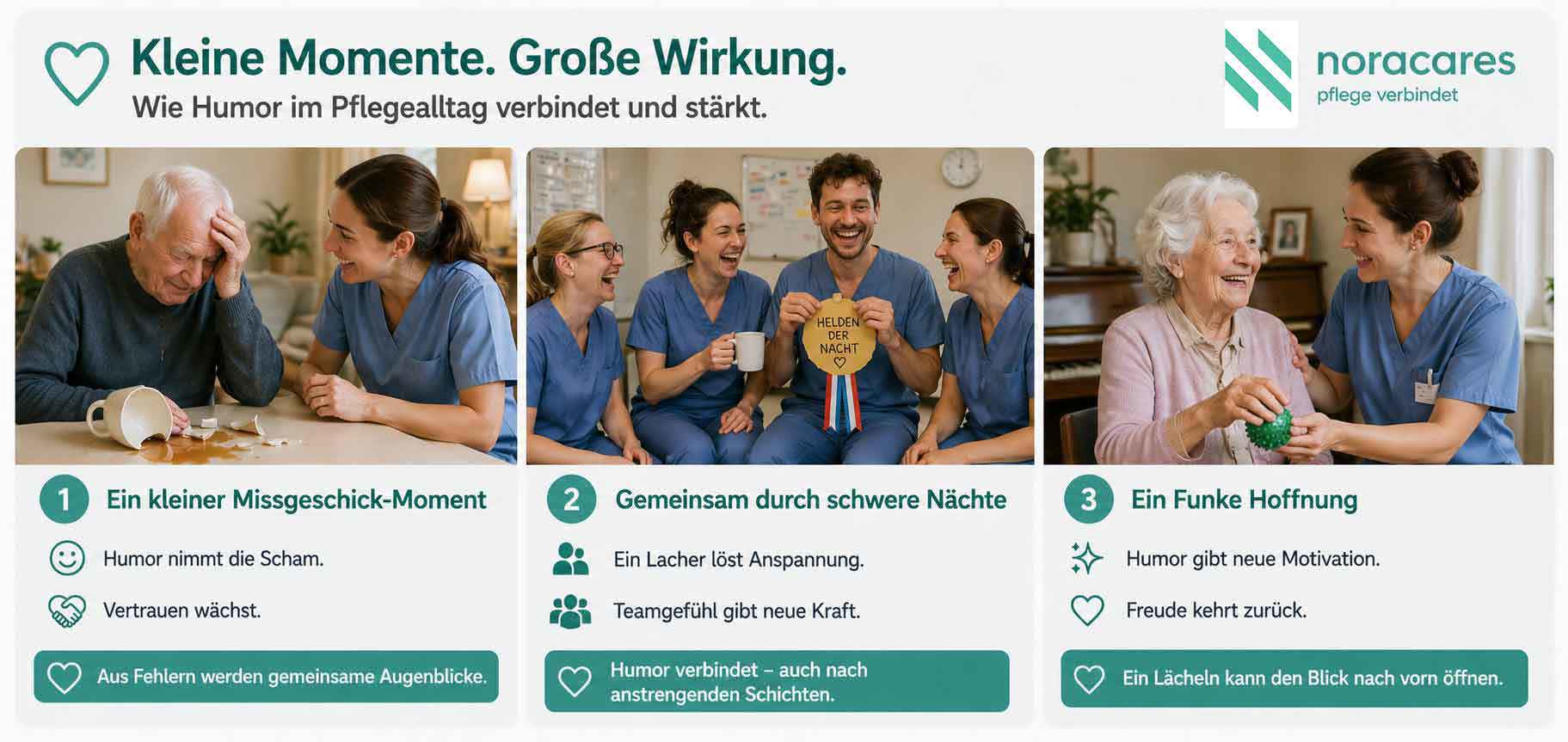
Sometimes it doesn't take big words, just the right moment of lightness to completely transform a situation. These three stories show you how humor becomes a bridge.
1. The coffee stain that became a smile
Mr. M. struggles with trembling hands every morning. When the full cup of coffee slips across the table and shatters today, his humiliation is visibly clear. He stares at the floor, his apologies sounding fragile with shame. Instead of reaching for a cloth with clinical efficiency, the caregiver pauses briefly, gives him a warm look, and says: "Well, Mr. M., we've already stirred up quite the action this morning! Luckily your coffee smells so good – now the whole room gets to enjoy it." The effect: The shame in his eyes gives way to a small sparkle. He laughs briefly, the tension in his shoulders eases. What began as a moment of weakness ends as a shared, human moment that deepens trust between them more than any flawless routine.
2. The team that "survived" together
The night shift was relentless – three emergencies, hardly a minute to breathe. During handover, everyone sits with drooping shoulders, the air heavy with exhaustion. No one has energy for small talk. A colleague silently steps to the humor board and pins an improvised paper medal reading: "Survivors of the night – Gold for everyone today!" The effect: It starts with a tired smirk and ends in a liberating, shared laugh. This brief moment breaks the leaden heaviness. Energy returns, and the team starts the day not as "functionaries" but as a united community.
3. The piano concert of hope
Ms. K. stares resignedly at her trembling fingers. The Parkinson's exercises often feel like a painful reminder of what she has lost. "What's the point of all this?", she asks quietly, trying to withdraw her hand. The caregiver gently takes her hand and says with a smile: "Well, who knows, Ms. K. – we're practicing here for your big piano comeback next year. I've almost reserved the tickets!" The effect: Ms. K. shakes her head amused at this "nonsense," but a smile sneaks onto her face. Her resistance breaks. She begins the exercise – not because she has to, but because humor for a moment has lifted the weight of her diagnosis and returned a bit of joy to her life.
Humor is a powerful tool, but like any scalpel, it can hurt if misused. True professionalism is knowing the pitfalls and taking responsibility when a moment goes wrong.
Too early humor: The door is still closed
Humor needs a foundation of trust. If you are just getting to know a patient or resident or they are in an acute emotional low, humor often acts like a wall rather than a bridge.
The better way: Give presence and active listening first. Only when the relationship is stable can lightness cautiously enter.
Humor at the expense of others: The trap of cynicism
Sarcasm or irony about patients' helplessness is an absolute no-go. Even if a remark seems harmless "among colleagues," it slowly poisons your own empathy. What is once said leaves traces in the trust relationship that are often irreversible.
Gallows humor in the team: Shield or warning sign?
We all know: gallows humor can be the valve that keeps us from breaking down during a tough shift. It helps process the unimaginable. But beware: when humor becomes cynical, regularly targets patients, or excludes new colleagues, it is no longer a shield. It then becomes a warning sign for the onset of compassion fatigue and a toxic team culture.
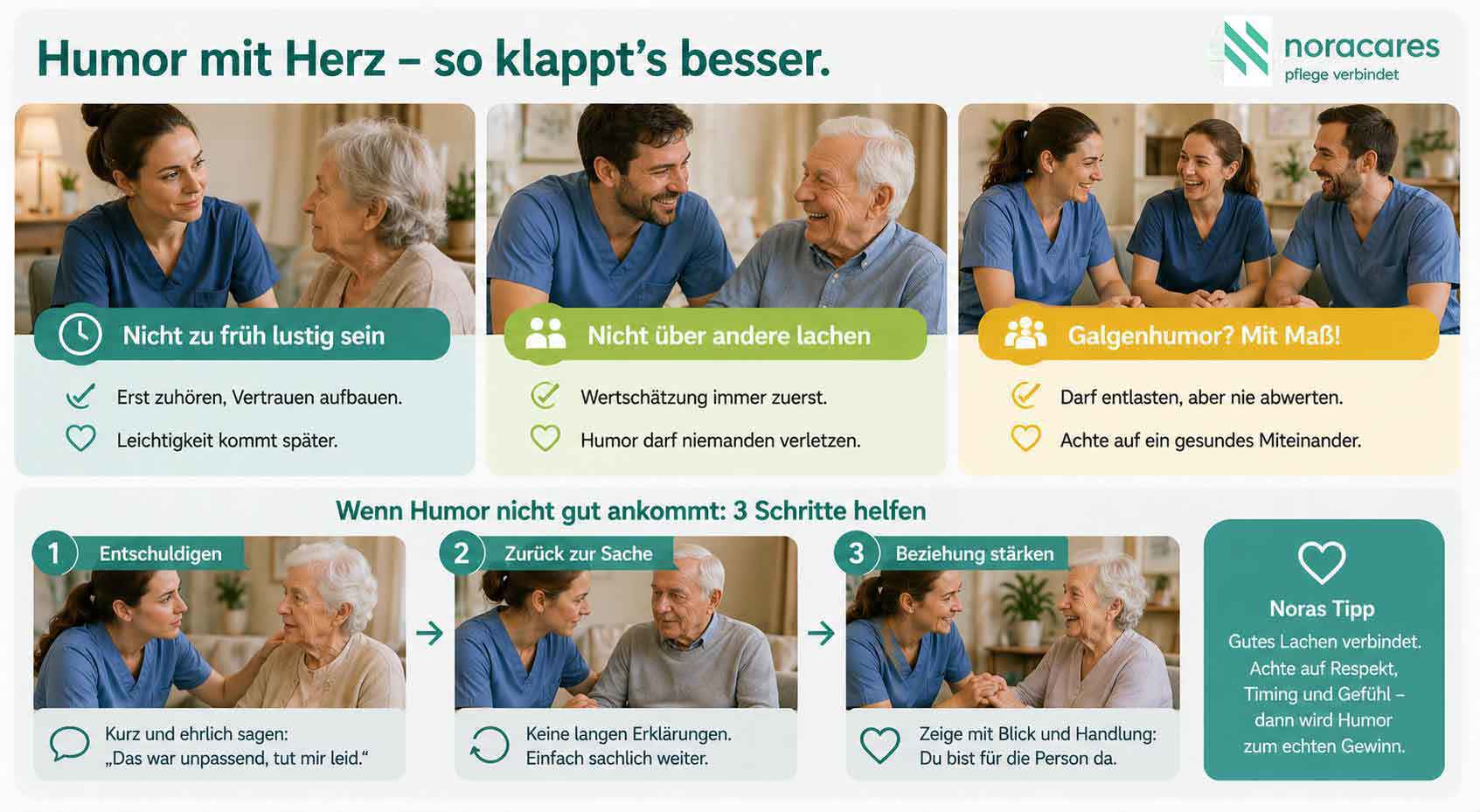
If your humor is received badly: The 3-step repair
It happens to the best of us. A comment meant to be funny may cause irritation or pain in the other person. In this moment, your professional reaction is crucial to save the relationship:
- Step: Apologize briefly – Take responsibility without drama: "That was inappropriate of me, sorry about that." An honest word immediately stops the hurt.
- Step: Return to the matter – Switch back to the empathetic factual level without lengthy justification. Explanations like "It was just a joke" usually make it worse.
- Step: Secure the relationship – Show through your next action (a attentive look, a gentle touch, or full focus on care) that the person is your top priority. Actions repair more than a thousand words.
Professionalism does not mean always being humorous – it means knowing when humor would worsen the situation. There are moments when lightness is perceived as disrespect. Here, restraint is your strongest skill.
Red-flag situations: Humor stays silent here
In these moments, consciously refrain from jokes or irony:
- Acute grief: After a loss, a serious diagnosis, or the death of a fellow resident. Silence, compassion, and your mere presence are required here.
- Strong sense of shame: In cases of incontinence or other embarrassing situations, the person needs protection, dignity, and discretion – absolutely no "cheering up."
- Confusion / delirium: In acute states of confusion, humor can be misunderstood as mockery or threat. This instantly destroys the trust you’ve built.
- Own emotional overload: When you are at your limit, humor often comes off as cynical or forced. Be honest with yourself: if the energy for genuine lightness is missing, factualness is the better safeguard.
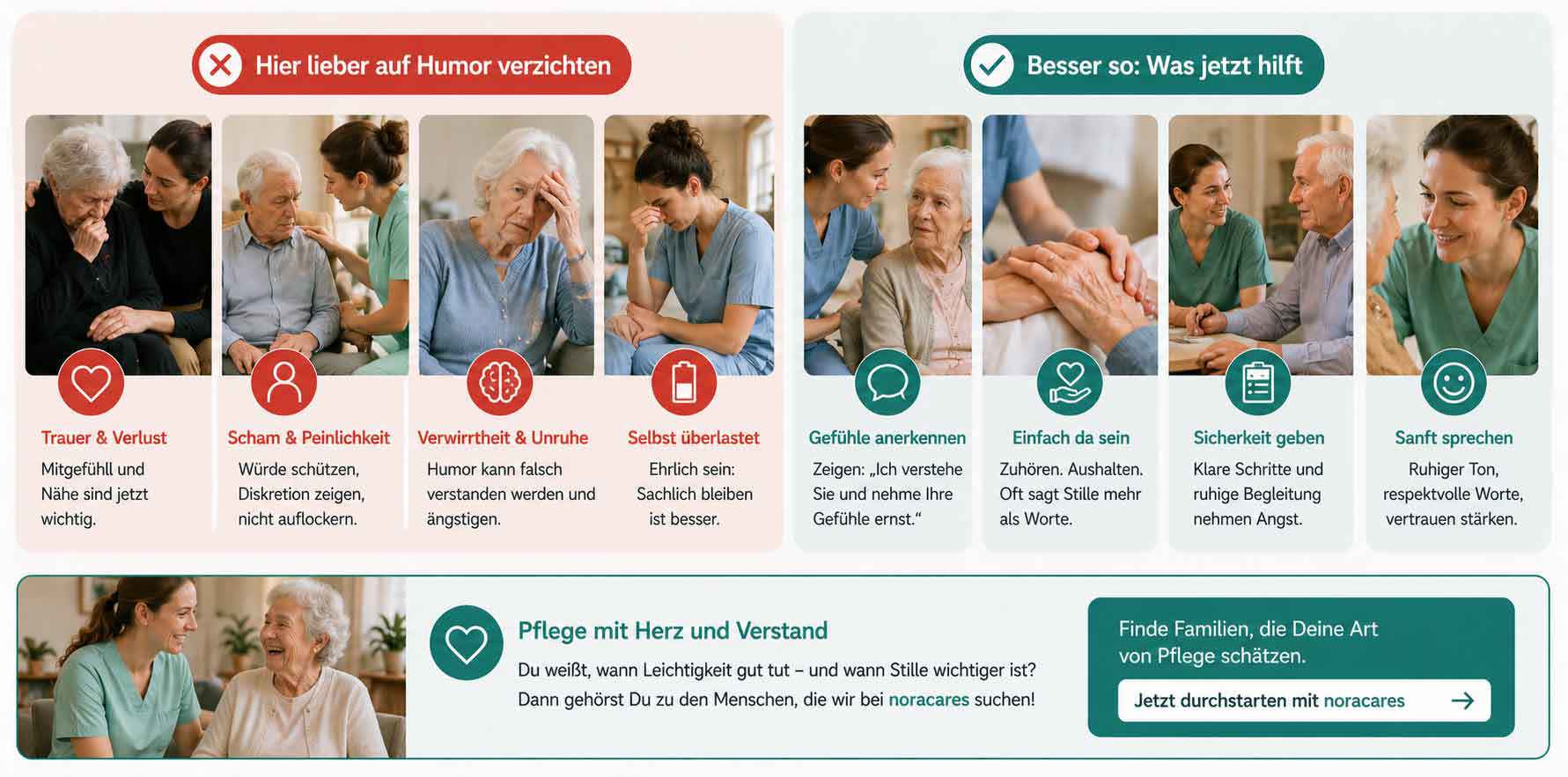
Better alternatives: What really helps in a crisis
When humor is not an option, these four approaches are your professional tools:
- Validate: Acknowledge the other person’s feelings. "This is really difficult right now. I understand that you feel this way."
- Show presence: Sometimes silence is the strongest form of care. Simply being there and enduring the situation gives the patient support.
- Provide clear structure: Uncertainty fuels fear. "I am here with you now. We will take this calmly, step by step."
- Calm, respectful language: A gentle, low tone signals to the patient’s nervous system: "You are safe."
Your path to appreciative care
Are you a caregiver who masters exactly this balance? You know when a smile heals and when silent presence is required? At noracares we are looking for people like you. Create your profile and find families who share your values – empathy, expertise, and genuine humanity. Completely without an agency, direct and self-determined.
The ability to use humor appropriately in situations is not purely a matter of personality – it is a professional skill that you can specifically train. It rests on four solid pillars:
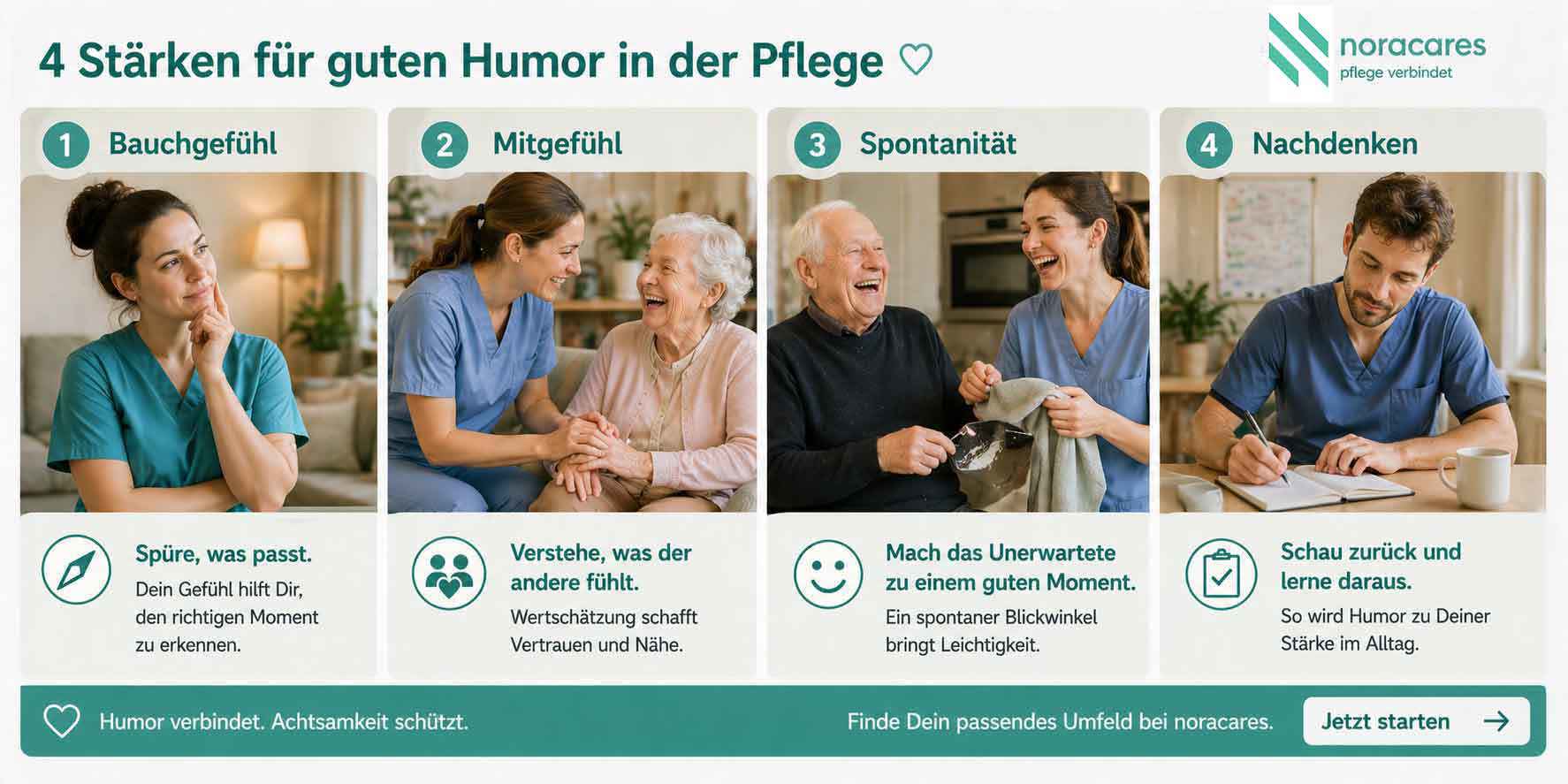
1. Intuition: Your inner compass
Listen to your gut. Your intuition is a store of unconscious experiences that tells you instantly whether humor is building a bridge or a wall. The more you pay attention to this quiet voice, the finer your sense for the "right moment" becomes.
2. Empathy: The foundation
Can you see the world for a moment through the eyes of the other person? True empathy means perceiving and validating someone’s feelings. Humor in care is never about "laughing over it," but a shared, liberating experience on equal footing.
3. Improvisation: The art of situational comedy
In care, rarely does everything go according to plan. Improvisation means seeing the unexpected – like a mishap or accident – not as a disruption, but as a chance for a human moment. Spontaneity breaks the clinical rigidity and creates real closeness.
4. Reflection: Your personal quality management
True mastery comes through review. Take a moment at the end of the day: Where was humor a door-opener today? And where was it perhaps a stumbling block? This honest self-reflection sustainably refines your humor competence and protects you from emotional numbness.
You don’t have to be a born comedian to bring lightness into everyday life. It is often the small, recurring moments that make the biggest difference – for you, your team, and your patients.
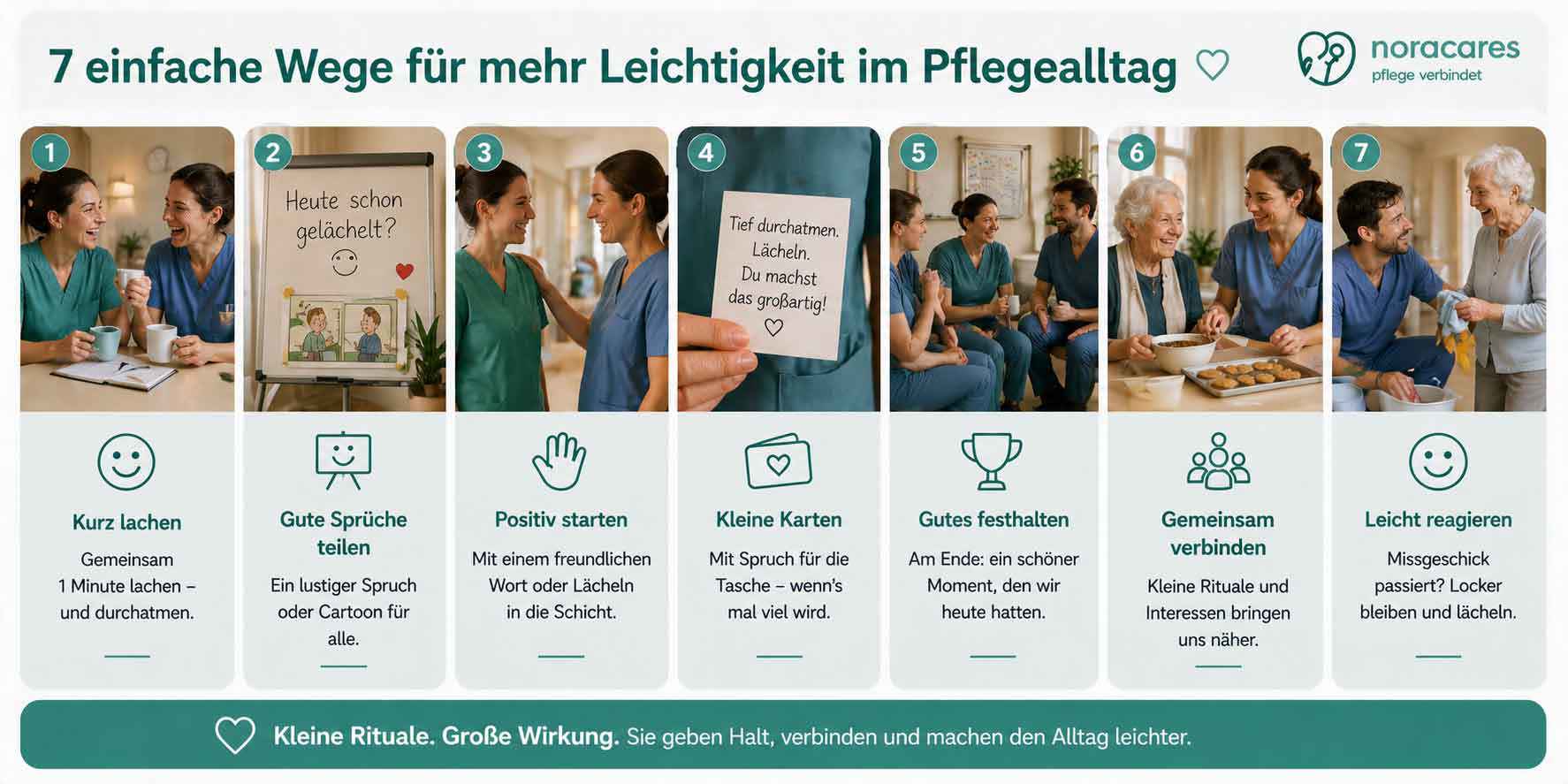
Your toolbox for more joy on duty
Why rituals are so powerful
Rituals provide security. In an environment often marked by unpredictability, these small anchors create a reliable foundation for your mental hygiene. They signal to your nervous system: "Despite the stress, I am safe and connected here."
Humor is not a task for solo players. It unfolds its full power only when actively desired and promoted by the institution or family.
In 2026, humor competence is no longer a "soft skill" but a measurable factor for employee retention and patient satisfaction. As a (self-employed) caregiver, you have the right – and today more than ever also the choice – to work in an environment that takes your emotional burden seriously and actively models a healthy team culture.
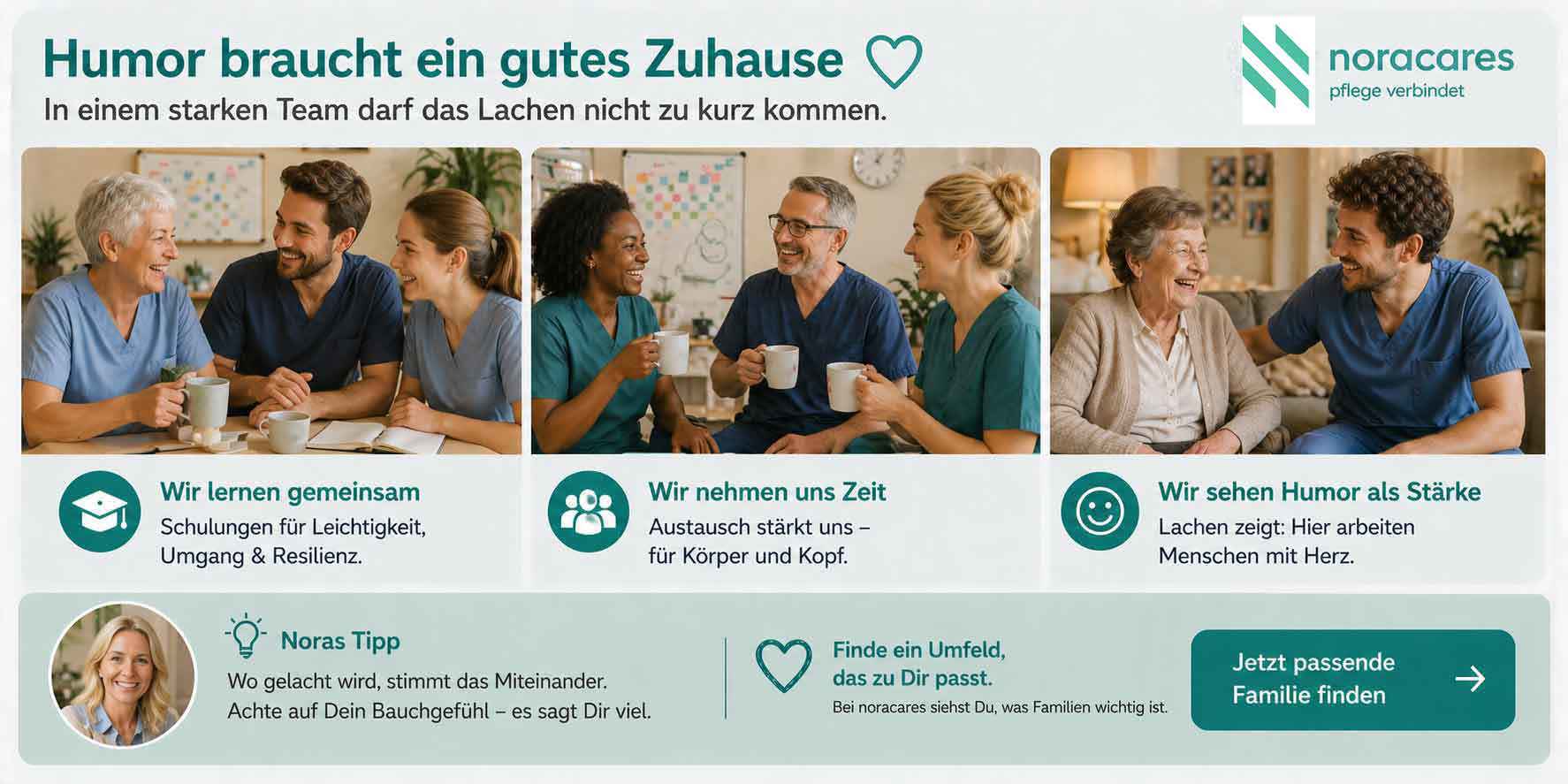
How to recognize a healthy culture:
- Training: Advanced facilities and platforms offer training in humor competence, de-escalation, and resilience.
- Resources: There are time slots for team exchange and contacts for mental well-being.
- Openness: A laugh in the hallway is not seen as "unproductive" but as a sign of functioning mental hygiene.
At noracares we go a step further: In our profiles, you can immediately see which values are important to a family or facility. This way you find a care situation where you are the perfect fit not only professionally but also personally.

Humor in nursing is not a nice extra or a mere plaything. When used consciously and professionally, it is one of your most valuable resources: for your own mental stability, for deep and sustainable relationships with your patients, and for a healthy, vibrant team culture.
At the same time, humor is an expression of responsibility. Its healing power only unfolds when you carefully assess the situation, the relationship, and the boundaries of your counterpart. True professionalism does not mean always laughing – it means sensing when a joke builds a bridge and when silence, validation, or a supportive hand is needed instead.
When you use humor thoughtfully, you not only enhance the moment but also strengthen your own approach in this wonderful yet demanding profession. The real power does not lie in the laughter itself, but in the humanity that it makes possible.
Your path to nursing that is good for you too
Are you a nurse who masters this balancing act? Are you looking for a work environment that values your personality and sees your humor as a skill? At noracares you find families looking for exactly that: real people with heart and mind. Create your profile, show your strengths, and shape your nursing career independently, fairly, and with the ease you deserve.


- Affiliative Humor: A type of humor that brings people together and creates a positive, trusting atmosphere. Inclusive, warm, never at the expense of others.
- Compassion Fatigue: Emotional exhaustion from continuously taking on others' suffering – a major risk factor for burnout in nursing professions.
- Comic Relief: A technical term for liberating comedy – a humorous element that temporarily lightens a serious situation and reduces emotional tension.
- Gallows Humor: Humor about serious or threatening situations. Can create bonding among nurses – the line to cynicism must be consciously drawn.
- Humoral Pathology: An early form of medicine according to Hippocrates, based on balancing the four bodily fluids as the foundation of health and balance.
- Humor Therapy: The deliberate use of humor and laughter to relieve pain, reduce stress, and support mental health in professional nursing.
- Laughter Yoga: A method in which laughter is used as a deliberate physical exercise – often in groups – to enjoy the physiological benefits of laughter without jokes or reasons.
- Psychohygiene: The conscious care of one's own mental health in daily work – through relaxation, reflection, and social connection – to prevent burnout.
- Resilience: Mental toughness – the ability to handle difficult situations without lasting impairment and emerge strengthened.
- Validation: A respectful form of communication – especially in dementia care – where the experienced reality and feelings of the person are accepted as valid instead of corrected.
Legal Notice
The information contained in this article is for general informational purposes only and does not replace professional medical, psychological, or nursing advice. The methods and recommendations described for using humor in nursing are based on current scientific knowledge and practical experience, but may vary depending on individual situations, medical conditions, and facilities.
noracares accepts no liability for decisions made based on the information contained in this article. For health or nursing questions, please consult a qualified professional.
© 2026 noracares – All rights reserved. noracares.at

