Falls in Old Age: Recognising Risks, Overcoming Fear & Staying Safe

When the phone rings and someone says: “Mom has fallen,” it makes many relatives briefly stop in their tracks. You may have already experienced how quickly something like this can happen—a misstep, a slippery floor, or a brief moment of dizziness. A fall in old age often seems harmless but can cause great uncertainty for older people and their families.
In fact, about one in three people over 65 falls at least once a year. The good news: many of these falls can be prevented if the most common causes are known and simple measures are taken in time. Even small changes in daily life—better lighting, safer paths in the home, or targeted exercise—can significantly reduce the risk.
In this article, you will learn why falls are so common in old age, what consequences they can have, and above all what you can do to better protect your loved ones. We also show you how to respond correctly in an emergency, when medical help is necessary, and how to create more safety in everyday life in the long term.
Because a fall does not have to mean the end of independence. With the right knowledge and a few practical steps, you can help older people move through everyday life more safely, independently, and with greater confidence.
Give the gift of safety: Find the right support for your loved ones now.

🎙️ Welcome to our podcast!
No time to read? No problem! Listen to the key content of the article conveniently as audio and stay up to date.
A fall happens in a fraction of a second, but it is far from an isolated case. Statistics clearly show that the risk of falling is a natural part of aging—but also where we can take targeted action.
One in four people is affected
It is a striking number: “About one in four people aged 65 and older reported in 2022 that they had fallen at least once in the past 12 months, and one in ten even multiple times,” according to the health reporting of the Robert Koch Institute.
The likelihood increases further with age:
- From age 65: Around 24 percent fall at least once per year.
- From age 80: Here, one in three people (33.5 percent) falls at least once a year.
This shows us: the older we get, the more important a “fall-safe” environment becomes. It is not about creating fear, but about being mindful.
Where do most falls happen?
Contrary to the assumption that most accidents happen “outside,” the opposite is true: most falls occur in one’s own home or immediate living environment. The home, the place of safety, often hides the most dangerous traps.
This is where accidents happen most often:
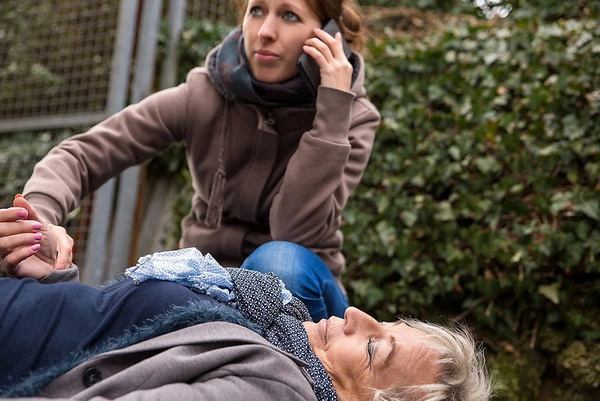
Imagine time briefly standing still: you hear a dull thud or a cry. Your pulse races. In this moment, your most important job is not physical strength, but calmness. To know exactly what to do in this shock situation, follow this 3-step plan:

Step 1: Breathe and stay calm
The first impulse is almost always: “Quick, I need to pull them up!” Stop. Acting too hastily can cause injuries to both the person and yourself.
- Move close to the person, kneel down, and speak to them calmly.
- Leave the person lying where they are at first. The ground is safe—they cannot fall further from there.
Step 2: Do a “check-up”
Before you help them up, you need to assess the situation. Look into the person’s eyes:
- Are they responsive? Do they respond clearly or seem absent and drowsy?
- Are they oriented? Do they know what happened and what day it is?
Step 3: Carefully check for injuries
Ask specifically what hurts while the person is still lying down.
- Visible signs: Is a leg twisted unnaturally? Is there a head wound?
- Pain check: Gently touch arms and legs. If the person flinches or cries out, this is a clear stop signal for any attempt to help them stand.
What happens next?
Once you are sure there is no immediate danger, you can help the person slowly gather themselves. How to gently help someone back to their feet without straining their back is explained further below in the section “Immediate measures after a fall.”

Falls are rarely random. Usually several factors come together like puzzle pieces. If you understand where the insecurity comes from, you can take targeted action. We divide the risks into four clear areas:
Physical changes: when the signals weaken
Our body changes over time – this is completely normal, but we must respond to it.
- Muscle weakness: Especially thigh strength declines. This makes standing up and stepping securely more difficult.
- Balance: The “navigation system” in the inner ear often works more slowly.
- Eyesight: Contrasts are perceived less clearly. A carpet edge blends into the floor, or a step becomes invisible in the shadows.
Medication: the invisible danger in the medicine cabinet
Many medications have side effects that significantly increase the risk of falling. A regular check with a doctor is worthwhile:
Illnesses: When the body reacts differently
Some diagnoses bring a natural instability with them:
- Neurological causes: diseases such as Parkinson change gait (small steps, leaning forward).
- Dementia: Dangers are often no longer recognized as such, or coordination of the feet becomes more difficult.
- Cardiovascular problems: Sudden arrhythmias can lead to brief fainting spells or dizziness attacks.
Environmental factors: the “traps” in your own home
This is the area that you can change most easily and quickly. Often it is small things that become tripping hazards:
- Loose rugs & runners: The classic “foot traps.”
- Cable clutter: Extension cords running across the room.
- Lack of lighting: Too dim light bulbs or missing switches by the bed.
- Improper footwear: Worn-out slippers or socks without grip provide no support.
Taken from life: where things often get risky in everyday life
Theory is good, but what do these dangers actually look like in real life? Often they are very banal situations that we do not even perceive as risks. Here are three typical examples that show why attention is so important:

The “slip slide” in the bathroom
Imagine: after a relaxing bath, your loved ones step out of the tub. Their feet are still damp, and a fine mist of condensation has formed on the tiles. Without a firm handhold, a tiny moment of imbalance is enough, and the smooth floor becomes like ice.
- The solution: Non-slip mats in the tub and in front of it as well as firmly screwed grab bars are the “lifesavers” here.
The “night expedition”
It is three o’clock in the morning. The phone is not ringing, but the bladder is pressing. Many older people do not want to wake anyone or avoid the bright ceiling light. So they make their way to the toilet in the dim light. With age, the eyes take longer to adjust to darkness, and the legs are often still a bit shaky after getting up. A slipper lying in the way quickly becomes an insurmountable obstacle.
- The solution: A simple motion-sensor night light in the hallway safely shows the way without fully waking you.
The “treacherous edge” in the living room
The beloved oriental rug has been in front of the sofa for 30 years. But over time, one corner has slightly curled up. When walking with a walker or even just shuffling in socks, you catch exactly this small bump. The body’s momentum moves forward, but the foot stays behind – a classic tripping fall.
- The solution: Double-sided tape for carpet edges or, even better, removing small “bridges” and runners creates a clear path.
A fall often leaves more than just physical traces – it shakes the sense of security of your loved ones. Suddenly, the familiar hallway becomes a danger zone, and the fear of the next time creeps into every movement. But this is exactly where you can start. When we understand why balance has been disrupted, we can stop the vicious circle of fear of falling and inactivity.
It is now about moving from “reacting” to “acting.” With a little detective work and the right support, you can turn the home back into a place where your loved ones can move safely and freely.
Recognizing and minimizing risk factors
The way out of the vicious circle always starts with the attending doctor. As a caregiver or family member, you should work together with them to assess the risk of another fall. It is important to identify and eliminate the causes of falls in everyday life. This shows that care and assistance are NOT the same and require careful risk assessment.
Often tripping hazards in the home, such as slippery floors or raised carpet edges, are a danger. Poorly fitting shoes that do not provide support can also increase the risk of falling. Low blood pressure is another risk factor that can lead to falls. In some cases, medication may be responsible for weak legs or loss of balance.
Nora’s Home Safety Check: the invisible tripping hazards
- Ensure even, bright lighting in all rooms, especially at night. Motion sensors in hallways and bathrooms can work wonders. Tripping hazards are often not visible in dim light.
- At home as well: non-slip, well-fitting slippers with sturdy soles. Walking barefoot or wearing socks without anti-slip grips increases the risk.
- Secure all cables and avoid objects lying around that are not needed for walking – also outdoors such as on terraces or balconies.
- Bathroom safety: think of non-slip mats in the shower/tub and grab bars. A raised toilet or toilet seat riser can make standing up easier.
If you are helping someone get up from the floor after a fall, the most important rule is: stay calm! And this applies to both sides. Do not help the person up immediately; instead, give them time to collect themselves and recover from the shock. You can place a small pillow under their head and cover them, because especially if they have been waiting for help for some time, there is a risk of hypothermia on the floor.
Dealing with stress situations: In stressful situations like these, older people may sometimes lose control. If that happens, remove wet clothing to prevent the person from getting cold.
Getting up with aids or external help
No serious injuries found? Great! But what happens now? It is best to get two stable chairs that the person can use for support while trying to stand up independently. If you need to leave the room for this, explain why you are leaving and that it will only be for a short moment.
If additional help is needed: Often the shock is still very strong, or the person cannot gather enough strength to lift their body weight. In this case, you must assess whether you are able to help them up on your own. If you are unsure, you should never attempt it, because if you fall under the weight and get injured as well, you will no longer be able to help.
It is best to call a second person such as a neighbor to help you manage the situation together. If no one is reachable and calls go to voicemail, it is also absolutely legitimate to call emergency services. No person who has fallen should lie on the floor for more than 45 minutes.
When do I need an emergency doctor? And first aid on the ground
When to call emergency services (144 / Europe-wide 112):
- If fractures are present, a joint is unnaturally twisted, or the person is unresponsive.
- If there are signs of circulatory failure (e.g., pale, clammy skin, rapid breathing, weak pulse).
- If you suspect a head or spinal injury (e.g., neck pain, numbness).
In such dangerous situations, movement should definitely be avoided! Until emergency services arrive, you should do everything to ensure the person feels comfortable and safe.
First aid measures on the ground:
- The checking breathing is the most important. Rarely, but sometimes, circulatory failure may be the cause of collapse.
- If the person is unresponsive but breathing, they should be placed in the recovery position.
- In case of respiratory arrest, life-saving measures such as resuscitation must be performed without delay.
- Open fractures can be temporarily covered with a clean dressing and loosely bandaged.
- If the legs or hips are seriously injured, the person should not be moved or allowed to stand under any circumstances.
- In the case of a broken arm, support with a sling helps to relieve it.
In any case, after initial care and securing the situation, emergency services (144) should be called immediately. Keep an eye on the injured person and, if possible, do not leave the room until help arrives.
Expert standard for falls: classification & measures
In the expert standard, falls are divided into four classes depending on their severity. Depending on which class the fall belongs to, the necessary measures are also determined:
When you should call for help immediately: the traffic light principle

After a fall, uncertainty often arises: “Is this an emergency or am I overreacting?” To help you make the right decision in seconds, this simple color system helps you. It serves as your internal compass:
🔴 RED: Call emergency services immediately (112 or 144)
There is no waiting here. If any of these signs occur, every minute counts:
- Unconsciousness: The person has fainted or is unresponsive.
- Severe pain: Any movement causes severe pain.
- Misalignment: A leg or arm appears unnaturally shortened or twisted.
- Head check: The person has fallen and is now experiencing nausea, vomiting, or severe headaches.
- Blood thinners: If the person is taking blood-thinning medication and has fallen on their head (risk of internal bleeding!).
🟡 YELLOW: Contact the GP (today)
The situation appears stable, but there are warning signs that need medical clarification:
- Persistent discomfort: Pain does not improve or occurs under strain.
- Dizziness & unsteady gait: The person feels shaky on their feet or fears falling again.
- Behavioral change: Your relative appears confused, very quiet, or unusually tired.
- Repetition: It was not the first fall recently – we must find the cause!
🟢 GREEN: Observe with care
You can breathe easy for now if:
- No pain: The person can move all limbs freely.
- Stable standing: Standing up has worked well (perhaps with help) and the gait is stable.
- Clear head: The person is fully oriented and feels fine apart from the shock.
- Tip: Still remain alert for the next 24 hours. Sometimes a bruise or minor contusion only appears the next morning.
To prevent falls, there are several tips that can have a preventive effect and make everyday life significantly more stable.

Practicing getting up again: gaining confidence
If a fall has occurred in the past, it should be practiced how to best get up from the floor when no one is nearby to help. Often it is possible to crawl to the nearest chair and pull oneself up.
The “roll and crawl” trick: safely standing up alone
Finding ways the person can help themselves provides additional safety, and the great fear turns into minor uncertainty. It is advisable to practice getting up after a fall regularly.
Getting attention: when standing up is not possible
You should also explain to the person how they can draw attention if—due to a fracture, for example—standing up is not possible:
- Loud calling: Instead of “Help!”, shout: “Help, I have fallen! I cannot get up!” so the message is clear. Simple cries for help are unfortunately often not prioritized correctly by the human brain.
- Knocking signals: Knock on walls in a clear rhythm to alert neighbors.
- The emergency call system: It is an essential aid. Make sure the button is always within reach (e.g. on the wrist). The fallen person should not hesitate to press it, as it is an emergency.
- Phone within reach: Sometimes it is possible to crawl to the phone and call for help. Therefore, the device should already be positioned so it is reachable from the floor.
- Warmth: If all else fails, if possible pull a blanket, jacket, or towel over yourself to keep the body warm.
Stay active: simple exercises for more stability
Think of your muscles as a protective shield: the stronger and more alert they are, the better they can catch you if you stumble. The good thing is: balance and strength can be trained at any age – and comfortably in your living room!
Here are three small exercises that work wonders:
1. The “power pause”: safely standing up from a chair
This exercise is the perfect strength training for the thighs – your most important engine when walking.
- How it works: Sit on a stable kitchen chair. Place your feet firmly on the floor. Now try to stand up slowly – ideally without using your hands (or only lightly for support). Sit back down in a controlled way.
- Your goal: 5 to 10 repetitions. This strengthens the muscles that carry you when climbing stairs and walking.
2. The “rock in the surf”: single-leg stand with support
Balance is purely a matter of practice for your brain and joints.
- How it works: Stand behind a stable chair back or directly at the kitchen counter so you can hold on at any time. Now slightly lift one foot and try to balance on one leg for a few seconds.
- Your goal: Hold the position for about 10 seconds per leg. You will notice your ankles working – that’s the training!
3. The “tightrope walker walk”: heel-to-toe walk
Here you train coordination and awareness of your feet.
- How it works: Find a clear stretch in the hallway (ideally along a wall for support). Now consciously place one foot directly in front of the other so that the heel of the front foot almost touches the toes of the back foot – like walking on an invisible rope.
- Your goal: 10 steps forward and, if you feel secure, also two to three steps back.
Your extra safety: why support is the best fall prevention

You may be wondering: “Can I really watch every second?” The honest answer is: alone, that is hardly possible. This is exactly where noracares bridges the gap between your concern and the safety of your loved ones.
More than just help – your personal safety anchor
A 24-hour care worker or caregiver from noracares is far more than just a helping hand with cooking or dressing. She is the vigilant professional who prevents falls before they happen:
- The nighttime companion: When the path to the toilet in the dark becomes dangerous, someone is there. No groping along walls, no risk – but a safe arm for support.
- Activation instead of stagnation: Fear of falling often leads seniors to move very little. Our caregivers motivate gentle exercise, promote balance, and restore confidence in one’s own body.
- Hazard radar in everyday life: The loose carpet edge or forgotten cable on the floor? An experienced caregiver spots these hazards immediately and removes them before the next step is taken.
Prevention that protects life
An emergency call system only responds after something has happened. A care or nursing professional from noracares ensures that the button ideally never has to be pressed. This preserves independence and keeps the home what it should be: a place of absolute safety.
Direct comparison: safety you can feel
It is a reassuring feeling not having to carry everything alone anymore. How much your everyday life and the safety of your loved ones change through noracares is shown in this direct comparison:
“I’m not old!” or “I don’t need a walker, I can still manage.” Do these phrases sound familiar? It is completely normal for your loved ones to want to maintain their independence. Accepting help often feels like admitting weakness.
To ensure you do not override your loved ones but include them, these three strategies will help you:

Make decisions together instead of imposing them
Nobody wants to be patronized. Instead of saying: “We need to install this grab bar now,” try asking: “I’m worried you might slip on the wet tiles. Which model would be least in your way in the bathroom?” When your loved ones feel that they retain control over their own lives, resistance decreases significantly.
Emphasize safety instead of weakness
Choose your words wisely. A walker or walking stick is not a sign of decline, but a “freedom tool”. Explain to your loved ones that these aids are meant to help them continue going shopping or taking walks independently. The goal is not monitoring, but maintaining mobility. The message should be: “I want you to stay as independent as you are now for as long as possible.”
Introduce changes step by step
Do not overwhelm your loved ones with a completely remodeled home over a single weekend. This often feels threatening. Start with “invisible” changes:
- First replace light bulbs with brighter ones.
- Secure loose carpet edges.
- Only when these small steps are accepted should you talk about larger changes such as grab bars or an emergency call system. Give your loved ones time to get used to the idea that prevention is not a burden, but a gain in quality of life.

A fall in old age can be a worrying moment for you and your loved ones. But it is important to know: a single fall does not automatically mean a loss of independence. Often, it is more of a signal to take a closer look at health, daily life, and the environment.
The good news is that many falls can be prevented. If you reduce tripping hazards in the home, encourage movement, have medications checked regularly, and pay attention to changes, you can significantly reduce the risk. Even small adjustments in everyday life can make a big difference and help older people feel safer and more confident in their daily lives.
If a fall does occur, the most important thing is to stay calm, assess the situation correctly, and seek help if needed. If you know the key warning signs and when medical assistance is necessary, you can respond quickly and safely.
Most importantly, do not leave your loved ones alone with the fear of another fall. Talking openly about it, finding solutions together, and accepting support can restore a lot of trust and safety.
With knowledge, attention, and a few targeted measures, you can help ensure that a fall in old age does not become a turning point, but rather an opportunity to make everyday life safer – so your loved ones can remain mobile, independent, and enjoy a good quality of life for as long as possible.
A fall does not have to mean the loss of independence. It is an opportunity to make your loved ones’ life safer.
Do not wait for the next call. Take action today and find a caregiver at noracares who gives your loved ones the necessary safety and stability.

- Expert standard in nursing: Guidelines and recommendations based on scientific evidence that are intended to ensure the quality of care in specific areas (such as fall prevention).
- Restraint: A measure in which a person’s freedom of movement is restricted (e.g. by being strapped to a bed or using bed rails). This is a restrictive intervention that may only be used under strict legal conditions and for the person’s protection.
- Geriatrics: A field of medicine that deals specifically with the diseases and needs of older people.
- Cognitive behavioral therapy (CBT): A form of psychotherapy aimed at identifying and changing negative thought and behavior patterns to cope with psychological problems such as anxiety or depression.
- Multimodal intervention: A therapeutic approach that combines different forms of treatment (e.g. physical training, medication review, psychological support, and home adaptation) to address a problem holistically.
- Osteoporosis: A bone disease in which bone mass decreases and bones become more fragile, increasing the risk of fractures.
- Post-fall syndrome: A psychological reaction after a fall, characterized by a strong fear of falling again, insecurity, and avoidance behavior. This can lead to reduced mobility and social withdrawal.
- Resuscitation: Life-saving measures performed in the event of cardiac arrest to restore breathing and heartbeat.
- Recovery position: A first aid measure in which an unconscious but breathing person is placed on their side to prevent choking on their own tongue or vomit.
- TUG test (Timed Up and Go test): A simple, standardized test to assess mobility and fall risk. The time is measured it takes a person to stand up from a chair, walk 3 meters, turn around, walk back, and sit down again.
- Home adaptation: Measures to modify the home environment to make it safer and more accessible and to minimize the risk of falls (e.g. removing rugs, installing grab bars, improving lighting).

