24-hour care in Vienna: around the clock for your loved ones

Mrs. Müller was worried about her father, who was often restless at night. Thanks to 24-hour care in Vienna, she could finally sleep peacefully again and be sure that her father is receiving the best possible care. Here are her experiences.

It is one o’clock in the morning in Vienna. Mrs. Müller sits on the edge of her bed, the light from her bedside lamp casting soft shadows on the walls. Her thoughts revolve around her father, who is sleeping in the next room but is often restless. The nights are long and full of worry. Has he had enough water? Is he safe if he gets up? These thoughts steal Mrs. Müller’s sleep and the peace of mind she longs for so much.
But one night everything changes. Mrs. Müller decides to make use of the support of 24-hour care in Vienna. The decision to find the right caregiver not only gives her the certainty that her father is receiving the best possible care, but also enables her to finally sleep peacefully again. The weight has lifted from her shoulders, and she now has more time for herself and her own needs.
In this article, we would like to show you how you too can organize round-the-clock care for your loved ones in Vienna, what advantages it offers and how noracares can help you find the ideal caregiver. Let’s find out together how you can optimally organize care for your relatives.
🎙️ Welcome to our podcast!
No time to read? No problem! Listen to the key points of the article conveniently as audio and stay up to date.

Making 24-Hour Care Affordable in Vienna
An overview of how 24-hour care in Vienna can be realistic, flexible, and affordable – with tips on funding, legal options, and practical strategies for families.
Subscribe on Spotify
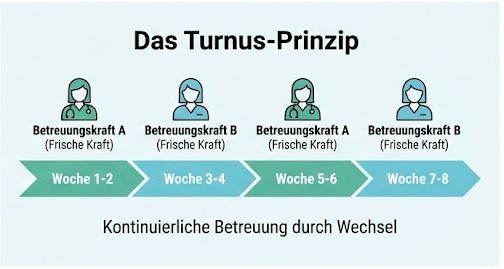
You shouldn’t imagine 24-hour care like a hospital operation. It is more like “assisted living” in your own home. A caregiver moves in with your loved ones, has their own room, and becomes part of everyday life. To keep quality and energy consistently high, two caregivers usually alternate every two to four weeks – so there is always someone on site with fresh strength and a listening ear.
Instead of the unfamiliar, often sterile atmosphere of a nursing home, everything stays the same: the familiar pictures on the wall, the smell of your own garden, and your own bed.
A day full of support: What 24-hour care does
The caregiver is the “all-round professional” in the household. They step in where one’s own strength starts to decline:
- Morning routine: Gentle help with getting up, washing, and getting dressed.
- Moments of enjoyment: Cooking together, support with eating and drinking.
- Safety: Support while walking or going to the doctor.
- Feeling comfortable: Taking care of household chores, doing laundry, and keeping things tidy.
- Warmth: Playing cards together, reading aloud, or simply listening.
- Reliability: Help with taking medication (within the legal framework).

The costs for round-the-clock care depend on various factors, such as the caregiver’s German language skills or the level of care required. In Vienna, the gross costs for two self-employed caregivers (who alternate in shifts) are usually between 2,300 and 3,200 euros per month.
But don’t worry: thanks to state subsidies and the care allowance, this amount is reduced significantly.
Cost components at a glance
- Caregivers’ fee: Daily rates between approx. 75 and 105 euros.
- Travel costs: Arrival and departure of caregivers (usually every 2–4 weeks).
- Social insurance: Contributions for self-employed personal caregivers.
- Service fees: For placement and ongoing quality control.
- Room & board: A free room and meals for the on-site caregiver.
Funding options: This financial support is available
So that people like Mrs. Müller and her father can afford 24-hour care, Austria has a safety net of subsidies and financial support. There are three pillars on which your financing is based.
The 2026 care allowance in Austria
You can think of the care allowance as a earmarked “voucher” from the state that helps ensure care at home remains affordable. The best part: net is the same as gross – no taxes or social insurance contributions are deducted. It lands in the account exactly as shown in the table, and 12 times a year, punctually on the first of each month.
Here is the overview for 2026 – depending on how much support your loved ones need:
Funding for 24-hour care
The federal government supports 24-hour care directly with a monthly subsidy. This is cash money that you can apply for in addition to the care allowance.
Amount of funding:
Employment of self-employed caregivers:
- 400 Euro per month and per caregiver
- maximum 800 Euro per month (this corresponds to two caregivers)
Employment of non-self-employed caregivers:
- 800 Euro per month and per caregiver
- maximum 1.600 Euro per month (this corresponds to two caregivers)
Source: oesterreich.gv.at
The requirements:
- Care need: Your loved ones need at least care level 3.
- Necessity: From level 5, necessity is considered automatic; at levels 3 and 4, a medical confirmation helps (e.g., in cases of dementia).
- Qualification: The caregiver must be able to provide proof of training (e.g., home help) or must have provided professional care for at least six months.
The income limits: Who is eligible?
The subsidy is intended for those who need it most. The monthly net income limit of the person in need of care is 2,500 euros.
- Important: Care allowance, family allowance or housing benefit do not count as income!
- Bonus for relatives: The limit increases by 400 euros for each dependent relative (or 600 euros in case of disability).
Example calculation: What’s left at the end?
Let’s remember Mrs. Müller. Before she decided to get support, she often sat at the kitchen table with a calculator. The worry: “Can we even afford this first-class care?” But when she calculated the subsidies and the care allowance, the tension gave way to great relief.
Let’s take a look at this calculation together – using the example of a typical situation in Vienna with care level 4 (as of 2026):
The kitchen-table calculation
Imagine the monthly costs for two qualified caregivers (who alternate on a 2- or 4-week schedule) are 2,850 euros. That sounds like a lot of money at first – but now the “supporters” come into play:
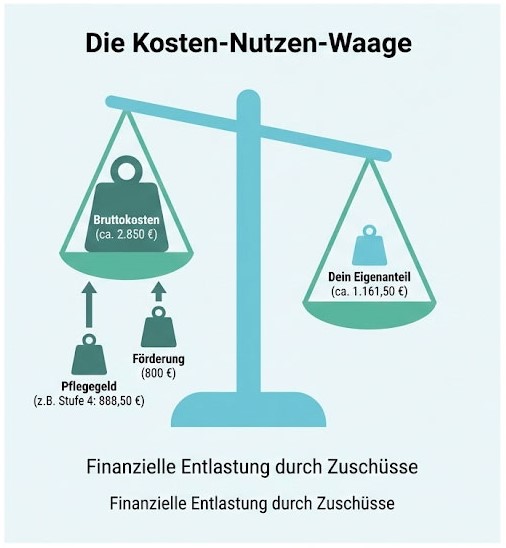
In the end, Mrs. Müller was left with a monthly out-of-pocket cost of about 1,161.50 euros. That is often less than a place in a good nursing home would cost – and in return, her father could stay in his own home, sit in his favorite armchair, and drink his usual coffee.

Imagine the caregiver is like a “professional guest” in your home. For this living arrangement to work, it takes clear boundaries and mutual respect in everyday life. In Austria, this is regulated very precisely – so both sides know where they stand.
What caregivers do for you
They are the day-to-day managers who make sure life at home keeps running. Their tasks include:
- Household & enjoyment: Cooking, shopping, cleaning, and taking care of the laundry.
- Joy of life: Providing companionship, walks, and accompanying them to appointments.
- Physical support: Help with getting dressed, personal hygiene, eating, getting up, and mobility.
- Health check: Ongoing monitoring of the condition and keeping a household or activity report.
The red line: What caregivers are not allowed to do
Important to know: caregivers are not doctors or certified nurses. There are clear taboos:
- No diagnoses: They are not allowed to diagnose illnesses or independently initiate medical treatments.
- Medical tasks only on instruction: Activities such as changing dressings, measuring blood sugar, or administering injections (e.g., insulin) may only be carried out if they have been instructed in writing and authorized to do so by a doctor or a certified nursing professional (so-called delegation).
Time to breathe: working and rest times
No one can stay fully alert 24 hours at a time. To keep the caregiver fit, the law provides for:
- Rotation model: Most often, work is done in a 2-week rhythm. After 14 days of work come 14 days off (or a similar rotation), so the caregiver can recover in their home country.
- Daily breaks: Per day, the caregiver is entitled to at least 3 hours of break time, including at least two breaks of 30 minutes at a stretch. During this time, they may leave the house and do not have to be on call.
- Night rest: Even at night, there must be time for sleep, unless there is an acute emergency.
Your duty as a host
So that the caregiver can do their job well, you are responsible for their well-being on site:
- A private place to retreat: An appropriate, lockable room with a window, heating, and access to bathroom/toilet is mandatory.
- Meals: The caregiver participates in the household’s meals. This is not a “bonus,” but the legal basis for living in the household.

The decision to opt for 24-hour care has been made – but how do you find the right support now? In Vienna, there are three main routes, which differ primarily in flexibility, price, and security.
Many families today face a choice: Do I want the “all-inclusive, worry-free package” from a traditional agency, or am I looking for a more modern, cost-transparent solution where I can also have a say myself? Here is the direct comparison for you:
The model comparison at a glance
Why the trend is moving toward platforms
More and more families in Vienna are choosing digital platforms like noracares today. The reason is simple: you have full cost transparency and pay no hidden monthly commissions. At the same time, you keep direct choice – you decide who moves into your loved ones’ home, not an algorithm or an agency.
It’s the golden middle ground for anyone looking for security and professionalism, but who still wants to keep hold of the reins.
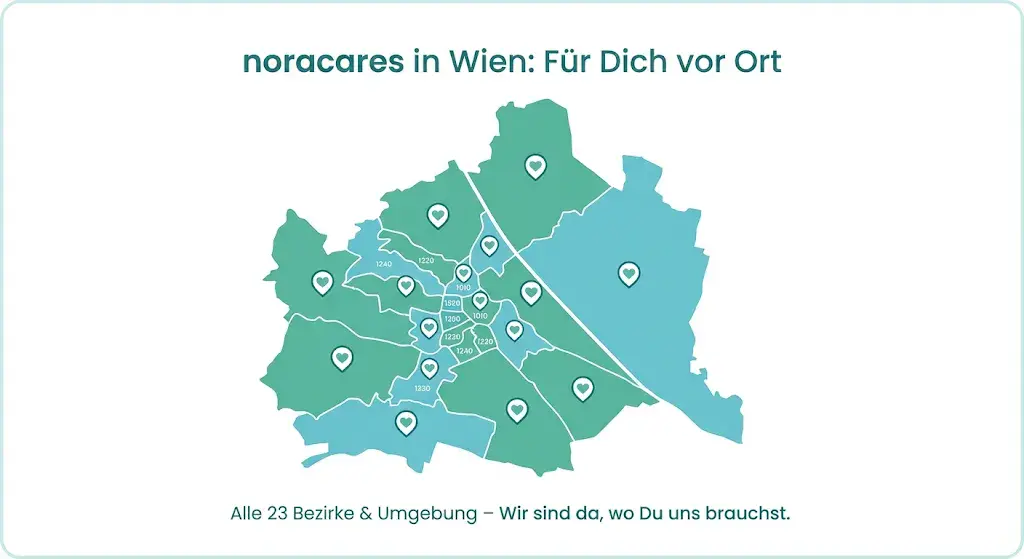
Whether your heart beats for the busy bustle of Favoriten, the quiet lanes of Hietzing, or elegant Döbling – loving 24-hour care knows no district boundaries in Vienna. noracares is there for you in all 23 municipal districts of Vienna.
We’re there where you need us
We often get the question: “Does that also apply to my neighborhood?” The answer is a clear yes. We arrange suitable support for:
- Inner-city districts: (1st to 9th district as well as the 20th), where short distances and urban infrastructure shape everyday life.
- The green outer districts: From Penzing and Ottakring to Floridsdorf and Donaustadt, where barrier-free living in green surroundings is often the top priority.
Also on site for you in the Vienna surrounding area
Caring about your loved ones doesn’t stop at the city limits. That’s why our network also covers the entire surrounding area of Vienna. If you live in Lower Austria, you benefit from exactly the same conditions and funding pathways as in the capital. We’ll find the ideal care for you in:
- Baden near Vienna & Mödling
- Klosterneuburg & Korneuburg
- Wiener Neustadt & Schwechat
At a glance: Your Vienna advantage

Organizing 24-hour care in Vienna is like putting together a puzzle: every step is important to complete the overall picture. With a clear plan and the right information, however, this process becomes much easier. Let’s explore together the key steps for organizing round-the-clock care.
Needs assessment: What support is required?
Before you begin searching for a caregiver, it’s crucial to determine the individual needs of your relative(s). Imagine stepping into the role of a detective who analyzes the specific needs of their “case.”
- Medical requirements: Are there health challenges that require special attention? Perhaps your relative needs regular medication or help with mobility.
- Everyday support: Which daily tasks are particularly challenging? Does your relative need support with eating, getting dressed, or personal hygiene?
- Social interaction: Is it important that the caregiver provides not only physical but also social support? A listening ear and shared activities can greatly improve quality of life.
- Night care: Is it necessary for the caregiver to be present at night as well to ensure safety and support? This is not only about physical safety, but also emotional security.
When you answer these questions, you’ll have a clear idea of what kind of support you need.
Selecting a suitable caregiver
With a clear picture of the needs in mind, it’s time to start the search for the ideal caregiver. It’s about finding the perfect partner for the care of your relative(s).
- Experience and qualifications: Find out about the caregivers’ qualifications. Make sure they not only have the necessary certificates, but also experience dealing with similar situations.
- References: Ask for recommendations from other families. Testimonials can often say more than any brochure.
- Personal conversation: Arrange an in-person meeting or a video call. This is where you best feel whether the chemistry is right. A trusting relationship between the caregiver and the relative is the heart of any good care.
Legal and financial aspects
The legal and financial aspects are an important piece in the 24-hour care puzzle. They are often the foundations on which everything else is built.
- Contracts: Put all agreements in writing. A clearly worded contract protects not only you, but also the caregiver, and ensures that all services and payments are transparent.
- Financing: Find out about the costs of 24-hour care. What financial assistance is available? Long-term care insurance or government support can help you reduce the financial burden.
- Liability and insurance: Clarify which insurance is necessary and whether the caregiver is adequately insured. This gives you a reassuring sense of security if unexpected situations arise.
- Registration: Don’t forget to complete the required registration in Vienna. Depending on the type and organization of care, it may be necessary to register the caregiver with the responsible authorities or social insurance providers. This ensures that all legal requirements are met and that you are on the safe side in case of problems or questions.
With these steps in your toolkit, you can approach organizing 24-hour care in Vienna efficiently. This way, you ensure that your relative receives the best possible support, while you also create calm and security in your own life.
For Mrs. Müller, noracares was like a lighthouse in a stormy time. The search she had imagined to be so complicated was, in reality, a structured and secure process.
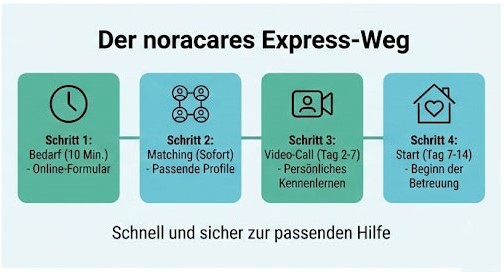
1. Define your needs (The profile)
First, Mrs. Müller created a detailed profile for her father. Here she could enter everything that was important:
- Health condition: Special requirements such as dementia experience.
- Personality: Her father's preferences and daily rituals.
- Expectations: What the caregiver should be able to do and bring to the role.
2. Targeted selection (The search)
Thanks to noracares’ intuitive filter function, Mrs. Müller didn’t have to sift through hundreds of profiles. She filtered specifically by:
- Region: Available caregivers directly in Vienna.
- Qualification: Certificates and many years of experience.
- Availability: Who can start the rotation from when?
3. Getting to know each other (Direct contact)
The heart of noracares: Mrs. Müller could contact people directly via the platform.
- Secure chat: Initial exchange of questions.
- Video call: A personal conversation to see whether the chemistry is right.
- Decision: Only when her gut feeling said “yes” was the collaboration made official.
Why noracares made the difference for Mrs. Müller
noracares didn’t just connect Mrs. Müller and her father with a caregiver—it also gave them back a sense of security. It was the key to a new feeling of life for both of them.

For Mrs. Müller, the decision to opt for 24-hour care was a journey that led her from worry and overwhelm to security and peace of mind. With the support of noracares, she not only found a competent caregiver who lovingly takes care of her father, but also the breathing room she had missed for so long. Now she can breathe again, find time for herself, and at the same time know that her father is in the best hands.
Around-the-clock care not only improved her father’s life, but her own as well. She can feel everyday life becoming easier again—and the sense of security that there is always someone there to take care of things gives her calm and serenity.
Your path to the right caregiver starts here
If you, too, are looking for trustworthy 24-hour care for your loved ones, then don’t wait any longer. With noracares you can quickly and easily find the ideal support that fits your family’s needs. Register today, create a profile, and discover how easy it can be to find the right caregiver.
Click here and start your search with noracares today!


- Delegation (medical/nursing): The written transfer of medical tasks (e.g., administering insulin, changing dressings) from a doctor or a qualified nurse to the personal caregiver. Without this, the caregiver may only help in the household.
- Tapering regulation: A funding rule where the subsidy does not stop abruptly if you slightly exceed the income limit (2,500 € net), but is reduced gradually.
- FSW (Fonds Soziales Wien): The City of Vienna’s central point of contact for social services. Among other things, it coordinates care advice and additional Vienna subsidies.
- Home Care Act: The Austrian law that regulates the framework conditions for 24-hour care, including working hours, contracts, and quality standards.
- Room & board: The family’s obligation to provide the caregiver with a private room and meals free of charge. This is part of the legal arrangement when living in the household.
- Net income limit: The amount (2026: €2,500) up to which full government funding is granted. Important: The care allowance itself does not count as income.
- Personal caregiver (self-employed): The legal form of most 24-hour caregivers in Austria. They hold a free trade license, pay their own social security contributions (SVS), and issue invoices.
- Care allowance indexation: The annual adjustment of the care allowance to inflation. The values mentioned in the article correspond to the status of the automatic increase for the year 2026.
- Quality assurance (home visits): Regular checks by qualified nursing staff (often every 3 months) to ensure that the care meets the health needs.
- Rotation: The caregivers’ work rhythm (e.g., 2 weeks on, 2 weeks off). A seamless rotation by two alternating caregivers guarantees around-the-clock presence.
- WKO registration: The registration of the caregiver’s business location with the Chamber of Commerce. Since the caregiver works in the family’s household, this location must officially be registered as a place of business.

