Nursing training in Germany: Your path to a future-proof career

Are you interested in training as a registered nurse and looking for a profession where you are truly needed? Do you want to support people when they are ill, improve their quality of life, and stand by their side in difficult times? With training as a registered nurse, you take on responsibility, receive recognition, and open up diverse paths for your future.
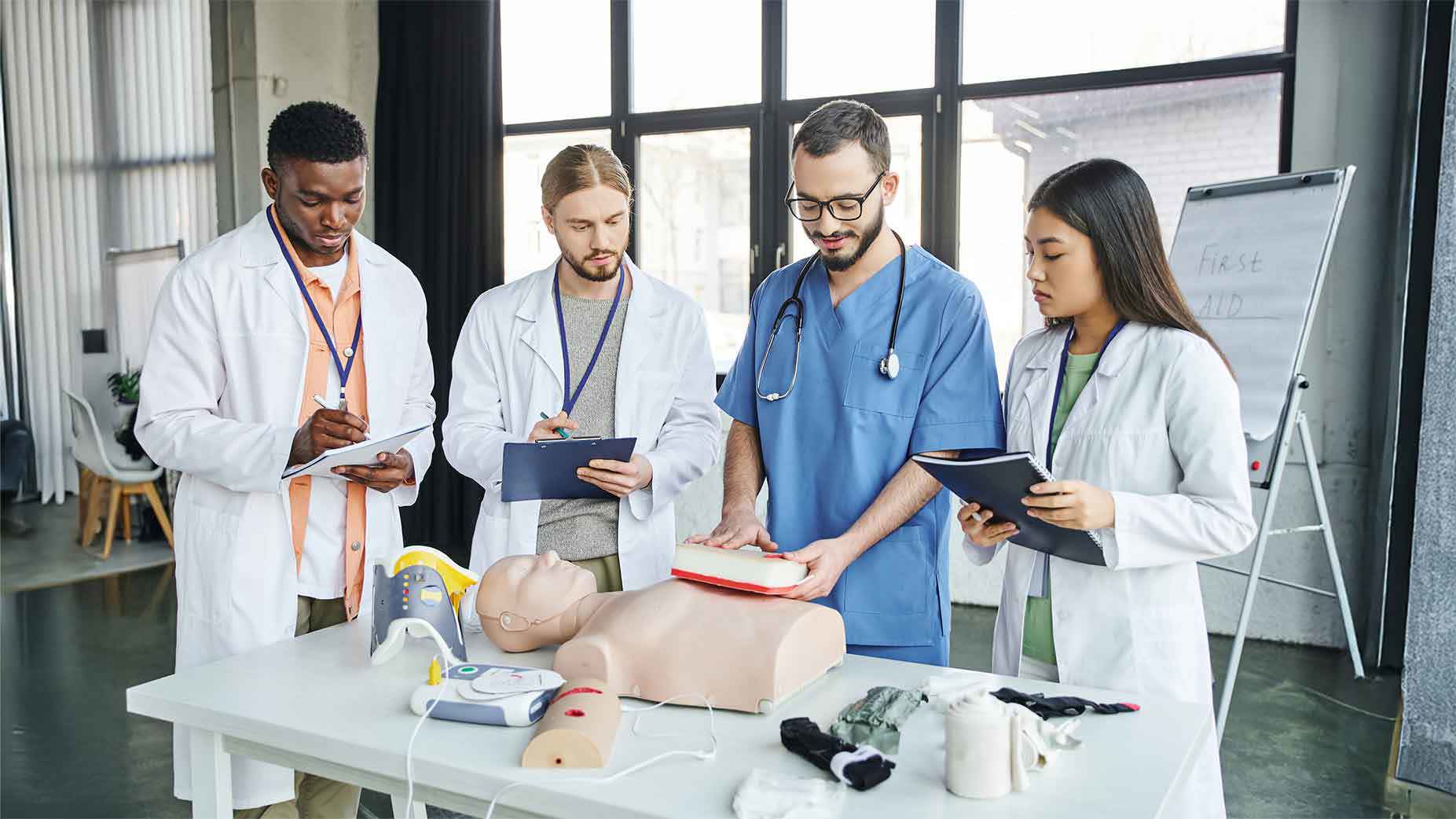
Perhaps you are asking yourself: How do I become a registered nurse?
In this article, you will learn everything about generalist nurse training in Germany – from requirements and duration to exams and career opportunities.
We show you why registered nurses are in such high demand, which further training opportunities are open to you and how you can build a secure and fulfilling future with this profession.
Deciding on training is never easy – especially when it comes to your own future. The good news: The registered nurse training not only leads you to a recognized state qualification but also opens the doors to one of the most future-proof professions of all. Due to demographic change, the demand for qualified nursing staff in Germany, Austria, and Switzerland is steadily increasing – and with it your chances of choosing a profession that is truly needed and makes a real difference.
Sandra is sitting on a park bench watching elderly people slowly stroll across the square. For weeks, one thought has been on her mind: “I want to work in nursing. But how do I actually become a registered nurse?”
At school, she often wondered which profession to choose – one that provides meaning and at the same time offers a secure future. Sandra imagines herself later working in a hospital, nursing home, or outpatient service, supporting people and putting a smile on their faces.
So she starts researching, but all the information overwhelms and confuses her. What requirements are needed? How long does the training take? What tasks can you really expect? Sandra feels a little lost among the many articles and brochures.
We understand this confusion, Sandra. But we want to assure you of one thing: Every hour you invest in this training is worth it. With the state examination, you become an independent professional. We will show you step by step how to get started as a registered nurse and guarantee that with noracares.at you will find the best springboard for the job afterwards. Your courage deserves the highest recognition – and the best salary!

Since 2020, the training has been generalistic, which means: Instead of three separate professions (healthcare and nurse, geriatric nurse, pediatric nurse), there is now one standardized qualification – registered nurse. This means you are trained in a versatile way and can work in different areas – in hospitals, nursing facilities, or outpatient services. The training combines theory and practice, so you take on responsibility early and gain real experience.
Differences from nurse / male nurse
You may be asking yourself: “Is a registered nurse the same as a nurse?” Not quite. In the past, there were separate professions such as “nurse” or “male nurse.” Today, registered nurse training combines these professions and makes you universally deployable – whether in pediatric nursing, geriatric care, or acute care. You therefore receive more comprehensive training that offers you greater flexibility and opportunities.
Why this profession is important & future-proof
Nursing is a profession that is needed – today more than ever. Demographic change and the shortage of nursing staff make qualified registered nurses indispensable. At the same time, the profession is recognized throughout the EU, offers long-term security, and many further training opportunities – for career changers as well as for young people who are just choosing their professional direction. You not only receive gratitude and recognition from the people you help, but you also build a solid and meaningful professional future.
Generalistic training as a key to self-determination
Generalistic training makes you universally deployable: Whether in a hospital, geriatric care, or outpatient care – you can later decide for yourself where you want to work. This flexibility is your greatest asset because it gives you the freedom to choose your workplace according to your needs and life circumstances.
Your advantage: With generalistic training, you are not limited to one area – you can work anywhere and decide for yourself where you want to shape your career.
EU recognition as a career lever
The training is automatically recognized in all EU countries. This means for you: You are not tied to Germany. You can apply throughout Europe and confidently negotiate your salary because you hold an internationally recognized qualification.
Your advantage: EU-wide recognition is a strong argument for actively shaping your salary and working conditions.
Your path to self-employment & entry opportunities
Even if you only have a lower secondary school certificate, there is a clear path:
- Complete nursing assistant training – gain initial practical experience
- Direct transition into generalist registered nurse training
- Start your career and specialize later – e.g. as a geriatric nurse, nurse, or in outpatient care
For many international professionals, this is the first step toward a secure, recognized, and future-oriented career in Germany. With this knowledge, you can plan your path, start confidently, and establish yourself in a future-proof field – regardless of your previous qualifications or your country of origin.
Are you interested in the registered nurse training and wondering: “What do I actually need to become a registered nurse?” Don’t worry – we will explain step by step which requirements are important so you can start your dream job in nursing.
Educational requirements
For training as a registered nurse you generally need at least an intermediate school-leaving certificate. However, entry is also possible with a lower secondary school certificate – often through preparatory measures or additional courses. What matters most is your motivation and willingness to learn. Your desire to help people counts just as much as your grades.
Health requirements
Before starting nursing training, the admission requirements and personal suitability for training must be considered. It is also important to have personal health suitability. In nursing, you are physically and emotionally challenged every day. Therefore, you must present a medical certificate and generally demonstrate a certain level of physical resilience. You should be fit enough to care for patients safely and mentally stable enough to handle challenging situations.
Language skills & soft skills
Good communication is essential in nursing. Therefore, German language skills at level B2 are expected. Equally important are soft skills: empathy, teamwork, communication skills, and resilience help you act confidently and compassionately in everyday nursing practice.
Additional documents
Many training institutions require a certificate of good conduct to ensure that you are reliable and trustworthy. In addition, an internship in a care facility may be mandatory or highly recommended. This gives you a realistic insight into the profession and allows you to check whether it truly suits you.
Sandra has her laptop in front of her and reads the same question for the third time: “How long does registered nurse training take?” She sighs softly. So much information – and yet this exact question is crucial for her. Because the duration of the training determines when she can finally do what she truly wants: help people and arrive in her dream profession.

Full-time nurse training (3 years)
Sandra learns that full-time training as a registered nurse usually lasts three years and begins every six months on April 1 and on the second Tuesday in September. Three years in which theory and practice alternate – with lessons at nursing school and real assignments with patients.
She imagines how she will grow step by step during this time, take on responsibility, and learn to act with both heart and expertise. Three years that may be demanding but are also full of valuable experiences. At the end of this period, she will hold her state examination certificate in her hands – and with it the key to a secure, fulfilling profession.
Part-time nurse training (up to 5 years)
There is also another option – part-time training. It can last up to five years – ideal for those who have family, work, or other commitments. The curriculum remains the same, but the pace is adjusted. Step by step, at your own rhythm, without losing sight of your goal.
Options for shortening (with prior experience, retraining)
Those who already have nursing experience – for example through work as a nursing assistant or a voluntary social year – can shorten the training, sometimes even by a full year. Shortened training is also possible in the case of retraining, depending on your previous occupation and qualifications.
Table: Training duration (full-time vs. part-time)
Would you like to know exactly how registered nurse training is structured and what content awaits you? We give you an overview of theory, practice, exams, and the opportunities to set your personal focus.

Theoretical instruction for nurses
A large part of the training takes place at the nursing school. You will spend around 2,100 hours in class, learn the fundamentals that you will apply in practice, and prepare for your exams.
Subjects
You will cover, among other things, the following topics:
- Nursing science – how care processes are planned and implemented
- Anatomy & Physiology – understanding the body in order to provide targeted help
- Legal foundations – for safety when dealing with patients
- Communication & social skills – to act empathetically and professionally
These subjects provide you with the theoretical foundation to act confidently and competently in practice.
Practical training as a nurse
Practice is just as important as theory: you will spend around 2,500 hours directly with patients and in facilities to apply what you have learned. Here you will grow with your tasks, take on responsibility, and gain real experience.
Nora's tip: Experience a shift before signing
Before deciding on a facility, take advantage of the opportunity for a trial day! Only during a real shift (preferably early or late shift) will you feel how the team works and how patients are treated. Pay attention to the following details:
- Quality of instruction: How much time does the practical instructor have for you?
- Team atmosphere: Is there laughter in the team or is there stress?
- Realistic tasks: Are you allowed to observe or actively participate?
Your internship is your trial run – make use of it!
Deployment locations
You will learn in various places, for example:
- Hospitals – acute care and specialized medicine
- Geriatric care facilities – everyday life and care of older people
- Outpatient services – care for patients at home
- Psychiatry – dealing with mental illnesses
- Pediatrics – Care of children and adolescents
This gives you a comprehensive insight into the diversity of the nursing profession.
Exams & Graduation
During your training, there are interim exams to regularly test your knowledge. At the end, there is the state examination, which determines your successful completion. If you fail once, a retake is possible so that you do not lose sight of your dream.
Specializations & Options
After or during your training, you can specialize in certain areas:
- Pediatric nursing – for working with the youngest patients
- Geriatric nursing – intensive care of older people
- Emergency nursing / Intensive care nursing – for special assignments and quick decisions
This gives you the opportunity to shape your career exactly according to your interests and focus on what truly suits you.
Table: Structure & Content of the Training
The question of your training salary is an important one, because your income shows how much your work is valued and helps you plan your future. We provide you with a clear overview of training compensation.

Training salary for nurses per year
Already during the nursing training you receive a salary.
- In the first year of training, you already earn 1,415 euros gross per month.
- In the second year, the salary increases to 1,477 euros,
- and in the third year, you can look forward to 1,578 euros gross.
Nora's fact check: What remains net
Even if 1,415 euros gross in the first year sounds great: remember that you still have to pay income tax and social security contributions (health, nursing care, pension insurance). With trainee pay, usually between 75% and 85% remains net.
Differences by employer
Depending on whether you work for a public or church-affiliated employer, salaries vary.
- Public (TVöD): The highest and most stable salaries. The collective agreement for the public sector guarantees regular salary increases and strong social benefits. If you value security, look for TVöD institutions."
- Church-affiliated (AVR Caritas / Diakonie): Well paid, but not always linked to TVöD. The employment guidelines are often comparable but offer their own regulations – usually with very good pension schemes.
Nurse salary after graduation
After passing your exam, your salary increases significantly.
Starting salary after training
As a newly qualified nurse, you can expect around €2,800–3,400 gross per month, depending on the employer and federal state.
Salary after 5 years of professional experience
With some professional experience, you can reach €3,200–3,900 gross. Your responsibility grows, and so does your income.
Impact of specializations & further training
If you specialize – for example in intensive care, emergency nursing, or pediatrics – or acquire additional qualifications such as practice instructor or wound expert, your salary can increase significantly again.
Country comparison Germany – Austria – Switzerland
It is also worthwhile internationally to know the differences:
- Germany: Starting approx. €2,800–3,400, after 5 years up to €3,900
- Austria: Starting approx. €2,300–2,800, after 5 years up to €3,200
- Switzerland: Starting approx. 4,500–5,500 CHF, after 5 years up to 6,500 CHF
Table: Salary comparison after training (DE / AT / CH)
If you, like Sandra, have decided to pursue a career in nursing, all that’s missing is your application for nursing training. We’ll show you how to optimally prepare your documents, avoid common mistakes, and impress in the interview.
Application documents (cover letter, CV, certificates)
For your application, you usually need:
- Cover letter: explain why you want to become a nurse, what motivates you, and which strengths you bring.
- CV: clear, structured, and including all relevant stages (school, internships, part-time jobs).
- Certificates: school qualifications, possibly internship certificates or proof of previous experience.
Your documents are the first impression the training institution gets of you – make it positive, professional, and personal.
Application tips & common mistakes
To maximize your chances:
- Customize your cover letter for each institution – generic texts stand out.
- Pay attention to spelling and layout – a clean, well-readable CV appears professional.
- Avoid gaps in your CV; instead, explain short transition periods or internships.
Typical mistakes you should avoid:
- Incomplete documents
- Unclear motivation
- Too little preparation for possible questions
- Interview & aptitude test
If your documents are convincing, the interview usually follows – sometimes supplemented by an aptitude test. There, the institutions want to see:
- Whether you fit the institution
- Your motivation and social skills
- Your resilience and ability to work in a team
Prepare yourself well, think of examples from your daily life or internships where you have taken responsibility, and show your enthusiasm for nursing.
Sample Application & Checklist
Here you can check step by step whether everything is complete and nothing important is missing. With this practical tool, you will feel confident and prepared – and can submit your application with confidence.
Sample Application for Nursing Specialist Training
- LebenslaufDesigns.de offers sample cover letters and résumé templates in Word and PDF format for both career starters and experienced applicants.
- Bildungsbibel.de provides you with a free application letter in PDF and Word format that you can customize individually.
Checklist for Your Application Documents
The Stiftung SPI has created a detailed checklist for applying to nursing specialist training. It includes, among other things, a cover letter, résumé, certificates, and other important documents.
The University Medical Center Mainz offers an editable PDF checklist to help you compile all the required documents for your application.

A Typical Day in the Hospital
Amelie enters the hospital early in the morning, still slightly sleepy but full of motivation. Today her early shift begins. After being greeted by the team, she starts with the handover: she learns everything important about the patients, planned treatments, and special incidents from the last shift.
As soon as the handover is finished, things get going: Amelie measures vital signs, assists patients in getting up, prepares medication, and accompanies nursing tasks under the guidance of experienced colleagues. Every move is a new lesson – the theory from school is applied here in real life.
Challenges and Strain
Everyday life is demanding. Amelie feels the physical strain of shift work – getting up early, long days, and sometimes night shifts. The work is also emotionally challenging: pain, fear, or grief among patients touch her deeply.
There are moments when decisions must be made quickly, and Amelie has to remain calm even though she feels under pressure herself. Despite the effort, she learns to combine resilience with empathy and to remain professional even in stressful situations.
Positive Aspects and Success Experiences
But the beautiful moments outweigh the rest. Amelie experiences how patients smile when she offers them small improvements or help. She feels the team spirit – how colleagues support each other, laugh, and find solutions together.
Every day gives Amelie the opportunity to take responsibility and make her own decisions. At the end of her workday, she feels satisfied: she has helped people, made small changes, and learned a lot at the same time. These successes motivate her to give her best every day and continue to grow.
You have successfully completed your training as a nursing specialist – and now what? The profession not only offers you a secure start, but also many opportunities to develop further, specialize, and work internationally.

Direct Career Entry
After passing your final exam, you can enter the profession directly. Whether in a hospital, nursing home, or outpatient service – you are needed everywhere. You take on responsibility, support patients, and become part of a team that strengthens each other. Direct entry gives you the opportunity to apply your skills in practice and gain your first successes.
Continuing Education Opportunities for Nurses
If you would like to specialize, numerous continuing education opportunities are open to you. For example, you can focus on intensive care, anesthesia, or emergency nursing, become a practice instructor, or aim for a position as head of nursing services (PDL). Each further training opens up new levels of responsibility, higher pay, and exciting career prospects.
Nursing Studies and Academic Paths
If you would like to advance academically, you can start a nursing degree – for example in nursing science, nursing education, or management. This allows you not only to work clinically, but also in research, teaching, or leadership positions. A degree opens doors to strategic tasks and long-term career planning.
International Opportunities
Your qualification is recognized throughout the EU. This means you can also work in other European countries and gain valuable experience there. Whether in Switzerland, Austria, or another EU country – your skills are valued, and you can discover new professional and personal horizons.
Table: Career & Continuing Education Opportunities
Become an Expert – and Secure Your Independence
Training as a nursing specialist is only the first step. If you truly want to be independent and decide for yourself about working hours, areas of deployment, and salary, you should pursue the path to expertise.
Specialization = higher value
Further training such as intensive care, practice instructor, or wound management is more than just additional certificates. It is your direct path to becoming an expert. Only those with expertise can negotiate confidently, influence their own working conditions, and develop professionally with freedom.
Every specialization increases your value – for employers, patients, and above all for yourself.
Resilience as Professional Capital
Training as a nursing specialist is challenging – that is undisputed. But these challenges are not an obstacle; they are a springboard. They help you develop resilience, perseverance, and professional maturity – exactly the skills you need as an independent professional. The more resilient and experienced you become, the more confidently you can shape your career and take control of your professional everyday life.
Those who follow this path have the best chances of securing themselves and their career in the long term – and shaping nursing in a way that suits them.

Would you like to know what prospects await you as a nursing specialist? The nursing profession not only offers meaningful work, but also long-term security and diverse opportunities for further development.
Nursing Shortage & Rising Demand Until 2030
The nursing shortage is real – and it will grow even larger in the coming years. By 2030, the demand for qualified nursing professionals will continue to rise steadily. For you, this means: your skills are urgently needed, your profession has stability, and your work is indispensable.
Demographic Change and Secure Career Prospects
Demographic change means that more and more people require care – older patients, chronically ill individuals, and people with special needs. For you, this means: as a nursing specialist, you have secure career prospects, can expect a stable job, and at the same time pursue a profession that is highly valued by society.
Digitalization & New Trends in Nursing
Nursing is constantly evolving. E-health, digital documentation, robotics, or simulation training open up new possibilities to care for patients better and make processes more efficient. If you are open to innovation, as a nursing specialist you can not only provide traditional nursing services, but also actively participate in modern care processes and use your skills in a future-oriented way.

As soon as you hold this state-recognized, universal final exam in your hands, you are an independent professional. By choosing training as a nursing specialist, you are choosing a profession that is not only in demand, but also meaningful and opens up diverse opportunities for you. You accompany people in decisive moments of their lives, take on responsibility, and will feel every day how valuable your work is.
Your training is the beginning – noracares turns it into the path to your dream job.
If you are looking for support when starting your career in nursing or would like to register safely and transparently as a nursing specialist, noracares is your reliable partner. Here you will find advice, guidance, and concrete support to start your path into nursing professionally.
Every hour of studying, every early morning, every moment of perseverance – all of it is valuable. But only with the right tools does your effort unfold its full impact. noracares accompanies you on your journey, giving you orientation, structure, and security. This turns effort into success – and your training into your dream job
Register now at noracares your career turbo.


- Generalist Training (Generalistics): The standardized training introduced in Germany in 2020 to become a nursing specialist. It combines elderly care, general nursing, and pediatric nursing and makes you universally deployable.
- Nursing Specialist: The modern, state-recognized professional title in Germany for the highest qualification in the nursing field (replaces "nurse").
- DGKP (Qualified Health and Nursing Professional): The highest qualification in nursing in Austria, equivalent to a bachelor's degree.
- PFA (Nursing Assistant): A mid-level qualification in Austria (two years of training) that takes on expanded nursing and medical tasks.
- Generalistics: The technical term for combining the nursing professions into one training program.
- TVöD (Collective Agreement for the Public Service): The collective agreement in Germany that regulates salaries and working conditions in many public hospitals and nursing homes and often guarantees the highest salaries.
- Training Allowance: The monthly salary that trainee nursing specialists receive during the three-year training period.
- Resilience: Psychological resilience; the ability to cope with stressful and challenging situations in everyday nursing without long-term impairment.
- Lichenification: Technical term for the thickening of the skin due to chronic scratching (a common symptom in skin diseases).
- Nursing Science: The academic discipline concerned with research, teaching, and the development of nursing practice.

