Foreigners working in Austria: The Master Guide 2026 for nursing staff

Do you dream of living and working in Austria’s picturesque landscapes? Between majestic Alps and vibrant cities, not only impressive nature experiences await, but also promising career opportunities. Find out how you, as a foreigner, can conquer the Austrian labor market, what opportunities are available to you, and which steps you need to take for successful integration – especially if you want to work as a caregiver.

Imagine you start your day in the charming streets of Vienna or in one of the quiet Alpine villages. Surrounded by impressive nature and a rich culture, you not only pursue your dream job, but also enjoy the quality of life that Austria offers.
Working in Austria as a foreigner – for many, a worthwhile goal that is within reach. But before you dive into the adventure, you need to prepare well. That’s why, in this guide, you’ll learn how to find your way into the Austrian care labor market, from job hunting to integration. Especially if you want to shape your professional future in Austria as a caregiver, you’ll find valuable tips and information here.
Yes – access to the Austrian labor market is possible. Austria’s labor market is like a house with two different entrances: for some, the door is wide open; for others, there’s a digital bouncer called “Red-White-Red.”
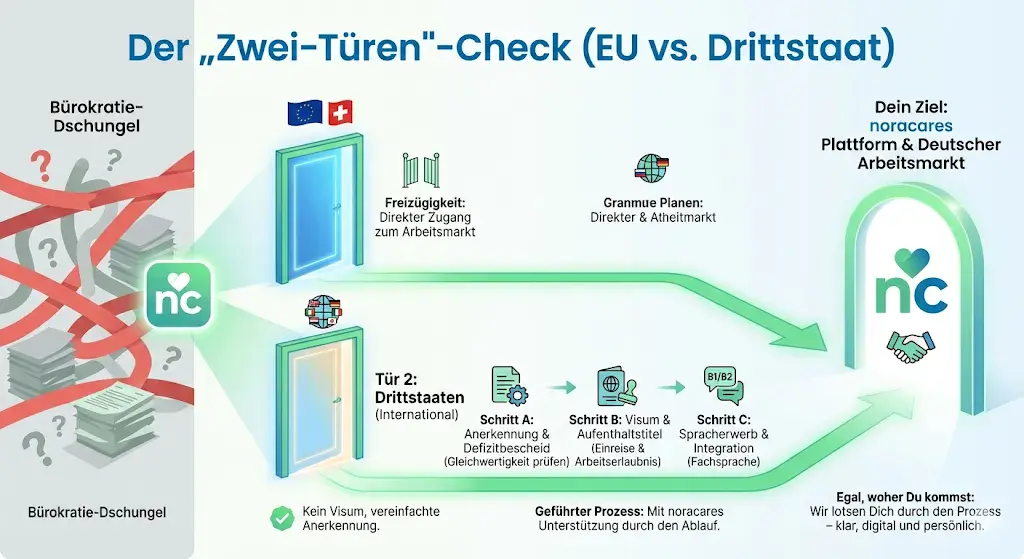
Here is an overview of how you get through the door:
EU citizens, EEA citizens & Swiss
For nationals of EU member states, the EEA (Iceland, Liechtenstein, Norway) and Switzerland, full freedom of movement for workers applies.
- Status: Free access to the labor market
- Condition: You need neither a work permit nor a special visa. You can simply apply, sign a contract, and get started.
- Formality: If you stay for more than three months, you only need to obtain a “registration certificate” (Anmeldebescheinigung) from the competent authority (municipal office/Magistrat or district authority/Bezirkshauptmannschaft).
Third-country nationals (non-EU/EEA)
People from all other countries (so-called third countries) need, for legal employment, a combined residence title that authorizes work.
Status: Restricted access.
The Red-White-Red – Card: This is the most important instrument. It is a points-based system that uses criteria such as qualifications, work experience, age, and language skills. It is aimed particularly at:
- Highly qualified persons
- Skilled workers in shortage occupations (e.g., care, engineering, trades)
-
Other key workers
- The EU Blue Card: Specifically for academic skilled workers with a certain minimum salary.
- Employment permit: In some cases (e.g., seasonal work in hospitality or harvest help), the Public Employment Service (AMS) issues a time-limited permit for a specific job.

Austria’s economy today is an international team project: without helping hands and know-how from abroad, the lights would go out in many businesses.
A look at the numbers
According to current data, the share of international workers is higher than ever before:
- Every fourth job: Around 25 percent of all employees in Austria do not have Austrian citizenship. That is almost one million people (approx. 980,000) who keep the country’s engine running every day (2023 | statista.com).
- The “Team Europe” dominates: About 60 percent of these foreign workers come from EU or EEA countries (first and foremost Germany, Romania and Hungary). The remaining 40 percent come from third countries (2024 | emn.at).
- Growth engine: Employment growth in recent years has been driven mainly by foreign workers. Without immigration, the number of employed people in Austria would shrink due to the retirement wave of the “baby boomers.”
A heartbeat for care: It doesn’t work without help
The dependence is particularly evident in care and healthcare. Here, the “international team” is not just an enrichment, but an absolute necessity: while the number of domestic caregivers tends to decline, the sector now grows only through immigration. Many skilled workers come from the eastern EU neighboring countries, but increasingly also through targeted recruitment from third countries (e.g., Colombia, the Philippines, or India).
In home personal care (24-hour care), the share is even more massive: here, almost 100 percent of caregivers come from abroad (mainly Romania and Slovakia).
Imagine Europe as one single, huge campus: you can choose which building you study, live, and above all work in. For you as an EU citizen, the borders within this campus are now only lines on the map.
Austria is one of the most popular destinations for skilled workers from the Union – not only because of the Alps, but because of the high labor standards.
Right to work: The “golden entry ticket”
As a citizen of the EU, the EEA (Iceland, Liechtenstein, Norway) or Switzerland, you have what is known as freedom of movement for workers.
- That means: You don’t need a permit, a visa, or confirmation from the Public Employment Service (AMS). Your passport is your master key.
- Equal treatment: You have the same entitlement to the job, the same pay, and the same working conditions as an Austrian citizen. Discrimination based on origin is prohibited by law.
Registration & residence: The “welcome check”
Even though you can come and go as you like, the Austrian state wants to know that you are there when you put down roots.
- Step 1: The Meldezettel requirement (within 3 days): As soon as you move into an apartment, you must register with the registration office (municipality or Magistrat). This is purely a formality.
- Step 2: The registration certificate (after 3 months): If you plan to stay longer than a quarter, the state asks you to “check in.” You must prove that you:
- have a job (or are self-employed),
- have health insurance,
- and have enough financial means so that you are not immediately dependent on social assistance.
Rights & obligations: Safe within the system
Working in Austria means being part of one of the most stable social security systems in the world. It’s like a safety net that catches you when things get stuck.
- Social insurance obligation: As soon as you earn above the marginal earnings threshold (approx. 550 euros/month), you are automatically insured for health, accident, and pension. Your employer registers you – you don’t have to take care of anything.
- Tax liability: Anyone who works in Austria also pays taxes here (payroll tax). The nice part: at the end of the year, you can often reclaim money from the tax office via the “income tax adjustment” (employee tax assessment).
- EU labor law: You enjoy full protection. That means: statutory vacation entitlements (at least 5 weeks per year), regulated working hours, and protection from arbitrary dismissal.
If you look at Austria from outside the EU, you won’t see an open gate, but a modern filtering system. Austria isn’t looking for just anyone – it’s looking for exactly you, if you bring the right skills. Your path runs through a points system that rewards qualifications.
Which permit do I need?
The route into a job depends on whether you want to put down roots long-term or are only coming for a summer. Here is your overview:
Red-White-Red Card (RWR) – The points system
The RWR Card is your “all-in-one ticket.” It is both your residence permit and your work permit. Imagine you’re taking part in a fair competition where your résumé fills your points account. You are assessed based on:
- Qualifications: Have you studied or completed an apprenticeship?
- Work experience: How many years have you already worked in your field?
- Language skills: Do you speak German (important for many jobs) or English (often sufficient in IT)?
- Age: Younger applicants often receive a bonus because they will remain in the system longer.
- Salary & job offer: You need a binding offer with remuneration that corresponds to the Austrian standard.
Employment permit
This document is like a “single-building permit” for your workplace.
- The employer’s turn: In most cases, your future boss must submit this application to the AMS (Public Employment Service).
- The replacement worker check: The AMS often checks whether there is already a registered unemployed person for this position (a national or EU citizen) who could do the job. Only if no one is found will you receive the permit.
Job-seeker visa
Are you a particularly highly qualified skilled worker (e.g., a scientist or top manager)? Then you don’t have to wait until you have a contract in hand.
- The 6-month pass: You can apply for a special visa to come to Austria for half a year and search for a suitable company directly on site.
- Requirement: You must already reach at least 70 out of 100 points in advance in the points system for highly qualified workers.
Important fact check: The RWR Card is not a “lottery.” If you reach the points and have an employer who pays you fairly, you have a legal entitlement to it. It’s a transparent path for everyone who wants to enrich Austria with their expertise.
The path into the Austrian labor market is not “one-size-fits-all.” Depending on what stage of life you’re in – whether you’re here to study, seeking protection, or bringing your family – the system adapts to your situation.
Working as a student
Austria is a popular place to sharpen the mind while also topping up the budget. But be careful: your studies must remain your main activity.
- EU students: For you, the “open house” principle applies. You may work alongside your studies as much as you want without needing an additional permit from the AMS.
- Non-EU students: Your residence permit “Residence permit for students” is your entry ticket. Since the latest reforms, you may work up to 20 hours per week with it.
Asylum status & work
For people seeking protection, work is the most important key to integration. Here, access is often tied to time-related hurdles.
- During the procedure: As an asylum seeker, you are generally only allowed to work 3 months after admission to the procedure. Access is usually limited to seasonal work or charitable activities.
- After the decision: As soon as you are recognized as entitled to asylum (refugee) or entitled to subsidiary protection, you have full and free access to the labor market. You no longer need an additional permit and can take any job.
Family & work (family reunification)
Austria wants skilled workers to stay long-term – and that works best if the family can come along and share in everyday life.
- The “Plus” joker: If, as a skilled worker, you hold a Red-White-Red Card or an EU Blue Card, your family members (partner and minor children) usually receive the Red-White-Red Card Plus.
- Full freedom: The word “Plus” is crucial here. It means your family has unrestricted access to the labor market from day one. They can work anywhere without the AMS having to approve it.
Focus on care: A special route for lifesavers
Since Austria is desperately looking for care workers, the hurdles here have been set particularly low:
- The “fast-track” procedure: Care workers from third countries are considered the top shortage occupation. You often receive the Red-White-Red Card faster and with lower hurdles for salary evidence than in other sectors.
- Recognition (nostrification): While you are waiting for your foreign diploma to be officially recognized, you may, under certain conditions, already work as a care assistant to get to know the system while your full salary as a qualified professional is being prepared.
If you work in the care sector, there are often special subsidies and scholarships (such as the “Care scholarship”), which can make getting started financially much easier.
Before you submit your first application, it is important to sort out the terms. In the world of authorities, it makes a big difference whether you only have a “visa” or a “residence permit” in your hand.
Visa vs. residence permit: What is the difference?
- The visa: It’s like a short-term “entry ticket.” It allows you to enter the country and stay for usually up to 6 months (e.g., the job-seeker visa). As a rule, you are not yet allowed to work with it.
- The residence permit (e.g., RWR Card): It’s your “long-term ticket.” It allows you to live and work over a long period of time. It is usually issued as a card.
RWR Card vs. RWR Card Plus: Your upgrade
There is often confusion here, but the difference is crucial for your freedom:
- Red-White-Red Card: You are tied to a specific employer. Your “key” fits only this one lock. If you want to change jobs, the authority must approve again.
- Red-White-Red Card Plus: This is your upgrade after 21 months (within 24 months). With it, you have free access to the labor market. You can change jobs whenever you want without asking the authority for permission beforehand.
Who applies for what? (Responsibilities)
Think of it like teamwork:
- You (the skilled worker): You are responsible for collecting your certificates and language proofs. You usually submit the application at the embassy in your home country.
- The employer: They must submit the “employer declaration” to the AMS. Without their binding promise to hire you under the stated conditions, there is no card.
- The authority (AMS & settlement authority): They act as referees. The AMS checks your points; the authority ultimately issues the card.
The path to a job in Austria leads through various offices. So you don’t lose your bearings, here you’ll find the most important points of contact and what they can do for you:
Before you submit a document, always check Migration.gv.at first for the latest forms. Bureaucracy in Austria loves order – if you use the right templates from the start, you’ll save yourself weeks of waiting time!

You can think of the work permit as the key to your new life in Austria. The “Red-White-Red Card” (RWR Card) is much more than just a piece of plastic – it opens the door to a successful career and a secure stay.
What’s special: it’s a combined ticket. It is valid as both a work permit and a residence permit at the same time. If you want to come to Austria as a caregiver, this card is your most important tool, since care work has been at the very top of the shortage-occupation list for years.
Requirements and application
The path to the Red-White-Red Card may feel like a steep mountain at first, but with the right preparation it becomes a well-developed trail. First, you need to make sure you fall into one of the target groups. As a caregiver, you belong to the group of “skilled workers in shortage occupations”.
To make it to the summit, you must master the following stages:
Check your qualifications (the points check)
.webp?version=1)
Austria uses a fair points system. Your education, work experience, language skills, and your age all add to your score.
- The magic number: For skilled workers in shortage occupations (such as care work), you must reach at least 55 out of 90 points.
- The navigator: Be sure to use the official online points calculator on migration.gv.at. That way you’ll immediately know where you stand.
- Job offer: You need a binding job offer from an Austrian employer who pays you at least the statutory or collectively agreed minimum wage.
Gather the required documents
Before you set off, your backpack has to be complete. Among other things, you will need:
- A valid passport and a current passport photo.
- Proof of your qualifications (diplomas, certificates).
- Proof of your language skills (German or English – in care work, German is usually crucial from level B1).
- The employer declaration: A form that your future boss fills out.
Submitting the application
You have two options: either you submit the application at the Austrian embassy in your home country, or your future employer submits the application for you directly to the competent authority (Governor/Magistrate/District Authority) in Austria. This often saves time!
Waiting for the decision
As soon as your application has been submitted, the Public Employment Service (AMS) checks whether you reach the required points and whether the job offer meets the standards. As a rule, you will receive a decision within 8 weeks .

You’ve decided to work in Austria – now it’s about finding the right position and applying successfully. To make the path to your dream job run smoothly, we’ve put together some tips and tricks for job searching and applying in Austria for you.
Where can I find open positions?

The search for the right job usually begins online – and Austria offers a wide range of platforms that can support you. Imagine browsing numerous open positions with just a few clicks, tailored to your qualifications and interests. Here are some of the most important places to start:
- Platforms: Specialized care platform like noracares enable you to search specifically for care professions in Austria. With tailored job suggestions, helpful application tips, and the option to create a professional profile, noracares effectively supports you on your way to a new job. At noracares, you’re not just a number in a file. You create your profile yourself and show your personality before you even set foot on Austrian soil for the first time. This way, you can also get to know your future patients personally in advance.
- AMS (Public Employment Service Austria): The job board of AMS Austria offers a large selection of vacancies in all sectors. There are also regularly new postings here for caregivers .
- EURES (European Employment Services): A EU platform that shows you not only jobs in Austria, but also in other European countries. Especially useful if you’re flexible and want to explore several options.
Application process

Your application is like a business card – it conveys a first impression and has to convince straight to the point. Here are some tips on how to design your application perfectly:
- Cover letter: In Austria, the cover letter plays an important role. It should be precise and clearly structured. Explain why you are applying for the position, what experience you bring, and why you would like to support the company or the private individual.
- CV: A clear, well-structured CV is essential. It should be no longer than two pages and present your most important professional stations, education, and qualifications clearly. Make sure you can explain any gaps in your CV.
- References and certificates: In Austria, employers place great value on proof of your training and qualifications. Therefore, include copies of references and relevant certificates with your applications.
- Interview: Be well prepared, find out about the potential employer and the position. In Austria, interviews are usually conducted formally, and punctuality as well as a professional appearance are crucial – including in a video call.
By focusing on these essential elements, you ensure that your application gets the attention it deserves. Remember that every application conveys an individual picture of you and leaves a lasting impression. With careful preparation and a clear focus on your strengths and qualifications, you’ll be well equipped to stand out in the selection process and achieve your career goals in Austria.

If your application and the Red-White-Red Card request were successful and you start working in Austria, you’re not only entering a new job market, but also a new cultural environment. To integrate successfully, it’s important to understand the country’s professional and cultural norms and adapt to them:
- German language skills: Even if you want to work in international companies, German language skills are often crucial. Many employers expect you to have at least basic knowledge of German (level A1 or A2), especially if you are in direct contact with female and male patients. Invest time in language courses to improve your chances on the job market.
- Differences in everyday work: If you want to work as a caregiver, you need to understand that your experience from abroad does not necessarily match the working conditions in Austria. It may be that everyday work is structured differently, you have to take on different tasks, or the way people interact differs. Be open to new challenges and experiences.
- Professional and cultural norms: The Austrian job market places great value on punctuality, reliability, and clear communication. Hierarchies in companies are often clearly structured, and respectful interaction is expected. The faster you understand these norms and adapt, the easier it will be for you to find your way around in the Austrian working environment.
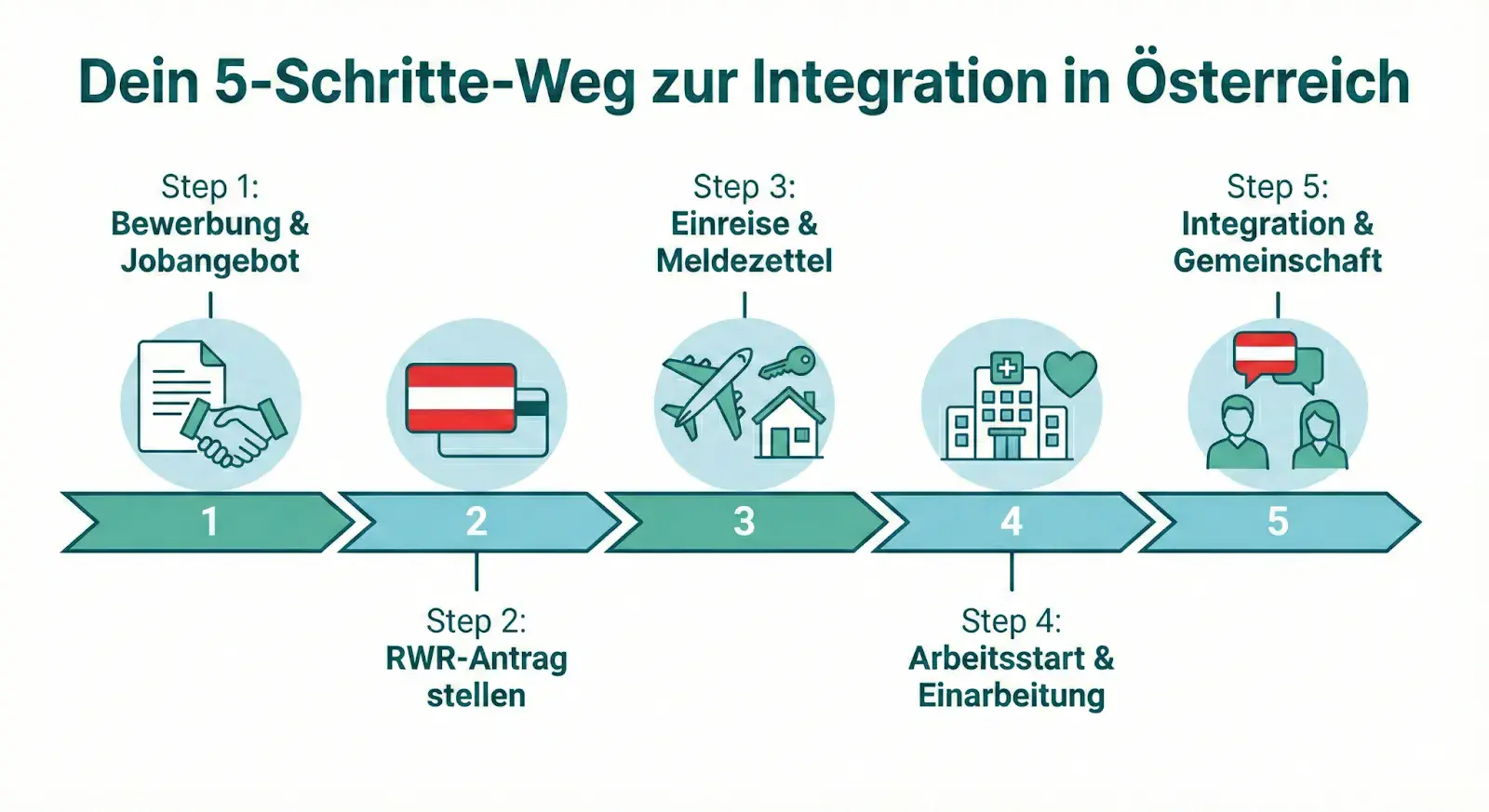
With these tips and the right know-how, you are well equipped to master the application process in Austria and successfully shape your professional future.
The path into the Austrian job market is well signposted, but there are a few places where you can easily take a wrong turn. To make sure your start in Austria goes smoothly, you should know these classic mistakes and avoid them:
Austrian authorities are very meticulous. A small mistake on the form can cost a lot of time. If you are unsure, it’s better to ask one time too many at the AMS or a counseling center (such as the ÖIF). A clean start will save you a lot of stress later on!

Imagine you begin a new chapter in a country that not only inspires you with its breathtaking nature, but also beckons with valuable professional opportunities. Austria is like a treasure chest full of possibilities for international skilled professionals. From obtaining the “Red-White-Red Card,” which opens access to this treasure for you, to a successful job search and integration, this country offers all the tools you need to make your career dreams come true. Prepare well, use the available resources, and experience how you flourish in this fascinating country both professionally and personally.
Start your journey today, and register at noracares. Our platform not only helps you with a targeted search for nursing professions, but also offers valuable application tips and support on your way to a new job in Austria. Take the opportunity to become part of this promising job market and open the door to your successful career in Austria!

We have created a step-by-step guide to help you master the process of obtaining a work permit in Austria as a foreign caregiver or nurse. Whether you are just starting out or want to review important steps, this downloadable and printable white paper ensures you are well prepared. From recognition of qualifications to applying for the Red-White-Red Card—everything important in one place. Download it or print it out and start your career in the Austrian healthcare system!


- AMS (Public Employment Service): The government authority that manages the labor market. For third-country nationals, the AMS checks whether the requirements for a work permit (such as the RWR card) are met.
- Registration certificate: Document for EU/EEA citizens who stay in Austria longer than three months. It confirms the right of residence based on work or sufficient assets.
- Third countries: All countries outside the EU, the EEA (Iceland, Liechtenstein, Norway) and Switzerland.
- Collective agreement (KV): An agreement between trade unions and employers’ associations. It sets minimum wages and working conditions for almost all industries (including care). This is why almost everyone in Austria is entitled to vacation pay and Christmas bonus pay.
- Shortage occupation: Occupations in which Austria has too few workers (e.g., qualified nursing, nursing assistant). Here, access to the Red-White-Red Card is significantly easier.
- Registration form: Confirmation of the registration of your residence. You must register with the municipality or the district authority within three days of moving in. Without a registration form, you cannot open a bank account.
- Nostrification: The official process of recognizing a foreign university degree or diploma so that you are allowed to work in Austria under your trained title (e.g., as a qualified nurse).
- ÖIF (Austrian Integration Fund): An institution that supports language courses and helps with social integration.
- Red-White-Red Card (RWR card): A points-based residence title for qualified skilled workers from third countries. It combines the residence permit with the work permit for a specific employer.
- Red-White-Red Card Plus: The “upgrade” to the standard RWR card. After a certain period (usually 21 months), it enables free access to the entire Austrian labor market without being tied to an employer.
- Social insurance (SV): The compulsory insurance system in Austria (health, accident, unemployment, and pension insurance). Contributions are deducted directly from gross pay.

