Care allowance in Austria: Amount, levels, application & table 2026

As of: January 2026
Are you wondering how the care allowance in Austria has changed in 2026 and how you can apply for it? We explain who is entitled and how the application process works – so that you receive the support for care that you are entitled to.

When a parent, partner, or you yourself suddenly need help in everyday life, many questions arise and there is usually little time. Care allowance in Austria is meant to provide support precisely in such situations. Nevertheless, many affected people and relatives find the topic complicated, unsettling, or even frightening.
You may be asking yourself right now:
- Am I even entitled to care allowance?
- How much money are we actually entitled to?
- What happens during the assessment?
- Can the application harm me later?
These questions are completely normal, and you are not alone with them.
In this guide, we explain care allowance Austria the way it is needed in this situation: clearly, understandably, and honestly. You will find out how much the care allowance currently is, what care levels exist, and how the application works step by step. We also explain what you should pay attention to so that disadvantages or unnecessary problems do not arise.
This is not about paragraphs of law or complicated official terms, but about your specific situation: What does care allowance mean in everyday life? Is it enough for care at home? And what can you do if the classification is not right?
Read on to get reliable guidance that gives you security and helps you take the next steps well informed and without fear.

Maria, an elderly lady, lives in a small village in Austria. She has experienced a lot in her life and was always independent. But over time, simple tasks such as shopping or cooking became more difficult for her. She knew that she needed support, but the financial burden associated with care seemed almost insurmountable.
This is where care allowance comes into play. This financial aid is designed to support people like Maria who depend on help. It was introduced to provide relief for those who need assistance and to maintain or even improve their quality of life.
For Maria, the care allowance created the opportunity to hire a loving caregiver to help her with everyday tasks – from personal hygiene to accompanying her on walks, Maria is now no longer on her own.
Who is care allowance intended for?
The care allowance is like a protective umbrella spread over people whose everyday lives are limited by barriers – regardless of whether these barriers are visible or invisible.
- Physical limitations: For those whose bodies no longer cooperate as they once did, for example after a serious fall, with advanced rheumatism, or when there is no longer enough strength in the hands and legs for daily dressing and cooking.
- Psychological & mental burdens: It is also intended for people whose “inner compass” or drive needs help – for example in the case of dementia, severe depression, or psychological impairments that mean everyday life can no longer be managed safely without external structuring.
What care allowance is not
It is important to distinguish care allowance from other benefits in order to avoid false expectations:
- Not wages or income: The care allowance is not considered taxable income. It neither increases your tax burden nor reduces your entitlement to social benefits (such as the compensatory supplement) – it is a purpose-bound flat-rate payment, not a salary.
- Not a benefit in kind: You do not receive a “voucher” for a caregiver, but cash into your account. You decide yourself whether to use it to pay the care service or pass it on as recognition to caring relatives.
- Not “fully comprehensive cover”: The money is a subsidy toward the costs incurred by care. In most cases it does not cover the full costs (e.g. for a private nursing home or round-the-clock care), but serves as financial relief.
Care allowance in Austria is like a map that adapts individually to your needs. The more support is needed in everyday life, the higher the amount. It is valuable help that ensures the financial burden caused by the need for care is cushioned.

Care allowance table 2026
The amounts are adjusted annually (valorized). Here are the currently valid values for the year 2026:
How often is care allowance paid?
The care allowance is paid 12 times a year. The transfer is made monthly in arrears, usually at the same time as the pension or retirement payment. If you are already receiving a pension, the care allowance is transferred directly together with it.
Is care allowance taxed or offset?
Here is good news for the household budget:
- Tax-free: No wage tax or income tax is deducted from the care allowance. It is a net amount that is fully available to you.
- No offsetting: Since it is a purpose-bound benefit, the care allowance is not counted as income (e.g. when calculating social assistance or minimum income support).
- Social insurance: No contributions are payable to health or pension insurance.
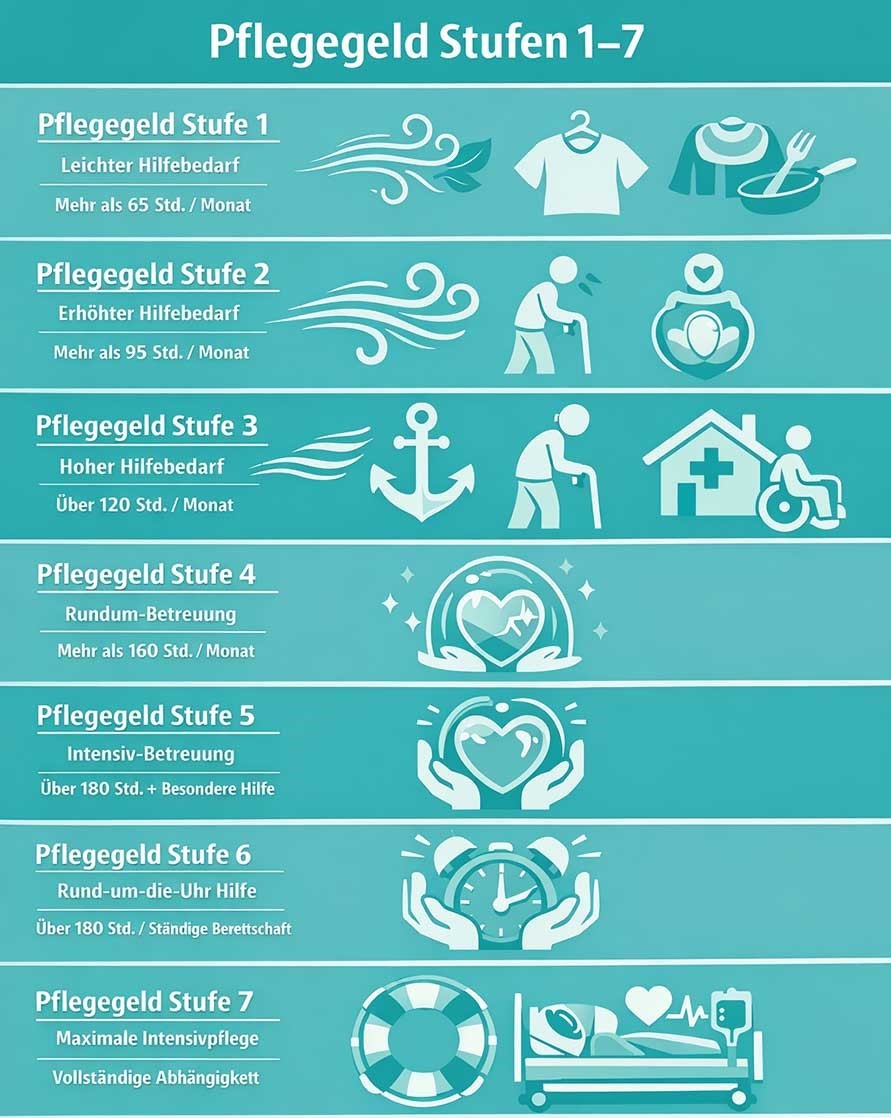
Imagine the care levels like a measuring tape that precisely measures the individual need for help. From light support in everyday life to comprehensive care – each level represents a clearly defined intensity of care.
This system ensures that every person in need of care receives the appropriate financial support, tailored to the actual challenges that everyday life brings. It is a recognition of the often invisible extra effort caused by illness or disability.
Care Allowance Level 1
Level 1 marks the beginning of the support system. It is intended for those who have a basic need for assistance, comparable to a light wind that throws you off balance. You need help with tasks such as getting dressed, personal hygiene, or preparing meals, but not yet to a great extent. The need for care amounts to more than 65 hours per month.
Care Allowance Level 2
With Level 2, the wind grows a bit stronger. Here, the need for assistance is already more noticeable, similar to a reliable companion you need for the most important daily activities. The person in need of care already requires support with several basic needs of life, often also when going to the toilet or with mobility. The need amounts to more than 95 hours per month.
Care Allowance Level 3
Level 3 marks a significant increase in the help needed, comparable to a firm anchor that provides support in a storm. Independence is already severely restricted here. Help is needed almost continuously with personal hygiene, nutrition, and mobility. More complex care measures are also often required. The monthly need for assistance exceeds 120 hours.
Care Allowance Level 4
At Level 4, everyday life becomes a real challenge that requires all-around support. Here, the person in need of care depends on comprehensive assistance in many areas of daily life. Independently eating meals or leaving the home on one’s own is often no longer possible. The amount of care required exceeds 160 hours per month.
Care Allowance Level 5
Level 5 is intended for those whose lives are shaped by a constant need for supervision and assistance, comparable to a fragile vessel that must be protected at all times.
In addition to the high care requirement (over 180 hours), there is an extraordinary care effort caused by a severe mental illness, an intellectual disability, or a particular physical impairment, for example where there is an increased risk of falling or constant supervision is necessary to prevent danger to oneself or others.
Care Allowance Level 6
At Level 6, life becomes an uninterrupted chain of helping actions that allow no planning or predictability. Here, care is practically impossible to coordinate in terms of time. The person also needs help several times during the night, or help must be provided again and again spontaneously and unpredictably.
It is a condition in which every minute can bring unforeseen needs, leaving caregivers with hardly any predictable breaks. The need exceeds 180 hours per month and additionally requires constant presence or readiness to intervene.
Care Allowance Level 7
Level 7 is the highest and most intensive form of support, a lifeline in a rough sea. It is granted only if the person in need of care can no longer independently perform purposeful movements with all four limbs or is in a comparable condition.
Here, there is complete dependence on others, often with artificial feeding, ventilation, or other life-sustaining aids required around the clock. Every action, from turning in bed to swallowing, requires intensive help.
Care allowance classification criteria: What really counts?
Classification for care allowance is not just filling out forms – it is drawing a detailed portrait of your everyday life. Imagine a set of scales: on one side is independence, on the other the "helping hands" needed to smooth out the unevenness of the daily routine. During the assessment, they look closely at where these scales begin to tip and how much time must be invested so that your life remains safe and dignified.

Care needs simply explained
Care needs are basically the time another person has to spend helping you with everyday things that you can no longer manage on your own. It is not only about medical procedures, but about the very ordinary yet essential steps from morning to evening. This need is measured in hours per month, with each activity assigned a fixed "time value" (a kind of time credit) by law.
What do 65 and 180 hours per month mean in practice?
To make these numbers tangible, a comparison with everyday working life helps:
- 65 hours (entry threshold): This corresponds to about 2 hours of help per day. This is often the time needed if you require help washing and getting dressed in the morning and evening, plus support with meal preparation.
- 180 hours (the threshold for the higher levels): This corresponds to full-time employment (approx. 6 hours daily). Anyone with this level of need depends on outside help for most of the day. At this point, it is usually no longer just about occasional support, but about care that extends through almost all areas of life.
The time interpreter: Your everyday life in hours
Since it is difficult to imagine what “120 hours of care” looks like, this table helps with self-assessment. It shows by way of example how the assessors add up the time values for typical activities:
In this example, the person would already be just short of Care Level 2 (from 95 hours).
Even with help washing, dressing, and cooking, you usually surpass the 65-hour threshold for Level 1 without difficulty. In cases of dementia, the additional hardship allowance of 45 hours often results in a direct jump to a higher level.
Which activities count toward care needs?
The assessors look at a clearly defined catalog of activities. A distinction is made between two major areas:
- Caregiving (close to the body): Everything that directly concerns the body, such as washing, showering, dressing and undressing, help with toileting, taking medication, or preparing meals in bite-sized portions.
- Help (household): These are activities such as cleaning the apartment, getting groceries, heating the apartment, or washing the laundry.
What is often underestimated (supervision, dementia)?
There is often the mistaken belief that care allowance is only available for "physical ailments." But especially in cases of mental illness or dementia, the devil is in the detail:
- Guidance instead of hands-on help: A person with dementia may still be physically able to wash themselves, but no longer knows how or when. The time a relative needs to stand by and provide guidance counts in full as care time.
- The hardship allowance: In the case of intellectual or mental disabilities (especially dementia), a flat-rate "bonus" of 25 hours per month is added because the care involved is objectively more difficult and time-consuming due to disorientation or restlessness.
- Supervision: Simply "keeping an eye out" so that nothing happens (e.g. making sure the stove stays switched off) is an essential part of care needs that is often forgotten when mentioning it in the application.
The path to care allowance does not begin at some distant authority, but with the people who need it most – the persons requiring care. It is a financial foundation that steps in where one’s own strength or orientation in everyday life is no longer sufficient. But who is allowed to make use of this social safety net?
.

Requirements at a glance
Eligibility for care allowance is tied to clear criteria. It is a fair system that ensures help reaches the right place:
Care allowance for illness, disability, or old age
Care allowance is not an "age-related condition," but support for every stage of life.
- In old age: When the bones grow tired and everyday things such as getting dressed or cooking become insurmountable hurdles.
- In case of illness or disability: Whether after a severe stroke, with multiple sclerosis, or due to a congenital physical impairment – what matters is not the diagnosis, but how much time other people must spend to support you in everyday life.
Care allowance for dementia or mental illnesses
Often the body is still fit, but the mind needs a guide. In cases of dementia or severe mental illness, the amount of care required is often determined by guidance and supervision. Therefore, there is a special rule here: the hardship allowance. From the age of 15, a flat 45 hours per month are additionally counted to account for the high emotional and time-related burden of care (e.g. in cases of disorientation or restlessness).
Care allowance for children and adolescents
Even the youngest can already be entitled. However, for children only the care need that goes beyond what a healthy child of the same age would require is counted. A baby always needs help with diaper changing – that does not count. Care allowance only applies once the effort is clearly higher than normal.
- Extra bonus for children: To support intensive care at home, generous supplements are also available here: 50 additional hours up to the 7th birthday and 75 hours up to the 15th birthday.
Submitting an application for care allowance is the first step toward weaving a safety net for everyday life. Do not see this process as a bureaucratic hurdle, but as the official “making visible” of your need for support. It is the moment when you tell the state: “I can no longer manage on my own, and I need help.”

Where is the application submitted?
In Austria, there is a clear address for your application – it depends on where you are already receiving benefits from. The application is basically a key that you hand in at the right door:
- Retirees: The first point of contact is almost always the Pension Insurance Institution (PVA).
- Working people & co-insured persons: Here, the respective health insurance fund (e.g. ÖGK, SVS or BVAEB) is usually responsible.
- Civil servants: They submit the application to the BVAEB pension service.
- Special case: If you receive an accident pension and the need for care arose from a workplace accident, AUVA is your gateway to care allowance.
Which documents are required?
Think of this part as gathering pieces of evidence for your portrait. The more precise the documents, the clearer the picture for the assessors:
- The application form: Completed in full and signed.
- Current findings: Medical reports from general practitioners, specialists, or hospital discharge reports.
- Diagnostic reports for dementia: Neurological or psychiatric assessments are especially essential in the case of mental impairments for the hardship supplement.
- Care diary (recommended): A list of which everyday tasks take how much time. It is not mandatory, but it helps enormously during the later home visit.
How long does processing take?
Patience is an important companion here. The process is thorough and takes an average of between three and six months.
After the application comes the assessment: A doctor or a qualified care professional visits you at home in your familiar surroundings. There, it is checked which tasks you can still manage on your own and where help is needed. This assessment forms the basis for the decision, which you will then receive by post.
From when is care allowance paid out?
Here the system shows its fair side: The care allowance is paid retroactively.
Entitlement always begins on the first day of the month following the application. So if you send your application on March 15, the money will be transferred to you retroactively from April 1 (once the positive decision has been issued). That means: Even if the review takes months, you do not lose a single cent from the time of the application onward.
The assessor’s home visit is the centerpiece of your application – you could call it the “live portrait” of your everyday life. It is not about presenting yourself in a sterile treatment room, but about showing in your own four walls where the stumbling blocks of life lie. The appointment serves to precisely measure the gaps between what you can still do and where you need help.

Who comes to the assessment?
As a rule, a doctor or a qualified nursing professional will knock on your door. These experts act on behalf of your insurance provider (e.g. the PVA). They are trained not only to pay attention to medical diagnoses, but above all to how these diagnoses affect your practical daily life.
How does the appointment proceed?
The appointment is not an interrogation, but a conversation that usually lasts about 30 to 60 minutes.
- The conversation: The assessor asks questions about your daily routine – from getting up to washing and preparing meals.
- The observation: You may be asked to walk a few steps or demonstrate an everyday movement. The aim is to assess mobility and dexterity realistically.
- The environment: The living situation is also briefly considered: Are there barriers? Are aids such as a shower seat available?
How do I prepare properly?
Preparation is half the battle. Think of the appointment as an important examination in which your limitations are documented:
- Trusted person: Ask a relative or your caregiver to be present at the appointment. Four ears hear more than two, and relatives can add details that you yourself often forget.
- Have documents ready: Have current medical letters, medication lists and (if available) the care diary ready on the table.
- Honesty instead of pride: Show your everyday life as it is on a bad day. It helps no one to “pull yourself together” for the visit and then collapse exhausted afterward.
Common mistakes during the assessment
Small misunderstandings can have major effects on the classification here:
- "It’s fine anyway": Out of politeness or false pride, people often claim everything is fine. If you state that you can wash yourself, but the assessor does not learn that it takes you 45 minutes and leaves you completely exhausted afterward, that time will not be counted.
- Concealing deficits: Especially in the case of dementia, those affected are often ashamed of their forgetfulness and try to play it down in conversation (“maintaining a façade”).
- Only mentioning physical help: Do not forget to mention guidance and motivation as well. Telling someone that they need to eat now, or accompanying them while walking for safety, is valuable care time!
Not every decision reflects the reality of your everyday life. Sometimes the result of the assessment seems like a distorting mirror that makes your daily struggles appear smaller than they are. But a negative decision is not the end of the road; it is often just the beginning of a process to obtain your rights. You have the right to have the insurance provider’s “measuring tape” reviewed by an independent body.

Care allowance objection / complaint (the lawsuit)
In Austria, there is no classic “objection” with the authority itself. If you do not agree with the decision, you must file a lawsuit with the Labour and Social Court.
- The deadline: You have exactly 3 months from the day the decision was in your mailbox. Do not let this deadline pass!
- The procedure: A lawsuit sounds dramatic, but in social law it is very citizen-friendly. The procedure is free of court fees for you as the plaintiff.
- The advantage: The court appoints an independent expert. This person often takes a closer look than the insurance provider’s assessors because they are not acting on behalf of the payer.
Application for an increase or a new assessment
If you are already receiving care allowance but your condition has deteriorated significantly, the application for an increase is your tool.
- When? In principle, an increase can be requested when the need for care has noticeably increased (e.g. after a new diagnosis or a fall).
- The "waiting period": If your case has only just been before the court and was decided there, there is often a one-year waiting period for a new application – unless you can prove a significant deterioration with a new medical report.
- The risk: Be aware that with every new application the entire extent is reassessed. In very rare cases, it can theoretically also lead to a downgrade if the condition has improved significantly (for example after surgery).
When is a new application worthwhile?
A new attempt always makes sense when the “care diary” over a longer period shows that the hours of assistance have reached the next level.
- Change in diagnosis: If dementia or a mental illness has now been added to physical ailments (keyword: hardship supplement).
- Loss of independence: If activities that used to be possible alone (e.g. getting up independently or personal hygiene) are now no longer possible without outside help.
- After a rehabilitation stay: If rehabilitation did not bring the desired success and the need for help remains permanently high.
In Austria, care allowance is like a basic building block in a foundation: It is a valuable basis, but it rarely carries the entire “house” of care costs on its own. Whether the calculation ultimately works out depends heavily on which care model you choose. Think of care allowance as a subsidy that eases the financial burden, but usually has to be supplemented by personal funds or further support.

Care allowance and mobile care
Mobile care (e.g. home help) can be arranged flexibly in Austria, but the costs depend heavily on the personal situation. The care allowance serves as earmarked support to finance these services.
The rates are sometimes socially tiered, but they are not regulated uniformly everywhere. That would mean: Someone with a higher pension usually pays significantly more per hour than someone with the minimum pension.
Two calculation examples (Care level 2: ~354 €/month):
- Example "Full coverage": A person with a low income pays only €11 per hour thanks to the social scale. At 30 hours per month, the service costs €330. The care allowance covers the costs almost completely.
- Example "Out-of-pocket contribution": A person with an average pension pays the standard rate of €35 per hour. At 30 hours per month, the costs amount to €1,050. The care allowance is nowhere near enough here – more than €700 has to be paid out of pocket.
Care allowance and family caregiving
If the family takes on the care, the care allowance functions more as recognition or compensation for the time spent by relatives.
- The bonus: Since 2023, there has also been the family caregiver bonus (2026: approx. 134.30 euros per month) if you care for someone at home from care level 4 onward and have a low income yourself.
- The calculation: In this case, the care allowance usually stays within the family. It then does not cover any "professional costs" but helps finance living expenses or aids (such as care beds, incontinence supplies).
Care allowance and 24-hour care
Here, the care allowance becomes part of a larger financing puzzle. 24-hour care is the most intensive form of home care.
- The costs: Reliable 24-hour care usually costs between 2,000 and 3,500 euros per month (including fees, social insurance, and travel costs).
- The support: In level 5, you receive approx. 1,207 euros in care allowance. In addition, there is a subsidy for 24-hour care (for two self-employed caregivers up to 800 euros per month, provided the person in need of care has a net income below 2,500 euros).
- Conclusion: Even with care allowance and subsidy combined (together approx. 2,000 euros), there often remains a gap of 800 to 1,500 euros that must be covered from one's own pension or savings.
Typical financing gaps
Despite government support, "invisible" costs often arise that quickly use up the care allowance:
- Home adaptation: An accessible bathroom or a stairlift often costs thousands of euros all at once.
- Co-payments for aids: Wheelchairs or special mattresses are often loaned out, but fees still apply.
- Medication & care products: Prescription fees and non-prescription ointments or disinfectants often add up to considerable amounts over the month.
The solution to the financing gap: use direct care
As we have seen, the care allowance often becomes a “pass-through item.” High agency fees in particular eat up a large part of the budget even before the first hour of care is provided.
This is where noracares comes in: Instead of paying high monthly commissions to an agency, noracares enables direct contact with qualified caregivers. The result is a simple equation that works for you: direct fee < agency price with system fees.
Your advantage: Since the expensive agency markups are eliminated, more of the care allowance remains available directly for care.
- More hours: You get more care time for the same money.
- More fairness: The money goes directly to the person who cares for you, which often leads to higher motivation and better quality of care.
- Transparency: You immediately see what the care costs and can plan your budget (care allowance + own contribution) much more precisely.
Although the care allowance is a pillar of the social system, there are downsides and hurdles that often catch those affected unprepared. Here is an honest analysis of the weak points.

What care allowance does not cover
The care allowance is a flat-rate benefit, not full reimbursement of costs. In most cases, it covers only a fraction of the actual costs. Especially with professional 24-hour care or expensive private nursing homes, even at the highest care level there is often still a financing gap of several thousand euros per month that must be covered from one's own pension or savings.
Psychological burden caused by the assessment
The classification is often perceived as a "deficit check." To receive the necessary classification, those affected must describe in detail to a stranger everything they can no longer do. This often leads to feelings of shame, a loss of dignity, or psychological stress, as one becomes painfully aware of one's own helplessness.
Dependence on correct classification
The system is rigid: A difference of just a few minutes in the expert’s assessment can determine whether you receive hundreds of euros more or less. Because the assessment is only a snapshot, "good days" often become a problem, since the actual, strenuous everyday average is then not correctly reflected.
Why care allowance still makes sense
Despite these disadvantages, the care allowance is the only unrestricted cash benefit that gives those affected full autonomy. It makes it possible to financially support caregiving relatives or to make occasional help (such as mobile services) affordable in the first place. Without this subsidy, staying in one's own home would simply be impossible for many people.
The concern that applying for care allowance automatically means having to “give up” your driver's license unsettles many people affected. But here there is reassurance: being in need of care and fitness to drive are legally two completely different things.

Does care allowance automatically lead to withdrawal of the driver's license?
No. There is no data exchange between the Pension Insurance Institution (PVA) and the driver's license authority. Receiving care allowance merely means that you need help with activities of daily living (such as cooking or getting dressed). That says nothing about whether you can safely drive a car. So there is no automatic report.
When is fitness to drive checked?
A check of fitness to drive only takes place if there are concrete concerns. This usually happens in the following situations:
- Official medical examination: If an illness (e.g. severe dementia, major visual impairment, or epilepsy) becomes known to the authority (e.g. through an accident or a police check).
- Limited-term driver's licenses: If time limits already exist due to a known diagnosis and an extension is pending.
- Risk to self/others: If the doctor makes a medical report (which is only permissible in cases of acute danger to road safety).
What care allowance does NOT affect
- The mobility level: Many people with care level 1 or 2 drive completely safely but need help with cleaning or drinking – one does not rule out the other.
- Insurance coverage: Receiving care allowance alone does not result in the loss of comprehensive insurance coverage as long as no doctor has determined that you are unfit to drive.
Sometimes, in old age, the heart pulls you to the sunny south or back to your family’s homeland. In this context, the care allowance is like a passport for your support: under certain conditions, it can cross borders and move with you so that your care remains secure even far away.

Care allowance within the EU
Within the EU, the EEA (Iceland, Liechtenstein, Norway), and Switzerland, your care allowance remains a loyal companion. If you move there, the care allowance is generally still paid from Austria ("export").
- Important: Austria remains responsible as long as you also receive your pension from there.
- At the same time, the following applies: You cannot receive duplicate benefits. If the new country of residence offers similar benefits in kind, these are often offset against the Austrian care allowance.
Care allowance outside the EU
As soon as you leave the borders of the EU (e.g. moving to Thailand or the USA), the connection is usually cut off. In so-called third countries, entitlement to the care allowance normally ceases.
Important reporting obligations
To keep your “care allowance passport” valid, you must inform the authorities (PVA) in good time. Moving abroad is a significant change that you must report within two weeks.
- Vacation: A short vacation abroad (up to two months) is not a problem and does not need to be reported.
- Hospital stays abroad: If you have to go to a hospital abroad that is paid for by a social insurance carrier, the care allowance ceases from the second day onward – just as it does in Austria.
The path to a stable care situation is not a sprint, but a well-planned march. Now that you know the framework conditions, the next step is to turn knowledge into action. Here you will learn how to safely reach the next milestones.

Checklist: applying for care allowance correctly
Before you send off the application, go through these points to increase the chances of a fair classification:
- Determine the status quo: Honestly document for one week where help is needed in everyday life (care diary).
- Collect findings: Obtain current medical letters and diagnostic lists (not older than 6–12 months).
- Submit the application: Send the form to the PVA (or your insurer). An informal letter with the sentence “I am applying for care allowance” already secures the application date!
- Prepare for the appointment: Inform a trusted person about the upcoming home visit so that they have time to be present.
- Check the living space: Check whether there are trip hazards (rugs, thresholds) that increase the care effort.
When additional help makes sense
Care is a marathon. There are clear warning signs that the care allowance alone is no longer enough and that professional or organizational support becomes necessary:
- Overload of family members: If the caregiving person is reaching their physical or psychological limits (sleep deprivation, irritability).
- Safety risk: If falls become more frequent or there is a risk that stove burners may be left on (especially in cases of dementia).
- Care level 4 or higher: From this level onward, complete care by family members alone without mobile services is usually hardly possible anymore.
Support for care at home
In Austria, there is a dense network of organizations that help you use the care allowance wisely. You can contact independent counseling centers at any time:
- State care hotlines: Each federal state offers free care counseling (e.g. the "Care Hotline" in Lower Austria or the "Care Hub" in Styria).
- Non-profit organizations: Care support centers run by Caritas, Red Cross, Hilfswerk, or Volkshilfe offer initial consultations on mobile care.
- Citizen service: Your municipality or the municipal office can also often connect you with local visiting services or meals-on-wheels services.
If you feel overwhelmed by the information, take a deep breath. You do not have to do everything at once. Just follow this battle plan for the next two days:

Today: Secure the claim
Send an informal application today (a simple three-line letter is enough) by mail or email to the Pension Insurance Institution (PVA). Why today? Because the postmark date counts: this secures your reimbursement of the care allowance from the current month, even if processing takes months.
Tomorrow: Gather evidence
Start a simple care diary (write down where help was needed today) and contact your general practitioner or specialist. Ask for copies of the latest findings and medication lists for the later assessment.
The day after tomorrow: Plan support
Now that the application is underway, you can plan calmly. Compare profiles and offers (e.g. on platforms like noracares) to see which mobile care or 24-hour care is suitable for your situation and your budget.

Care allowance in Austria is not a dry “bureaucratic topic,” but real support for you when you are currently facing a challenging situation. Whether you are acting for yourself or for someone in your family: it is completely okay to feel uncertain or afraid of doing something wrong.
What matters is: The care allowance is meant to relieve you, not make you feel insecure. It gives you the chance to organize the help you need in everyday life – step by step and at your own pace: You do not have to know everything right away. You may take your time. And you may accept support.
What you can do concretely now:
- Check the facts: Look at the table and the criteria again and check whether the care allowance may apply to your situation.
- Prepare yourself: Complete the application calmly and do not hesitate to let someone help you with it.
- Stay on it: If the classification is not appropriate, a reassessment is possible. That is not a failure, but a completely normal part of the system.
- Stay realistic: Remember that the care allowance is often an important building block, but rarely the complete solution for all costs.
Many families eventually ask themselves how care at home works best – whether through family members, mobile services or additional help. What matters is that you find a solution that truly fits your life and your everyday routine.
If you would like to learn more, take the time to compare different options transparently.
You are not alone in this situation. With the right information and clear next steps, you gain confidence and can make decisions that feel right for you.


- Family bonus – An additional financial benefit (2026: approx. 134.30 euros/month) for people who care for someone at home from care level 4 onward and themselves have a low income.
- Assessment – A home visit by a doctor or a qualified nursing professional on behalf of the insurance provider, during which the individual care need is determined in hours and the care level is established.
- Hardship supplement – A flat-rate supplement of 45 hours per month that is added to the determined care need in cases of mental or psychological impairments (e.g. dementia) from the age of 15.
- BVAEB (Insurance Institution for Public Employees, Railways and Mining) – Responsible body for civil servants and certain professional groups when applying for care allowance.
- PVA (Pension Insurance Institution) – The central point of contact for pensioners to apply for care allowance in Austria.
- ÖGK (Austrian Health Insurance Fund) – Responsible health insurance provider for employed persons and co-insured persons when applying for care allowance.
- Care diary – A recommended written documentation of daily assistance in everyday life that serves as evidence of the actual care need during the assessment.
- Valorization – The annual, automatic adjustment of the care allowance to inflation and wage and price developments in order to preserve the real value of the benefit.
- 24-hour care – A form of home care in which one or two caregivers work in shifts around the clock in the household of the person in need of care.
- Labor and Social Court – The competent court in Austria where a lawsuit can be filed against a care allowance decision if one disagrees with the classification. The procedure is free of court fees for plaintiffs.

