24-hour care in Austria: How round-the-clock care at home works

Caring for a loved one is one of life’s greatest challenges – and often an emotional burden as well. Perhaps you are facing the decision of how to ensure the best possible care for your relative, or you are wondering how you can manage the costs of 24-hour care in Austria. You are not alone: every year, many families choose 24-hour care so that their loved ones can also remain at home in familiar surroundings.

In this article, we explain everything you need to know about 24-hour care in Austria. We cover the costs, financial support, and the various care options so that you can make an informed decision. You will learn how care allowance can help you cover the costs, what requirements you must meet, and how to find the best provider – everything you need to offer your relative the support he or she deserves.
Let us take this important step together to ensure that you and your family receive the best possible support.
Imagine that a loved one does not want to spend their later years in an anonymous facility, but rather where every corner tells a story: in their own home. 24-hour care (technically more correctly called 24-hour support) is the link that makes this wish come true when everyday life can no longer be managed alone.
A shared rhythm of life
“24-hour caregivers help with eating and drinking, personal hygiene, getting dressed and undressed, standing up, walking, sitting down and lying down. They keep you company, go for walks with you, and accompany you on errands and doctor’s appointments” – pflege.gv.at/de/24-stunden-betreuung
In this model, a self-employed caregiver moves directly into your relative’s home. What that means for you: someone is always there. It is not a rigid “checking off” of tasks, but a shared life. The caregiver helps around the house, assists with dressing, prepares fresh meals, and above all is one thing: a reliable anchor in everyday life.
Who is 24-hour support intended for?
24-hour support in Austria is designed for those moments when support from family or mobile services reaches its limits. It is typically aimed at:
- Seniors, who are becoming more physically frail but do not want to leave their familiar surroundings.
- People with dementia, for whom consistency and familiar structures are essential for life.
- People with impairments, who need a helping hand in managing daily life.
The legal framework of 24-hour support
In Austria, this area is clearly regulated. In most cases, it involves personal caregivers, who operate under a free trade license. Important for you: for the quality to be right and for you to be able to claim financial subsidies (such as state support from care level 3), certain legal requirements must be met.
So it is about far more than just "watching over someone" – it is a form of care that enables dignity and self-determination into old age.

The topic of costs is often the biggest hurdle when you are thinking about round-the-clock care. At first it looks like a huge mountain, but if we work through it together piece by piece, you will see: with the right subsidies, this model becomes manageable for many families.
In Austria, the costs are made up of the caregivers’ fees, travel costs, and (for agencies) an organizational fee.
Price comparison 2026: Agency vs. self-organized arrangement
You have two ways to organize care at home. Here is an overview of the amounts you should budget for:
Here you can see the monthly cost factors in a direct comparison. The monthly costs are estimated values for the year 2026 with an average level of care required.
Important for you: Prices vary depending on the caregiver’s language skills and experience. A caregiver with excellent German and professional expertise usually costs a little more than someone with basic knowledge.
Don’t let the high gross amounts put you off. In Austria, there is a strong safety net. Here is an example calculation for you (based on care level 4, without an agency):
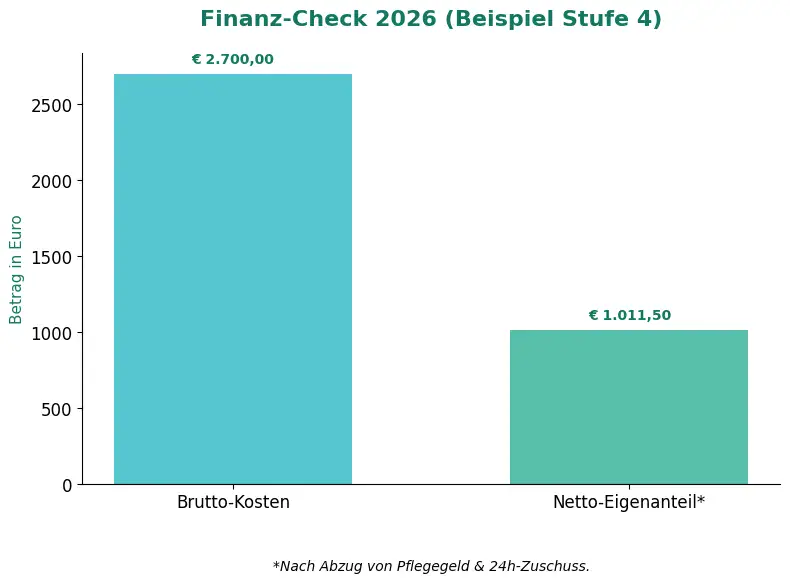
- Gross costs: approx. 2,700 euros
- Less care allowance (Level 4): – 888.50 euros
- Less state subsidy:* – 800.00 euros
- Your effective out-of-pocket share: approx. 1,011.50 euros
*You receive the state subsidy of up to 800 euros for two self-employed caregivers per month from care level 3 onwards, provided that the net income of your relative does not exceed 2,500 euros.
Costs for 24-hour care: What is included?
If you are holding an invoice for 24-hour care in your hands for the first time, the sheer number of line items can be confusing at first. So that you know exactly what you are paying for and where hidden costs may still be lurking, we break it all down for you.
In 2026, the package consists of three main areas:
1. The fee and social contributions
The core of the costs is the fee for your caregivers.
- What you pay: The daily rate for the work on site (household, companionship, support with personal hygiene).
- Professionally important: Since caregivers are usually self-employed, this fee also covers social insurance contributions (SVS) and the Chamber of Commerce levy. Check whether your offer already lists these items as an “inclusive fee.”
2. Travel costs and travel expenses
Since two caregivers usually alternate every two to four weeks, travel costs arise.
- Transportation: In most cases, specialized transport services organize the arrival and departure directly to your doorstep.
- The costs: Plan for between 50 and 350 euros per month in 2026, depending on the country of origin and your place of residence in Austria. You often pay these costs directly to the driver or the caregiver.
3. Accommodation and meals (“benefit in kind”)
This is a point that many people underestimate: The caregiver lives with you or your relative.
- Board & lodging: You provide a private lockable room with a window as well as shared use of the bathroom and kitchen.
- Meals: The caregiver eats with you as normal. These “benefits in kind” are part of the agreement. Legally, this is what is known as a benefit in kind that supplements the cash wage.
4. The agency flat fee (if applicable)
If you use an agency, you pay for its service. This includes:
- Organization: Selecting caregivers, replacement in case of illness or vacation.
- Quality assurance: Regular visits by qualified nursing staff.
- Bureaucracy: Support with applying for the state subsidy

At first glance, the costs of round-the-clock care often seem like an insurmountable wall. But in Austria, you do not have to walk this path alone. There is a financial safety net that is stronger than ever in 2026. If you submit the right applications, you can get your monthly burden reduced by almost half.
Here you can find out which pots of money are available to you and how to tap into them.
The care allowance: Your monthly foundation
The care allowance is the most important contribution. In 2026, it is automatically adjusted for inflation (valorized) so that you can afford the help your relative needs.
Source: pv.at/web/pflegegeld
Important: The care allowance is paid out net 12 times a year (without deductions). It is also independent of your income or assets. You are entitled to it as soon as the need for care has been medically established.
The subsidy for 24-hour care
In addition to the care allowance, there is a special subsidy for 24-hour care from the Social Ministry Service. This is essentially the "turbo" for your financing.
“If the person in need of care must be cared for around the clock, receives care allowance under Austrian legal provisions from level 3 onward, and their monthly net income does not exceed 2,500 euros, they are entitled to a subsidy—provided the other requirements are also met.” – oesterreich.gv.at
How much is the subsidy?
Employment of self-employed caregivers:
- 400 euros per month and caregiver
- maximum 800 euros per month (this corresponds to two caregivers)
Employment of employed caregivers:
- 800 euros per month and caregiver
- maximum 1,600 euros per month (this corresponds to two caregivers)
The family caregiver bonus
If you, as a close relative, also take intensive care of organization and caregiving, you are often entitled to the family caregiver bonus from care level 4 onward.
- Value in 2026: 134.30 euros per month.
- Requirement: Your own net income is below 1,710.90 euros per month.
Step by step: Your path to the money
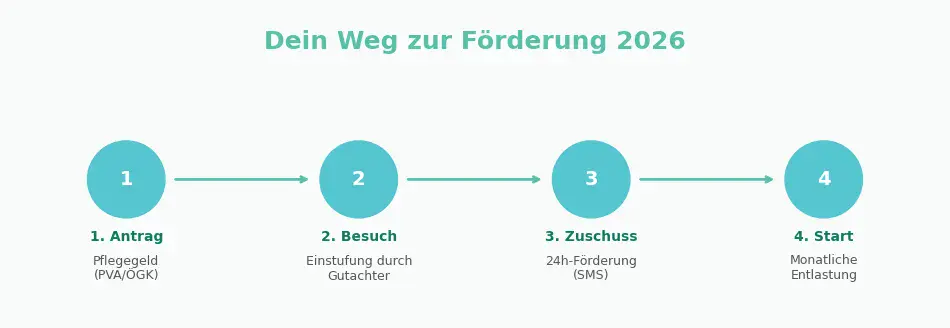
You do not have to be a bureaucracy expert to receive this help. Just follow this path:
- Care allowance application: You submit this to the responsible Pension Insurance Institution (PVA) or the ÖGK. An assessor will then come to your home.
- Subsidy application (24h subsidy): As soon as care level 3 (or higher) has been determined and the caregivers have been registered, you submit the application to the Social Ministry Service.
- Collect documents: Have the caregivers’ business licenses and fee invoices ready – this is your proof for the payout.
You can find details as well as step-by-step instructions for applying for care allowance in our article “Care Allowance Application Austria 2026”.]

Perhaps you imagine a caregiver standing watch around the clock—but the reality is much more human and structured. In Austria, this model is more like a “shared living arrangement for a limited time.” It is about stabilizing your loved one’s daily life where they feel most comfortable: in their own home.
The rhythm: The tandem principle
Care almost always works on a rotating basis. As a rule, two caregivers take turns caring for your relative. They usually stay in the household for two to four weeks at a time and then travel home to their own families for the same length of time. This ensures that there is always a rested and familiar person on site.
What exactly does the caregiver do all day?
The tasks are varied and adapt very flexibly to your relative’s routine. Professionally, they are divided into three areas:
- Household-related services: Cooking (fresh meals are the centerpiece!), shopping, cleaning the living spaces, doing laundry, and caring for houseplants or pets.
- Support in daily life (life management): Help with getting up and going to bed, assistance with dressing and undressing, as well as personal hygiene (washing, showering, combing).
- Companionship & activation: This is the emotional part. Playing cards together, taking walks, reading aloud, or simply listening over a cup of coffee. The caregiver is often the most important bridge against loneliness.
The structure: Closeness with personal space
To make living together work, the service is clearly structured:
The goal: “At home instead of in a home”
24-hour care at home structures the chaos that often arises when age or illness takes over everyday life. It gives your relative security and gives you the precious feeling that someone is there who can react immediately in an emergency.
If you are looking for support for your home, you face a choice: do you want to keep control yourself or rely on rigid structures? In Austria, there are essentially two paths today, although modern approaches are becoming increasingly important.

The placement platform noracares: Your direct connection
The most modern way to find suitable care leads through specialized platforms such as noracares. Instead of waiting to see whom an agency “assigns” to you, here you make the decision yourself.
- Maximum choice & transparency: You have direct access to profiles of self-employed caregivers. You can see qualifications, experience, and reviews at a glance.
- Cost efficiency: Because you contact the caregivers directly, the often high recurring monthly agency fees are eliminated. The money goes where the work is done.
- Self-determination: You decide who is the best personal fit for your family. noracares provides the legally secure framework and the right tools for this, without placing itself in a patronizing way between you and the caregiver.
Traditional placement agencies
Agencies act as traditional intermediaries. They handle the selection for you, which may sound convenient, but is often associated with disadvantages:
- Little say: Often, you have hardly any influence over which caregiver is sent—you have to take whoever is currently available.
- High ongoing costs: For their placement services, agencies usually charge hefty monthly fees that burden your budget year after year, even when care is already running smoothly.
Non-profit organizations
Large associations also offer care, but they are often tied to very inflexible procedures and rigid price lists. The personal touch and the individual selection of a caregiver who truly becomes like a family member often fall by the wayside here.

When it comes to the best possible care for your loved ones, noracares is the reliable partner by your side. As a platform for connecting qualified caregivers, noracares offers a simple and transparent way to find the right support for 24-hour care. With a network of experienced and vetted caregivers, noracares ensures that your relatives are well cared for around the clock.
Advantages of using noracares
Care means responsibility—and this is often associated with major challenges. noracares offers you innovative solutions that address exactly where you need support. Whether quick placement, tailored care, or noticeable relief: with noracares, you secure reliable support that is oriented to your needs. You benefit from the following advantages:
Choose caregivers yourself
At noracares, you can choose the caregivers who truly fit you and your family. You can get to know the caregiver personally in advance and then decide for yourself whom you let into your life.
Transparent costs
No hidden costs, no nasty surprises—noracares offers you a clear and transparent pricing structure so that you know exactly what to expect. Prices are not influenced by an agency, but agreed upon between caregivers and families.
Individual care
At noracares, we place special emphasis on ensuring that care is tailored to the individual needs of your relatives. You can choose the caregiver not only according to professional qualifications, but also according to the specific requirements and wishes of your family. This ensures that your loved ones receive the best possible and most personal care support.
Trustworthy care
We know how important trust is in care. noracares ensures that you can always feel safe, as all caregivers are carefully vetted and regularly monitored with regard to their qualifications. Our caregivers are not only professionally skilled, but also empathetic and respectful in their dealings with the people they care for.
Care with quality you can count on
We connect you with caregivers who have heart and brains, with the proper execution of every care activity at the center. From daily support to complex care, everything is planned and implemented with the utmost care. This way, you can be sure that your loved ones are in the best hands and that care is provided exactly as their individual needs require.
Your result: Mostly A? You are the perfect type for self-determined direct placement. With noracares, you keep full control while saving real money.
With noracares, you not only find the right caregiver, but also the best possible way to support your loved ones. Our platform makes it easy for you to find the right caregiver – no matter what requirements you have. noracares supports you every step of the way so that you can ensure the best possible care for your relatives

Are you considering working as a personal caregiver in Austria? This is a responsible role that is highly appreciated. So that you feel confident and know what matters, we have summarized the most important key points for your daily professional life in 2026 here.
Your legal status: Self-employment
In Austria, you generally work as a self-employed personal caregiver. This means:
- Trade license: You have an Austrian trade license for personal care.
- Insurance: You are insured through SVS (Social Insurance for the Self-Employed) for health, accident, and pension coverage.
- Freedom: You are not bound by instructions like an employee, but instead enter into a service contract with the person receiving care. Platforms like noracares help you connect directly with families and negotiate fair conditions.
Your competencies: What you are allowed to do (and what you are not)
Your role is caregiving, not medical nursing. The Home Care Act clearly defines your tasks:
- Everyday support: Support with eating, dressing, personal hygiene, and household management.
- Medical tasks: Activities such as administering medication, changing dressings, or giving insulin injections may only be carried out if you have received written instructions and training from a doctor or a qualified nursing professional. This is for your own safety!
Your protection: Time off and accommodation
The law is there for you too! According to the Home Care Act, you are entitled to adequate breaks, your own lockable living space, and free meals in the household. Since you usually work in a 2- to 4-week rhythm, a clear separation between working time and your well-deserved free time back home is important for your long-term health.

In Austria, 24-hour care is not a legal gray area, but has been clearly regulated since 2007 by the Home Care Act (HBeG). This law is your shield, because it defines exactly what is permitted and which obligations you as the client and the caregiver have.
The care contract: The foundation
Every care arrangement must be based on a written contract. If you find a caregiver through noracares, you conclude a so-called service contract with them. The following points must be included:
- Type and scope of services: What exactly is to be done? (e.g. household management, support with daily living).
- Start and duration: When does the care start and what do the notice periods look like?
- Guidelines for action: Clear instructions for everyday situations and emergencies.
Rights and responsibilities
The law ensures that both sides are treated well:
- For the caregiver: They are entitled to dignified accommodation (their own room!) and meals. In addition, their free time must be arranged in such a way that they can recover (rest periods).
- For you/your relative: You have the right to careful performance of the agreed services. The caregiver is obliged to summon help in an emergency and report any deterioration in condition immediately.
The delegation of care-related tasks
A critical point in the law: caregivers are not nurses. However, they may take on individual nursing or medical tasks if:
- It is an individual case (only for your relative).
- A doctor or a qualified nurse has expressly instructed the caregiver.
- The task has been ordered in writing.
Reporting obligations and transparency
The caregiver must register their trade with the competent district authority or municipal office. Reputable platforms like noracares make sure that only caregivers with an active trade license are placed. In addition, there is a legal obligation for documentation: The caregiver must keep a diary that you can review at any time.

The decision to organize 24-hour care for your relative is not easy. You have many questions – What does 24-hour care cost? How do I apply for care allowance? What funding is available? We hope that this article has given you the most important information to help you make this important decision.
Remember: You are not alone on this path. Care allowance and financial support can cover a significant part of the costs, and there are many reliable providers who can help you choose the best caregiver for your needs. It is important to make the right choice so that your relative can live in familiar surroundings and with the best support.
If you are now ready to take the next step, our care cost calculator will help you estimate the approximate costs of 24-hour care and find a suitable provider. Or you can contact a professional provider directly who offers exactly the help you need.
Trust that you are making the best decision for your relative – with the right information and support, you can ensure that he or she receives the care they deserve.
Register with noracares today and find the right caregiver for your loved ones.


-
24-hour subsidy: A state subsidy from the Social Ministry Service of up to 1,600 euros per month (with two self-employed caregivers), which is paid in addition to the care allowance.
- Family caregiver bonus: Financial support for people who care for close relatives at home from care level 4 onward and have a low personal income.
- Care log: Daily documentation in which the caregiver records important details such as fluid intake, medication administration, and well-being.
- Delegation: The legal permission for caregivers to take on simple medical tasks (e.g. changing dressings) after medical instruction.
- Home Care Act (HBeG): The legal framework in Austria that has precisely regulated the conditions for 24-hour care since 2007.
- Fee: The agreed payment for the caregiver (daily rate), which generally also covers the costs of their social insurance.
- noracares: The modern placement platform that directly, transparently, and without high agency fees brings families and caregivers together.
- Personal care: The official technical term for the trade of 24-hour assistance, which includes household and everyday support.
- Care allowance: A monthly, income-independent state benefit (levels 1–7) to cover the costs of necessary care.
- On-call availability: The time during which the caregiver is present in the house in order to provide immediate help if needed, without working actively all the time.
- Benefit in kind: The provision of meals and a private room, which is considered part of the compensation for the care work.
- SVS: The "Social Insurance for the Self-Employed," with which caregivers in Austria are insured for pension, health, and accident protection.
- Valorization: The annual adjustment of the care allowance to inflation so that the financial support retains its value.
- Service contract: The legal link between you and the caregiver that bindingly defines tasks, working hours, and payment.

