Earn more money in nursing - Your path to self-employment

You work hard, take responsibility, step in when there are shortages – and yet your income often feels capped. Maybe you ask yourself: Is this all there is? Or are there ways to earn significantly more in nursing?
The honest answer: Yes, it is possible – but not automatically. To earn significantly more in nursing in 2026, you need to increase your market value through specialization, use surcharges strategically, or take the step into self-employment. At a time of massive skilled labor shortages, you have more levers in your hands than ever before.
Anyone who wants to earn more does not need lucky breaks, but strategy. Whether specialization, smart shift planning, leadership roles, or the full autonomy of self-employment – there are concrete ways to noticeably increase your income.
In this guide, we show you step by step which levers really work – and why self-employment via platforms like noracares is now the most lucrative path for many experienced caregivers.
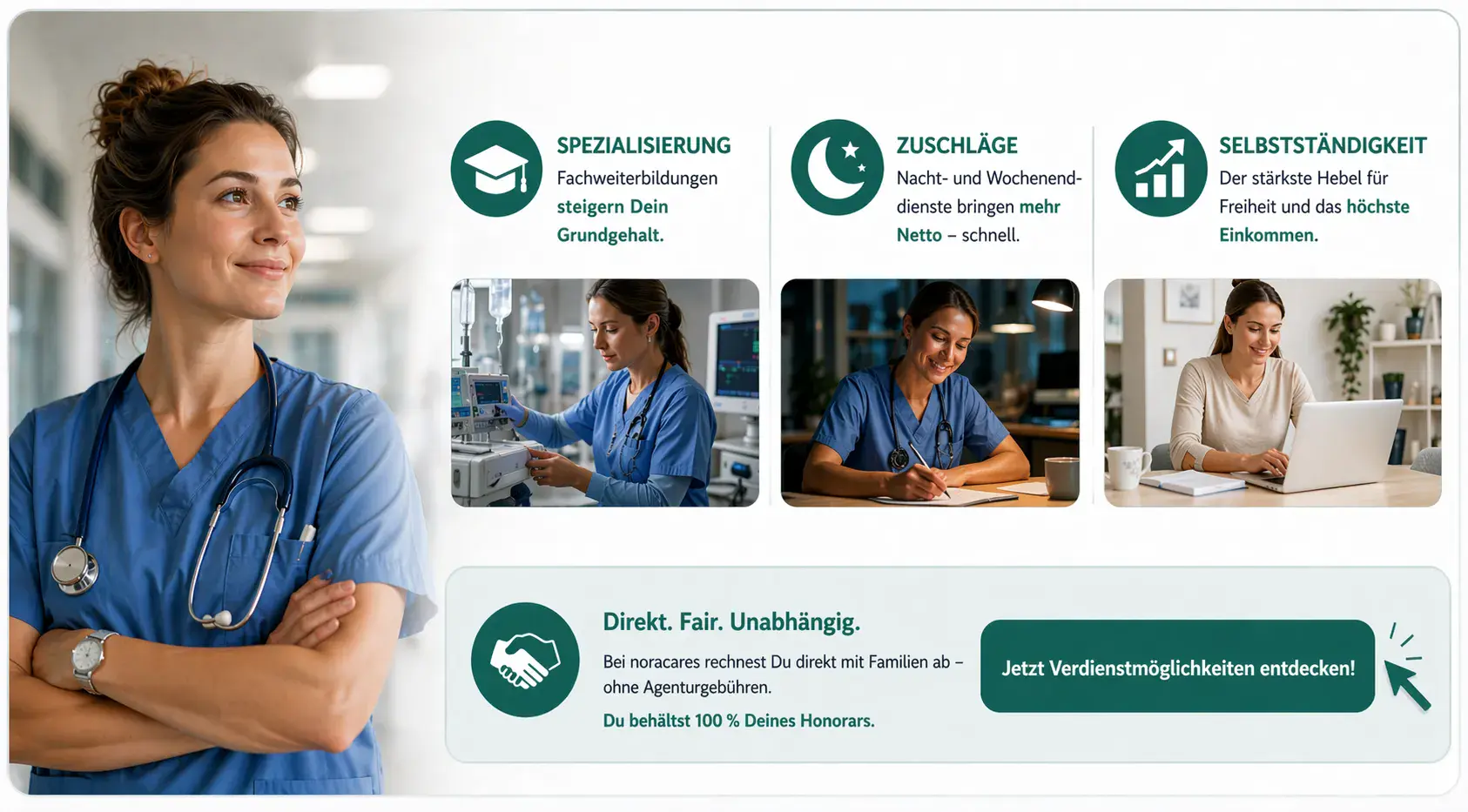
TL;DR – The most important points at a glance:
- Specialization: Advanced professional training (e.g. intensive care/anesthesia) is the foundation for a significantly higher base salary.
- Surcharges: Strategic night and weekend shifts are the fastest way to increase your monthly net income.
- Self-employment: The strongest lever for maximum freedom and the highest income. Through direct billing without agency fees, you keep 100% of your fee.
Curious what noracares offers for self-employed caregivers? Discover how you can connect directly with families and shape your income without deductions – transparently, fairly, and completely independently.
Before we go into the details: here is your strategic overview of all the ways to increase your income – and how they differ in potential, risk, and speed.
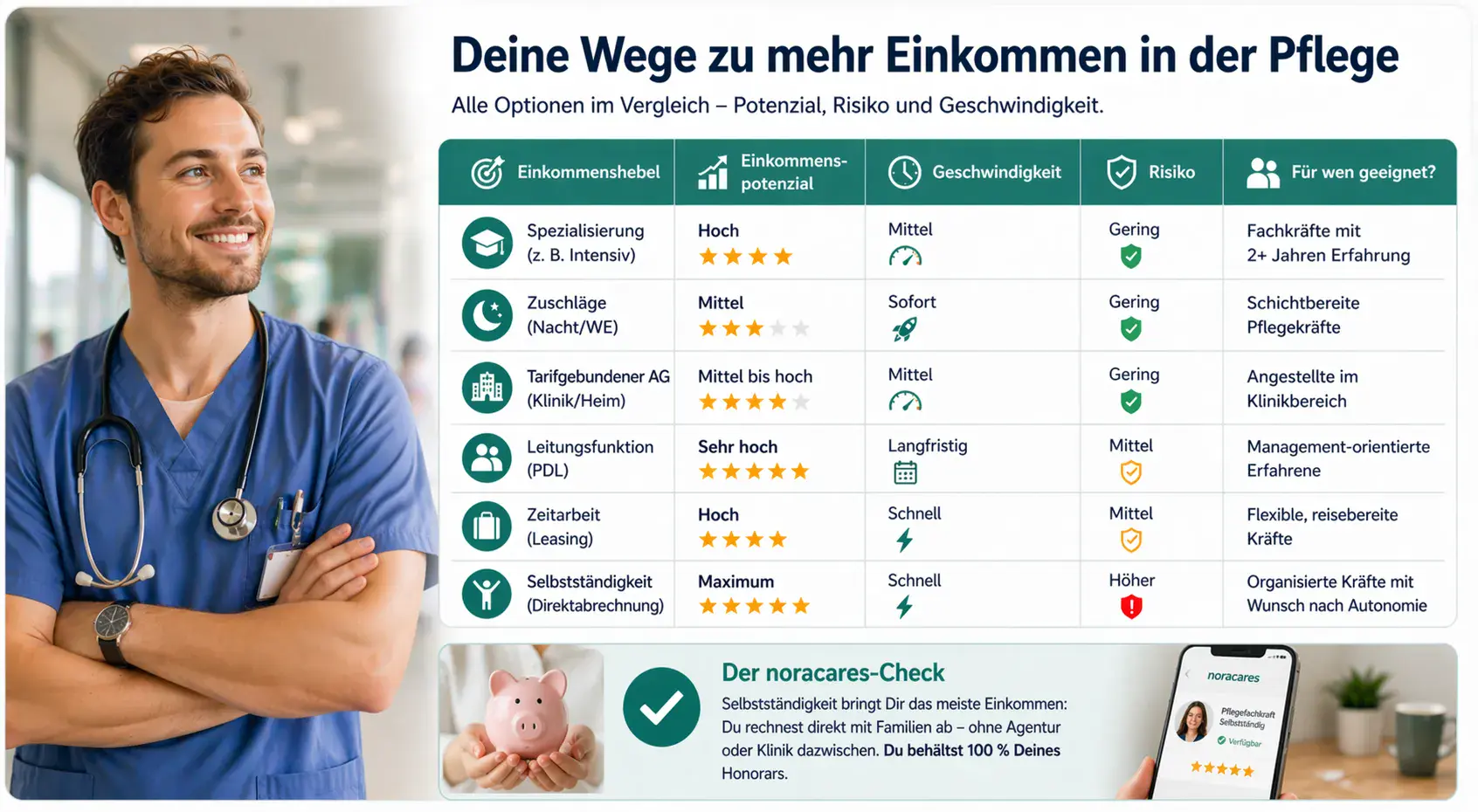
Strategic comparison of income levers (as of 2026)
(Sources: Based on TVöD-P, SWÖ-KV 2026 & WKO guidelines)
The noracares check:
Self-employment is at the very top of this list – and for one simple reason: it is the only path where no middleman (neither a clinic administration nor a traditional agency) stands between you and your full earnings. In self-employment through noracares, you keep the full fee for your valuable work.
Not all nursing sectors pay equally. The higher the responsibility, the required specialist knowledge, and the flexibility, the higher the earnings. In the current market situation of 2026, salaries have risen noticeably due to the latest collective pay adjustments (TVöD-P and SWÖ-KV).
Earning potential by nursing field (DACH region 2026)
(Sources: estimated values based on TVöD-P & SWÖ-KV as of April 2026)
Austria vs. Germany:
While gross salaries in Germany often appear higher, Austria scores with the 13th and 14th salary payments (vacation and Christmas bonuses). However, the decisive lever remains the same: as a self-employed caregiver on noracares, you bill directly. You no longer exchange time for a fixed salary, but offer your expertise at your own fee.
Intensive care – highly paid, but structurally limited
In 2026, intensive care remains one of the best-paid employed sectors. But despite a gross salary often exceeding €4,600, one problem remains: you are tied to rigid clinical hierarchies and shift schedules that leave little room for self-determination.
Leadership roles – the maximum within the employed model
Advancing to ward manager or director of nursing services (PDL) is financially lucrative, but often a marathon. It requires years of experience and usually part-time study alongside work.
More qualifications = more salary – and higher fees as a self-employed professional
In nursing, 2026 more than ever proves: those who pursue further training invest directly in their bank account. For self-employed caregivers, specializations are even the decisive competitive advantage. They enable you to demand significantly higher fees and to be found specifically by families who are desperately searching for exactly your expertise.
Caregivers with a recognized specialization (e.g. dementia care or wound management) earn on average 15% to 20% more than colleagues without additional qualifications.
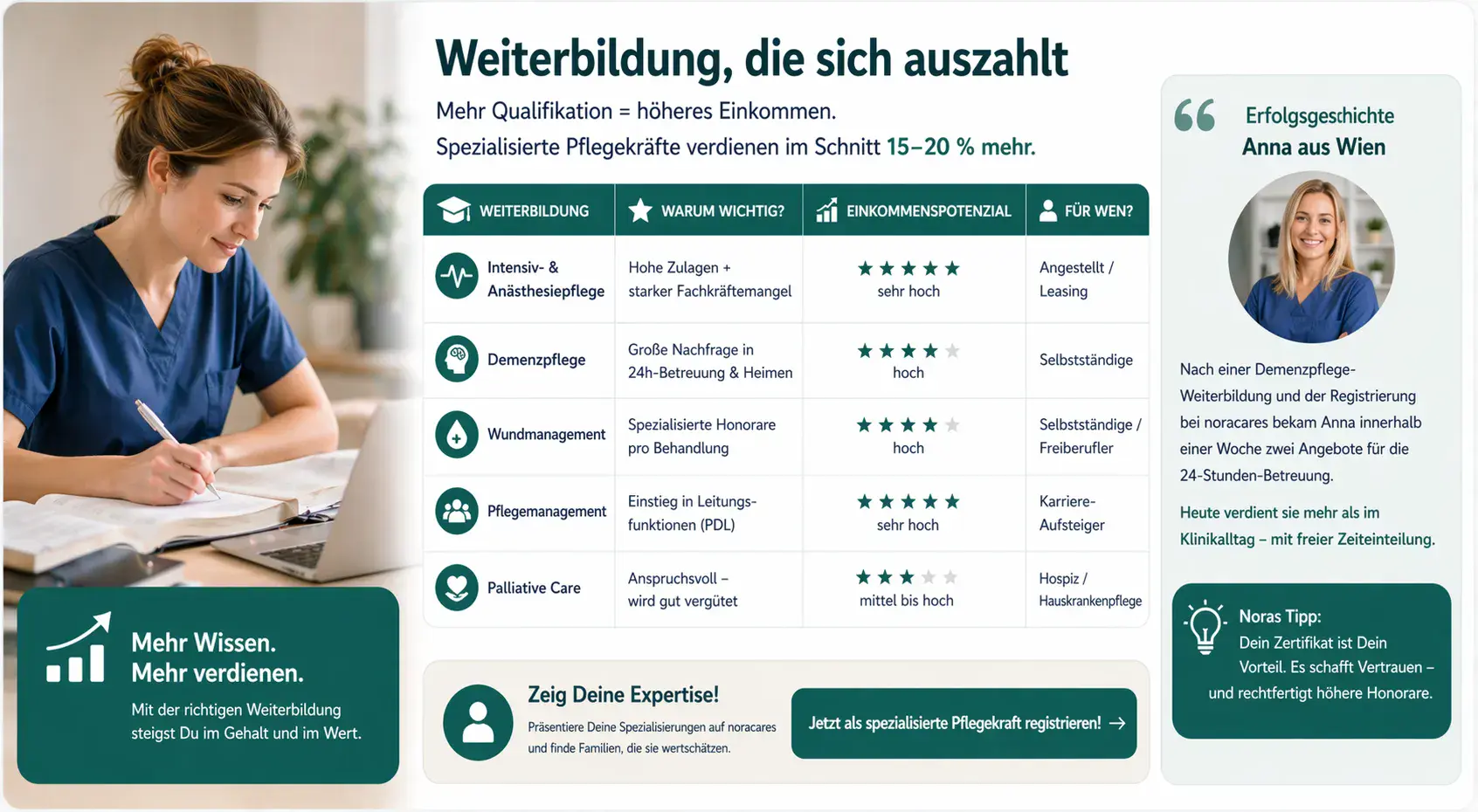
Further training with the greatest financial leverage (as of 2026)
(Information on current courses in 2026 can be found at gesundheit.gv.at or at the ÖGKV)
Ready to increase your market value as an expert?
Let your certificates work for you. Register on noracares, present your specializations, and find families who value your professional expertise and compensate it fairly.
Case study: Anna from Vienna
Anna, a qualified nurse from Vienna, felt financially "capped" after two years in everyday ward work. She decided to complete certified further training in the field of dementia care.
Just six months after completing it, everything changed: She registered with noracares using her new qualification. By proving her expertise, she was approached by two families within the first week for specialized 24-hour care. Today, Anna works independently and earns a fee that is significantly higher than her old clinic salary – with full control over her working hours.
If you work in care, flexibility is your most valuable currency. In Austria and Germany, bonuses for night, weekend, and holiday shifts are the fastest way to massively increase your monthly net income without negotiating a salary.
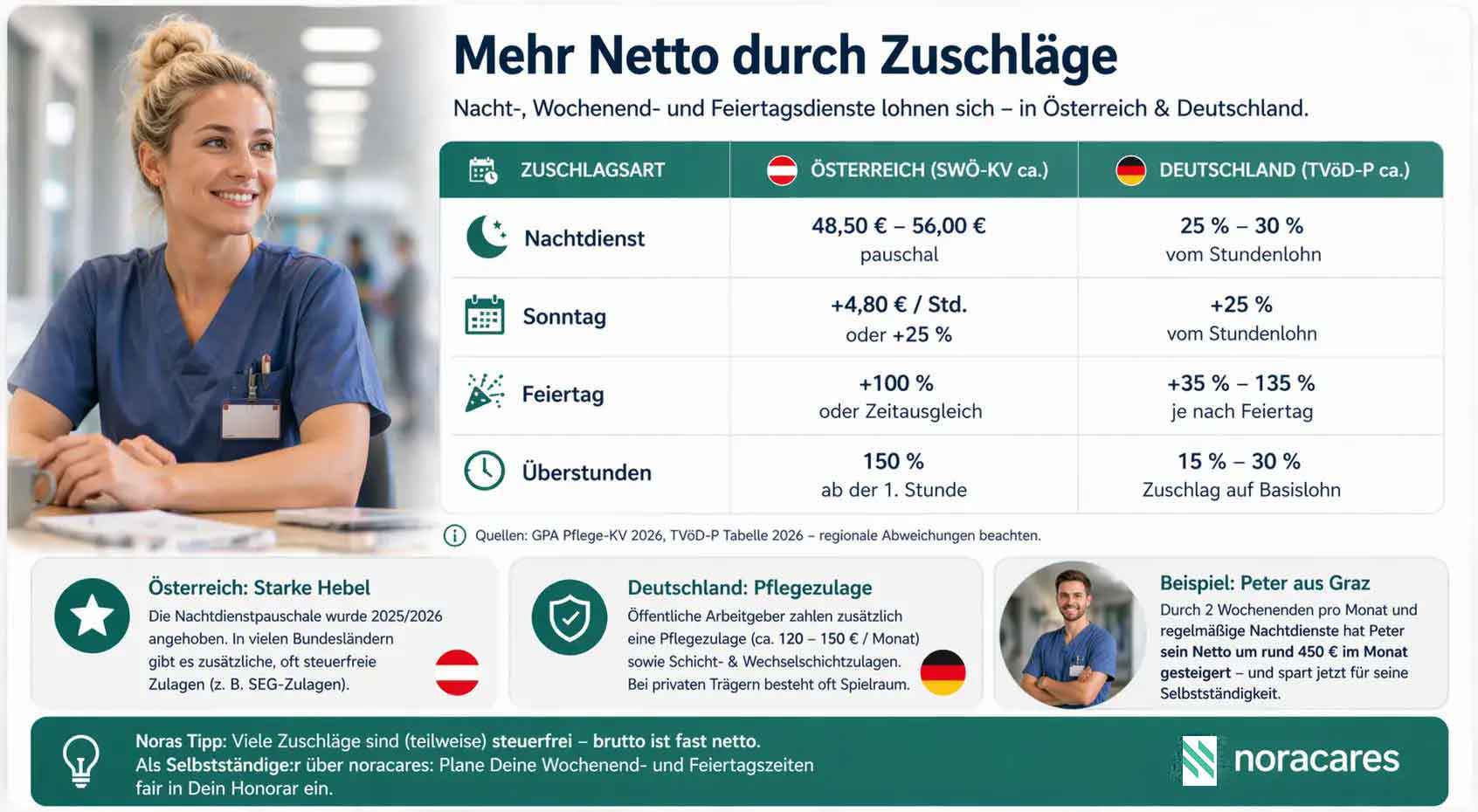
Which bonuses apply in April 2026?
(Sources: GPA Care CBA 2026, TVöD-P Nursing table 2026. Please note regional in-house agreements.)
Austria: The SWÖ-CBA as a benchmark
In Austria, bonuses were significantly increased as part of the latest collective bargaining negotiations for 2025/2026. The flat-rate night shift bonus in particular is a powerful lever. Important: In many federal states (e.g. Upper Austria or Vienna), there are additional allowances for "difficult working conditions" (SEG allowances), which are tax-free or tax-advantaged.
Germany: TVöD-P and the nursing allowance
In Germany, caregivers in the public sector benefit from the monthly nursing allowance (approx. 120 € - 150 €) as well as the shift and rotating shift allowance. Although private providers have been required to pay in line with collective agreements since 2022, there is often still room for improvement in variable bonuses.
Case study: Peter from Graz
Peter, a qualified health and nurse (DGKP) from Graz, optimized his duty roster strategically. By focusing on two weekends a month and regular night shifts, he was able to increase his net salary by around 450 €. He now uses this money to prepare for self-employment – without dipping into his savings.
This is the decisive leverage point of this guide. While bonuses and specializations increase your income in employment, there is always an institution between you and the money you have earned: the employer or the placement agency.
As a self-employed caregiver, this middleman no longer applies. Through noracares, you bill families directly – transparently, fairly, and on your own terms. You are no longer a number on the duty roster, but a valued partner of the family.
Employed vs. self-employed: The direct comparison
The decisive difference: In traditional 24-hour care, agencies often keep up to 40 % of the amount paid by the customer as a "fee." As a self-employed caregiver on noracares, that share belongs to you.
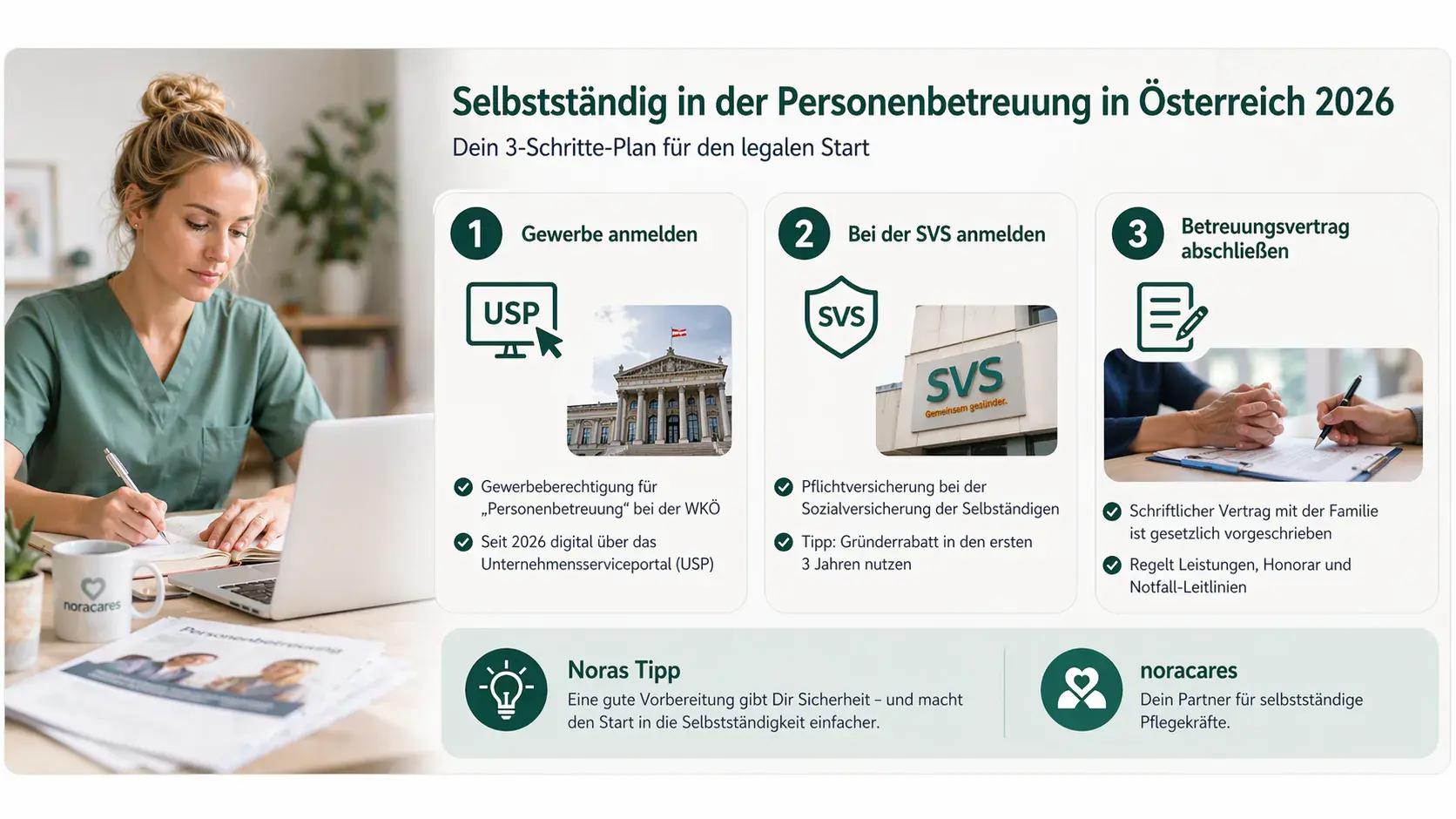
What you legally need – Austria 2026
To get started legally in Austria as a self-employed personal caregiver, the following steps are necessary:
- Business registration: You can obtain the trade license for “personal care” from the Chamber of Commerce (WKÖ). Since 2026, this has been possible almost everywhere digitally via the Business Service Portal (USP).
- SVS registration: As a self-employed person, you are mandatorily insured with the Social Insurance for the Self-Employed. Tip: The minimum contribution base for 2026 has been adjusted – find out about the "founder discount" in the first three years.
- Care contract: A written contract with the family is required by law. It governs services, fees, and action guidelines for emergencies.
What you legally need – Germany 2026
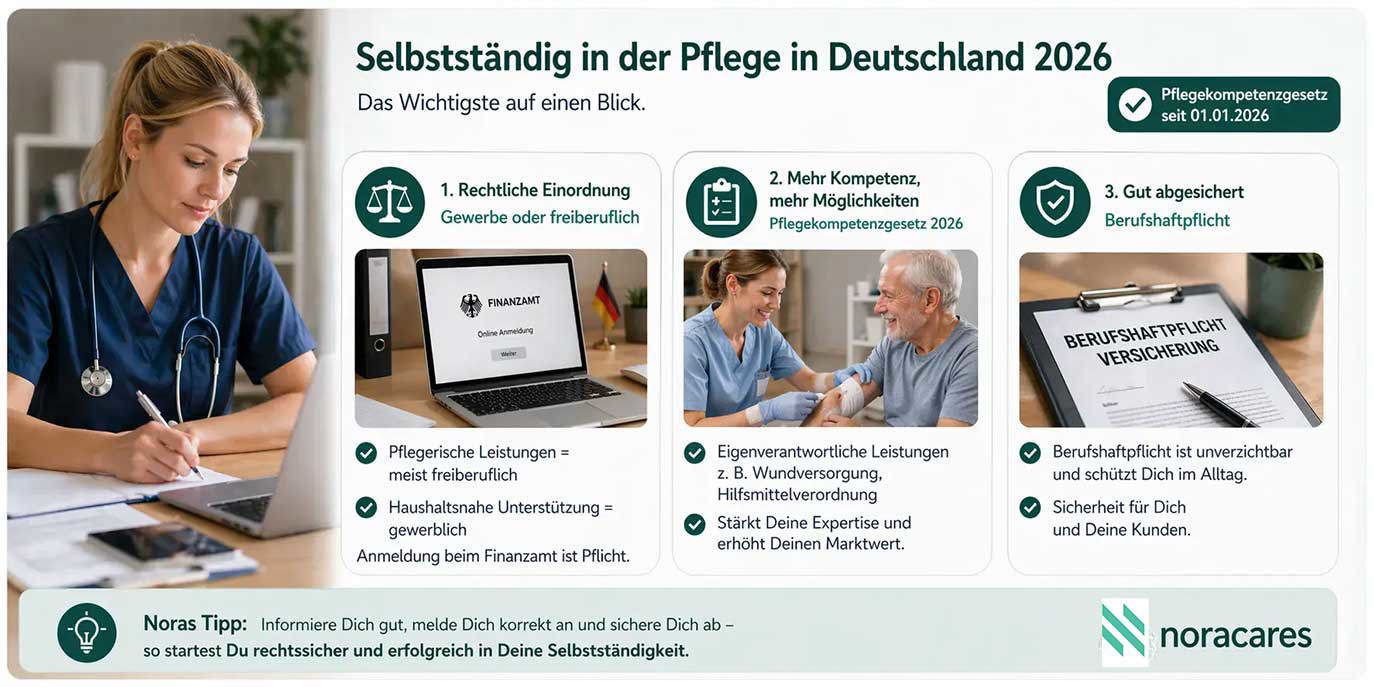
In Germany, the Nursing Competence Act (since 01.01.2026) has strengthened the role of self-employed professionals:
- Business vs. freelance professional: Nursing activities are often freelance, while purely household support is commercial. Registration with the tax office is mandatory in any case.
- Nursing Competence Act 2026: You may now provide certain services independently (e.g. wound care, prescription of medical aids) based on your nursing diagnosis. This greatly increases your market value as a self-employed professional!
- Insurance: Professional liability insurance is essential for self-employed people in Germany and protects you in your everyday professional life.
Tax advantages: More net from gross
As a self-employed person, you only pay taxes on your profit, not on your revenue. You can deduct many expenses for tax purposes:
- Further training: Every specialist certificate reduces your tax burden.
- Mobility: Travel costs to the place of assignment or a proportional mileage allowance.
- Work equipment: From professional clothing to the tablet for documentation.
- Home office: The portion of your home that you use for administration can often also be deducted.
Would you like to bill families directly – without an agency, without detours? noracares is the platform where you can realize your independence. Create your profile in just a few minutes, present your expertise, and determine your fee yourself from now on.
Not every path is the right one for every phase of life. While one person needs security, another seeks maximum autonomy. This table helps you find your personal income strategy for 2026.
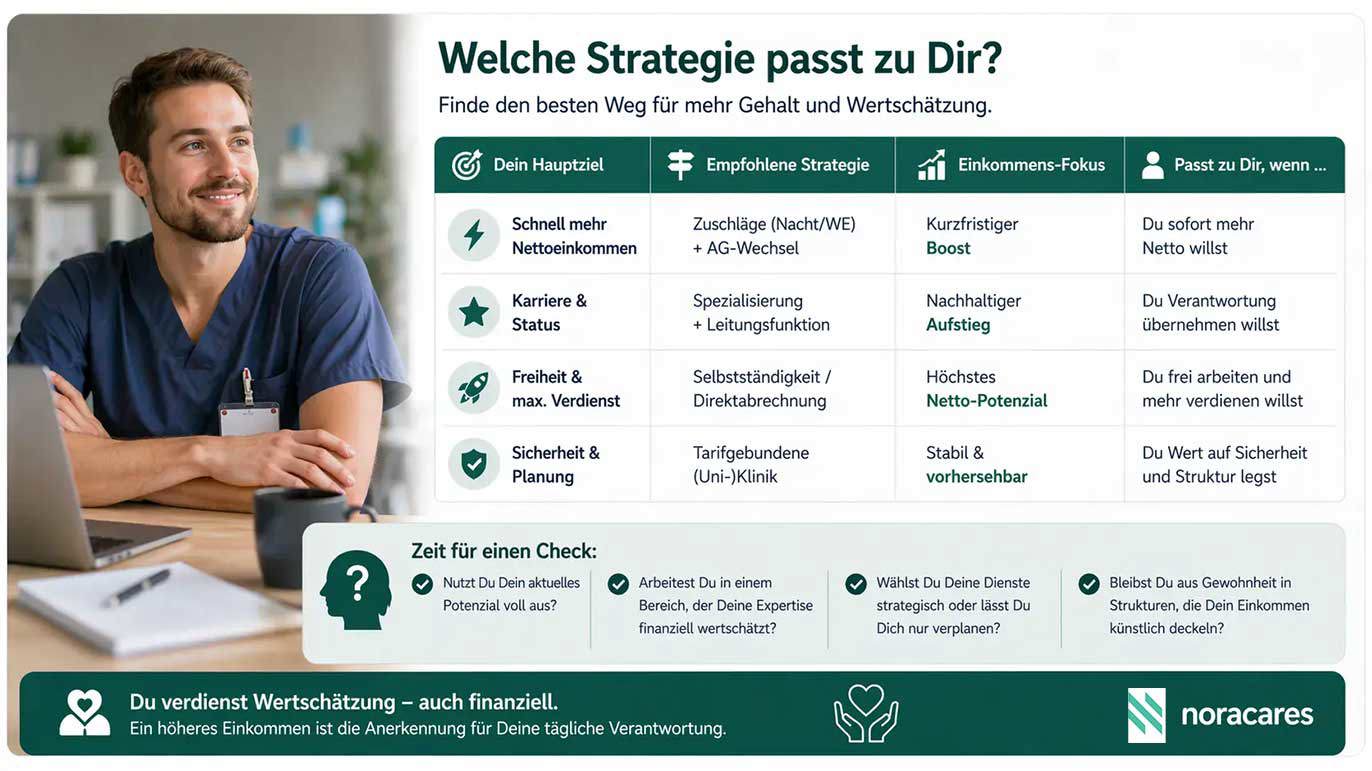
Your roadmap to more salary & appreciation
Time for an honest assessment
Ask yourself, based on this table, quite honestly:
- Are you really using your current potential to the fullest?
- Are you working in a field that also financially values your expertise?
- Do you choose your shifts strategically or do you just let yourself be “scheduled”?
- Or do you stay in structures out of habit that artificially cap your income?
Healthcare needs you in 2026 more than ever. But you may – and must – also think about yourself. A higher income is not selfishness. It is the necessary appreciation for your daily responsibility, your psychological burden, and your professional competence.

Your expertise is your capital! Your income in 2026 is more than ever in your own hands. Working in healthcare long meant giving more than you receive financially. But that is not a law of nature.
Whether through targeted further training, the strategic use of bonuses or the courageous step into self-employment – you actively decide your market value and your future. The most successful caregivers have one thing in common: they stopped waiting for better pay scales and started shaping their careers strategically themselves.
Self-employment may not be for everyone – but for experienced, organized professionals who are ready to take responsibility for their own “business,” it is the most effective path to maximum earnings and true autonomy.
At noracares you will find the infrastructure that supports you: direct connection to families, transparent conditions, and the end of dependency on middlemen. Become your own boss – families out there are waiting for someone with your expertise.
Ready for the next step toward more freedom and income? Register now for free with noracares, create your individual profile, and start your self-employed career – directly with families, on equal footing and without agency fees.


- Earn money with nursing – The targeted development of a higher income in the nursing profession through specialization, bonuses, employer choice, or self-employment.
- Self-employed caregiver –Caregiver who is not employed but works on their own account and bills directly with families or institutions.
- 24-hour care – Care model in which the caregiver lives in the household of the person in need of care and is available around the clock.
- Trade license (AT) –Legal requirement for self-employed caregivers in Austria, issued by the Chamber of Commerce (WKO).
- SWÖ-CBA –Collective agreement of the social economy in Austria, which regulates salaries and bonuses for caregivers in Austria.
- TVöD-P –Collective agreement for public service in the nursing sector in Germany. Basis for salaries, bonuses, and working hours in the public healthcare system.
- Direct billing – Billing of fees directly between caregiver and family – without an agency or institution as an intermediary.
- Further training / specialization –Additional qualifications such as dementia care, intensive care, or care management that increase income potential.
- Bonuses –Additional payments for night, weekend, or holiday shifts, regulated in collective and tariff agreements.
- SVS –Social insurance for the self-employed in Austria – responsible for health, accident, and pension insurance of self-employed caregivers.

