Care in Vienna: How to find the best care for your relatives

Imagine your loved ones receiving exactly the care they need – compassionate, professional, and in the place where they feel most comfortable. Whether mobile care, day care, or 24-hour care – Vienna offers many options. But which one is the right one? Find out how noracares helps you find the best support!

The search for the right care in Vienna can be overwhelming and emotionally stressful – whether you are currently dealing with an acute situation or planning long term. Between day care, 24-hour care, and mobile services, many questions arise: What is the best solution? What costs will I face? And how do I overcome the bureaucratic hurdles?
This guide not only gives you a clear overview and objective comparisons, but also the confidence to make the right decision for your loved ones.
After this article, you will know exactly:
- What types of care are available in Vienna and which one suits you.
- How much care costs and which subsidies you are entitled to.
- How to find available places and bridge waiting times smartly.
- Who helps you locally and how you can immediately find the right support with noracares.
Keeping track:
Which care is right for your family? The selection in Vienna is large, but every situation is unique. Use noracares to compare profiles without obligation and get a feel for the support available in your district.

Anna is facing a decision that is keeping her awake at night. Her mother Celeste, once full of energy, now needs support in everyday life. Anna lives in Meidling, while her mother Celeste still lives in her apartment in Leopoldstadt. The distance across the Danube Canal makes daily support difficult for Anna alongside her job.
But what is the best solution? Care at home so that Celeste can remain in her familiar surroundings? Or a care facility where someone is there for her around the clock?
Care in Vienna means far more than just support in everyday life – it is about quality of life, dignity, and the good feeling of making the right decision. But with all the options available, choosing can become a challenge. What types of care are there? What advantages do inpatient facilities have, and when is outpatient care the better choice?
Types of care in Vienna – From day care to 24-hour care
Anna starts researching and quickly comes across the different care options in Vienna. She realizes that there are not only inpatient nursing homes, but also many flexible solutions for home care.
- Day care: Here, Celeste can be cared for during the day while Anna works – a relief for both.
- Mobile care: Professional nurses and caregivers come to the home and help with personal hygiene, administering medication, and household tasks.
- Assisted living: A mix of independence and support if Celeste can no longer live alone in her apartment.
- 24-hour care: A caregiver lives with Maria and takes care of her around the clock.
- Specialized care (e.g. dementia care): Specialized care facilities or trained caregivers specifically look after people with special needs such as dementia or chronic illnesses.
Each of these options has its advantages and disadvantages. But which one is the best for Celeste’s needs?
Care facilities vs. outpatient care – What is best for you?
Anna wonders what the right choice is for her mother. On the one hand, she wants Celeste to be able to stay in her home – where memories of happy years are still alive. On the other hand, she knows that a care facility can often offer more structure and support. She is torn and decides to make a comparison of the advantages and disadvantages of both options:
Anna realizes: There is no universal answer. Every family must weigh up individually which factors matter most to them and which type of care fits best. For Anna, however, one thing is clear: she does not want to tear her mother away from her beloved surroundings. That is why she decides on home care.
In Vienna, you can choose between different care paths. Often, a combination of several providers is the best solution for your relatives.
Anyone looking for a place in a municipal or subsidized nursing home in Vienna at short notice often needs patience. Demand is high, and allocation is handled by the Vienna Social Fund (FSW) based on urgency.
How long are the waiting times in Vienna?
There is no general "waiting list" that is simply processed one by one. Instead, the principle of urgency applies:
- Acute cases: If care at home is absolutely no longer possible (e.g. after a hospital stay), an attempt is made to find a place within a few days or weeks.
- Regular search: Anyone who registers "as a precaution" or with a lower care level must expect waiting times of several months to over a year, especially at popular homes in districts such as Hietzing or Döbling.
Where can I find available places?
Availability changes daily. To get an overview, there are two main ways:
- FSW customer service: The central point of contact for all subsidized places.
- Private providers: Private nursing homes or residences often have shorter waiting times, but are significantly more expensive without subsidies.
The solution for long waiting times: Home-based alternatives
If the waiting time for a nursing home is too long or bureaucratic hurdles are holding you back, mobile care or 24-hour care offers the perfect bridge solution – or even a permanent alternative.
The advantage: While you wait for a care home place, a caregiver from noracares can often start at your home within 24 to 48 hours. This spares your relative the stress of moving, and care is secured immediately.
For Anna, the moment when she realized how expensive care for her mother Celeste could become was a real shock. It felt as though the costs kept rising with every decision she made.
But Anna knew that she had to find the best possible care for Celeste – and that meant dealing with the financial aspects. How much would the care cost? And what financing options were there to help bear the burden?
So that you can get an idea of all the options and their costs, we have summarized average values for you:
Keep in mind that the costs depend on the individual circumstances as well as the care provider. The costs stated are for guidance only.
How you save money: noracares direct advantage
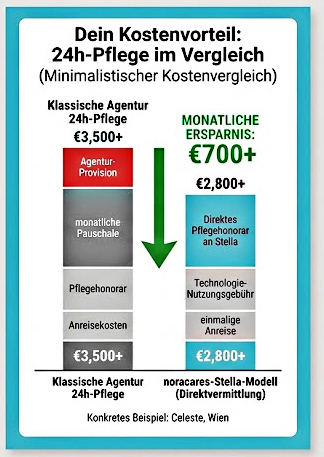
Anna knows that with care level 2, her mother does not yet need 24-hour care in Vienna, but she definitely does need regular support in everyday life. Therefore, she decides on mobile care, which in Celeste's case offers the perfect balance between help and independence.
Financing care: These subsidies and grants are available
When Anna saw the costs of 24-hour care, she had to swallow hard. But there are some financing options she can consider.
Care allowance
In Vienna, there is particularly valuable support: the care allowance, which is paid out monthly and helps families organize the best possible care. Especially for people like Celeste, who rely on regular support, this care allowance can provide important relief.
The care allowance is staggered according to care needs and is based on the number of hours required for care:
Source: pv.at/web/pflegegeld
As Anna adds up the numbers on the calculator, she feels a lump in her throat. But when she sees that by combining the care allowance and the noracares advantage, the care remains affordable, a huge weight is lifted from her shoulders.
The care allowance is paid regardless of the family's income or assets. It can be used flexibly, for example to pay for caregivers, aids, or other necessary support services.
For Anna, the care allowance is valuable support that enables her to provide Celeste with the best possible care without constantly having to worry about the financial burden.
Subsidy for 24-hour care in Vienna
If your relatives have at least care allowance level 3 and 24-hour care is truly necessary, you can take advantage of a subsidy from the FSW or the subsidy for 24-hour care. Another criterion, however, is that the monthly net income of the person receiving care must be below 2,500 euros.
Amount of subsidy:
- Self-employed caregivers: 400 euros per month, maximum 800 euros for two people.
- Employed caregivers: 800 euros per month, maximum 1,600 euros for two people.
But it is not only the financial help that matters: caregivers must demonstrate a minimum qualification – either through training as a home helper or through at least six months of experience in care. This ensures that the caregiver looking after your relative is highly qualified and can provide professional care.
Subsidy for care aids
In Vienna, people in need of care who depend on aids such as wheelchairs, care beds, or shower chairs can apply for a subsidy for the purchase of these devices. The amount of the subsidy depends on individual needs and the aids required. Depending on the type of aid and the financial situation, up to 80 percent of the costs can be covered.
Bonus for caregiving relatives
The relatives bonus is important support for everyone who cares for family members at home who need care from level 4 onwards. It is intended to recognize the valuable work of caregiving relatives, who do a great deal every day.
In Vienna, there are two ways to receive the monthly bonus of 134,30 euros: if the person in need of care is self-insured or continues to be insured in the pension insurance due to the care, the bonus is paid automatically. Otherwise, you can apply for the bonus if your monthly net income in the last year was no more than 1.710,90 euros and you have mainly provided the care at home for at least one year.
Tax relief
Anna can also claim the care costs for her mother Celeste for tax purposes. In Vienna, there are tax relief measures that ease the financial burden on people in need of care and their relatives. If Celeste needs special aids or Anna takes care of her mother at home, she can deduct the costs as an extraordinary burden. This support can be a real relief for many families, especially when expenses for care and support continue to rise.
Anna can also have the expenses for Celeste's care entered as an extraordinary burden if they exceed the reasonable personal contribution. There are even tax relief measures for care facilities if the person in need of care lives in a nursing home and costs for accommodation and meals are incurred. These tax advantages help reduce the financial pressure.
Calculation example: How affordable care in Vienna is in 2026
So that you can see how the subsidies work together in practice, let's look at Anna's calculation for Celeste. Let us assume that Celeste will need 24-hour care in the future (care level 4) through noracares:
Anna's conclusion: At first, the 2,300 euros seemed like an insurmountable mountain. But after subtracting the care allowance and the funding – and because there are no hidden fees with noracares – loving care in her mother’s own apartment in Leopoldstadt suddenly becomes absolutely feasible.
Affordable care without hidden costs
Why pay more than necessary? Like Anna, save up to 500 euros per month in agency commission and invest this money directly in the quality of care.
Anna sits at the kitchen table, a steaming cup of tea in front of her, while she scrolls through endless lists and profiles. She wants the best for her mother Celeste – a caregiver who not only has experience, but also brings heart and understanding. But how do you find the right support for a loved one in Vienna?
How to find the right caregiver – tips for choosing
Anna knows that a caregiver is much more than just a helping hand. She becomes an important person of reference for Celeste, perhaps even a kind of friend or family member. That is why Anna pays particular attention to the following points:
- Experience and expertise: Has the caregiver already cared for older people? Is she familiar with Celeste’s specific needs?
- Interpersonal chemistry: Celeste is a proud person; she wants to be respected. Anna makes sure that the caregiver is empathetic and patient.
- Flexibility and reliability: Everyday life can be unpredictable. A good caregiver remains calm and adaptable even in stressful moments.
- Recommendations and references: Personal testimonials from other families help Anna make the right decision.
What qualifications should a caregiver have?
Not every caregiver has the same training. While some offer basic support, others are specially trained for medical care. So it is very individual which qualifications you should pay particular attention to:
A competent caregiver should:
- Experience in elderly care and possibly with special needs
- Knowledge of personal care, mobilization, and nutrition
- Medication be able to administer correctly
- Confidence in dealing with emergency situations
- Have a loving, patient manner
Important certificates and qualifications in care
To check professional knowledge, you can take a look at the certificates and qualifications the caregiver has. Depending on the type of care, the following credentials can be useful:
- Home care assistant training: Basic knowledge for care and support in everyday life
- Qualified health and nursing care: Comprehensive medical expertise
- Care assistant: Support with care-related and medical tasks
- Specialized social assistance: Care and support for people with special needs.
- Specializations such as dementia care: Particularly valuable if Celeste needs more support at some point
- First aid course: Important knowledge for emergency situations and acute care measures.
Find caregivers easily – with noracares
At first, the search for the perfect caregiver for Celeste felt like an endless puzzle to Anna. So many options, so many uncertainties. But then she discovers noracares – a platform that makes everything easier.
How it works:
- Registration & entering the requirements: Anna creates a profile on Noracares and specifies Celeste’s care needs. Whether hourly support or 24-hour care – everything is possible.
- Find caregivers: Thanks to an intelligent matching system, suitable caregivers are suggested to her immediately. She can filter by qualifications, experience, and reviews.
- Compare & choose: Anna compares different profiles and chooses the caregiver who is a perfect match for Celeste both professionally and personally.
- Get in touch & start care: Via chat or video call, she can contact the caregiver directly and clarify everything else.
noracares makes the search not only easy, but also safe and transparent. Anna can rely on Celeste being in good hands.
Why Noracares?
- Flexibility – Caregivers are available by the hour or around the clock.
- Transparency – All profiles contain qualifications, experience, and reviews, so there are no surprises.
- Comparison options – Quickly and easily find different caregivers and make the best choice.
- Reliability – All caregivers are carefully vetted and bring the necessary experience.
- Individual care – A match for the family not only professionally, but also personally.
Anna finally feels relieved – she knows that Celeste is in good hands. noracares is more than just a platform – it is a bridge to ideal care in Vienna.
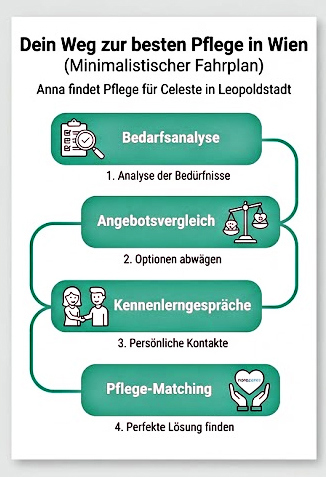
If the situation is acute, there is no time to wait around. With this roadmap, you can organize care in Vienna efficiently and safely:
- Clarify needs (checklist): Make a short list: What does the caregiver need to do? (Personal care, household, medication?) Is hourly help enough, or does someone need to live in the house?
- Choose the right type of care: Use our comparison table (see below) to decide between mobile care and 24-hour care. In Vienna, 24-hour care is often the fastest solution when needs are high.
- Find suitable profiles on noracares: Register for free and enter your criteria. Our matching system immediately shows you available caregivers in your Vienna district (e.g. Donaustadt or Meidling).
- Organize the start & apply for funding: Contact your favorites directly via the platform. At the same time, you should submit the application for care allowance to the FSW or your insurance provider in order to reduce costs from the very beginning.
Anna sits at the kitchen table, a stack of documents in front of her. Her thoughts revolve around care.
She has found a suitable caregiver, but now new questions arise: Which contracts are necessary? What rights does Celeste have? And what does she need to keep in mind as a relative?
Care contracts and legal requirements
A care contract is more than just a formality – it is the basis for safe and transparent care. As Anna reads through the contract for Celeste’s caregiver, she pays attention to clear regulations:
- Which services are included?
- How many hours are covered?
- Which working hours are agreed?
- What remuneration does the caregiver receive?
- And what happens if Celeste’s condition changes?
In Vienna, strict requirements apply to care arrangements. Caregivers must work either as self-employed personal caregivers or as employees. Anna learns that Celeste’s caregiver needs a trade license in order to work independently. Alternatively, she could be employed through a recognized organization.
Anna breathes a sigh of relief. With a watertight contract, she can ensure that Celeste is well cared for – and that the caregiver also has fair conditions.
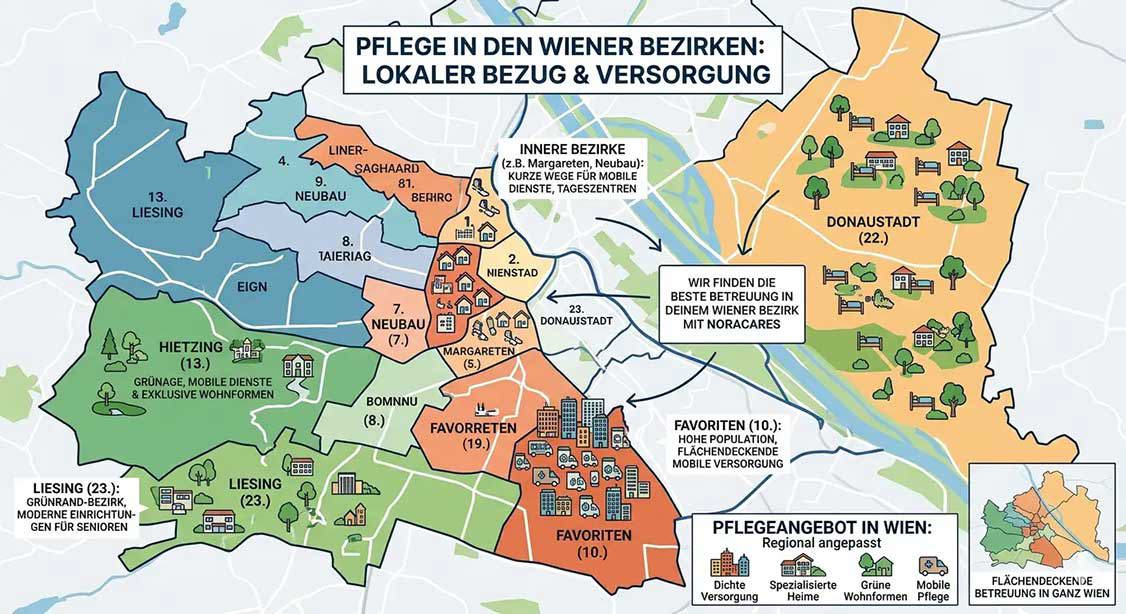
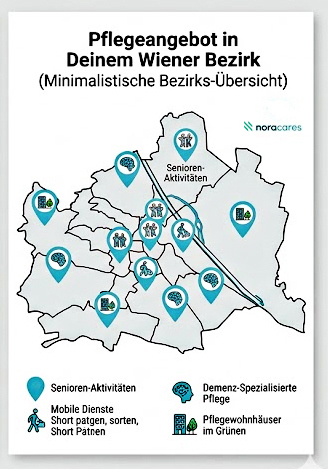
Whether in densely populated Favoriten, green Hietzing, or the large-area Donaustadt – the offer of mobile care and day centers in Vienna is comprehensive. An important insider tip: the regional customer teams of the FSW (e.g. in Guglgasse for the 3rd, 4th, and 11th districts) help you better assess regional capacities. While in inner-city districts such as Margareten or Neubau the routes for mobile services are often short, outer districts often offer specialized nursing homes in green surroundings.

Anna is sitting with her mother Celeste on the old, familiar park bench where she so often sat as a child. The autumn sun bathes Vienna in golden light while Celeste smiles at her gratefully. The decision was not easy, but now Anna knows: Her mother is getting the support she truly needs – compassionate, professional, and exactly where she feels comfortable.
Care is not just a matter of organization, but one of the heart. It is about safety, dignity, and quality of life. If you are currently facing a similar decision, you are not alone. noracares helps you find the perfect care for your loved ones – individual, reliable, and with a network of experienced caregivers. Sign up now and find the right caregiver for you and your family!
Give your loved ones a dignified life in Vienna
Do not wait for long waiting lists. Find the caregiver today who not only impresses professionally, but is also a good personal fit for your family.


- Outpatient care: Support that takes place directly in the home of the person in need of care (e.g. mobile care or 24-hour care).
- Family caregiver bonus: A monthly financial support payment (€134.30) for people who primarily care for relatives with at least care level 4 at home.
- Assisted living: A form of housing for seniors that combines independence in their own apartment with the security of on-call additional services and emergency call systems.
- Qualified health and nursing care (DGKP): Nursing professionals with comprehensive medical training who are also permitted to carry out complex nursing tasks.
- Urgency principle: The FSW procedure according to which nursing home places are allocated not by waiting time, but by the severity and urgency of the care needs.
- Specialized social assistance: Specialized support for people with special needs or chronic illnesses.
- FSW (Vienna Social Fund): The central body of the City of Vienna that plans, arranges, and coordinates care services and subsidies (such as the grant for 24-hour care).
- Trade license: Document that 24-hour caregivers need in order to work legally in Austria as self-employed personal caregivers.
- Home Care Act: The legal basis for 24-hour care in Austria, regulating working hours and qualifications.
- Home help: Support with housekeeping and simple activities of daily living (e.g. help with dressing or eating).
- Mobile care: Professionals come to the home at fixed agreed times to help with personal hygiene, medication administration, or household tasks.
- noracares: A digital platform that brings people in need of care together directly with qualified caregivers, enabling a transparent and individual selection without traditional agency barriers.
- Care assistant: Supports qualified nursing staff in care and carries out certain medical tasks under supervision.
- Care allowance: A state, income-independent benefit in seven levels intended to provide a flat-rate compensation for additional care-related expenses.
- Care level: A level (1 to 7) determined by assessors based on the monthly time required for the care needed.
- Inpatient care: Permanent admission and care in a facility (nursing home or care residence) around the clock.
- Day care / day center: A facility where people in need of care are looked after during the day and can make social contacts, while returning to their own home in the evening and at night.
- 24-hour care: A form of home care in which the caregiver lives in the household to ensure constant presence and support.

