Application and communication in the nursing sector: Your master's guide for 2026 with checklists

A compelling CV, a cover letter with heart, and the right communication are your ticket into a team that truly values you. Discover in our comprehensive guide how to present your strengths perfectly, avoid pitfalls, and master your next career step stress-free with noracares.

Imagine starting your first day at your new nursing job full of anticipation. Your heart is pounding as you enter your client’s home, the modern nursing facility, or the specialized hospital ward – and deep inside you feel: This is exactly where I belong.
But before that moment becomes reality, there is one first hurdle to overcome: an application that not only presents facts but reflects your personality. But don’t worry, you’re not alone! Annabell impressed with her individual CV and found her dream job that way. With the right preparation and the right tools, you too can stand out from the crowd.
What awaits you in this guide:
In this comprehensive guide, we will accompany you step by step through the entire process:
- What modern employers really expect from you today (Spoiler: It’s more than just your diploma!).
- The perfect CV: Structure, professional identity, and focus on your specializations.
- The cover letter: How to combine “heart and mind” to open doors.
- Appearance & design: Why professionalism in photos and layouts increases your value.
- The job interview: Your roadmap for the “live visit” – on-site or digital.
- Communication skills: Practical tips for dealing with patients, relatives and the team.
- Special guides: Tips for international nurses, experienced professionals, and career changers.
- Exclusive downloads: Checklists and sample templates for download.
Many nurses have already paved their way into their dream profession. With this guide in hand, you too will find your place where your passion for nursing can truly shine.
The nursing market has fundamentally changed: While institutions used to be able to choose from a wealth of applications, today “reverse recruiting” is a reality – facilities often almost apply to professionals.
But anyone who believes that the certificate as a registered nurse alone is the ticket to their desired job is mistaken. Employers in healthcare today are looking for a specific profile that goes far beyond simply mastering basic and treatment care.
1. Digital affinity: Tablet instead of clipboard
The image of handwritten documentation is fading. Employers today expect “digital curiosity.” Those who are ready to confidently manage care planning and performance records in digital systems score highly. It’s not about being an IT expert, but about showing openness to seeing technology as a tool for relief.
2. Empathy meets professionalism
In a stressful ward routine, emotional intelligence is the most important currency. Employers pay attention to whether applicants can maintain the balance:
- Patient focus: The ability to make people feel seen even under time pressure.
- Team player mentality: Nursing is a team sport. What’s needed are people who communicate in a solution-oriented way instead of just looking for others’ mistakes when problems arise.
3. Professional agility and specialization
Medical progress is advancing rapidly. “We’ve always done it this way” is now a disqualifier. What’s expected is a willingness for lifelong learning. Whether wound management, palliative care or practice instruction – those who show that they want to develop professionally signal long-term value and initiative to the employer.
4. Reliability as the foundation
It sounds trivial, but in times of staff shortages it is more critical than ever. A team is only as strong as its most reliable support. Punctuality, keeping agreements during the application process, and honest communication about your own limits are valued more highly today than a gapless CV.
Your CV is much more than just a list of employers – it is your personal business card and the first proof of your professionalism. In modern nursing, it’s not only about getting hands-on, but about how you provide care, document, and act within the team.
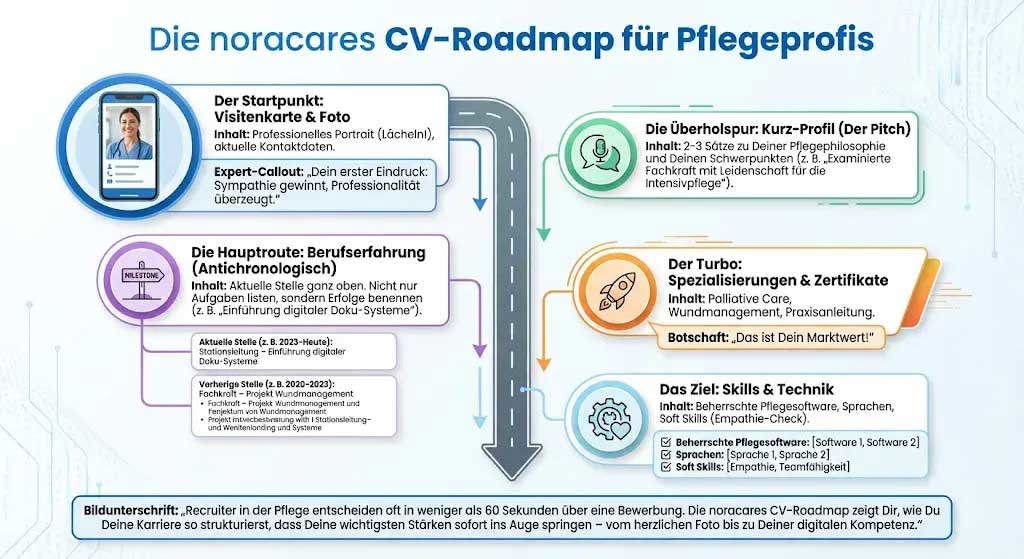
1. Structure: A common thread instead of paperwork chaos
In a stressful ward routine, recruiters have little time. Your CV must therefore convince immediately:
- Clarity over frills: Use a clean layout with easy-to-read fonts. Avoid overly colorful designs; subtle colors appear serious and modern.
- Reverse chronological structure: Start with your current or most recent position. That’s what employers are most interested in.
- Your business card: Your contact details (phone, email) must immediately catch the eye.
2. Content: Show your professional identity
Instead of just writing “Nurse from 2020 to 2023,” bring your positions to life. Every further training and additional qualification is a puzzle piece that completes your picture:
- Name your specializations: Are you a wound care expert, practice instructor, or specialist in palliative care? These qualifications are your strongest arguments for better conditions.
- Digital confidence: Mention specifically which nursing software (e.g., DAN, MediFox, Vivendi) you have already worked with. “Digital documentation” is now a core skill, not a bonus.
3. Soft skills: Demonstrate empathy and communication
Everyone writes “team player” in their CV. Stand out by emphasizing communication-related activities directly in your career history:
- “Confidently conducting conversations with relatives.”
- “Active participation in case discussions and ward rounds.”
- “Responsibility for nursing documentation in the digital system.”
4. The application photo: Friendly & professional
A picture is worth a thousand words. A friendly, open smile signals empathy – a core virtue in nursing. Pay attention to a well-groomed appearance and appropriate clothing. A professional photo acts like a promise: “You can rely on me.”

If the CV is the skeleton of your application, then the cover letter is its soul. It is your invitation to the employer to get to know the person behind the certificates. In nursing, recruiters are not looking for file managers, but for personalities who combine expertise with empathy.
1. The opening: Capture the moment
Forget standard phrases like “I hereby apply...”. Your first sentence must be as firm as a confident handshake. Use a personal story to make your motivation tangible.
Sample wording:
Dear Ms./Mr. [Name of contact person],
Nursing has accompanied me for half my life. What began as family support during afternoons with my grandmother Annabell has developed into my professional calling. Back then, I learned how much a smile and dignified care can achieve. Today, I combine this empathy with solid professional expertise and modern working methods.
2. The main part: Competence meets motivation
Here you build the bridge between your skills and the needs of the institution.
- Why this institution? Show that you have done your research. What excites you about their concept (e.g. focus on palliative care, modern staffing ratios or innovative dementia housing models)?
- Present instead of list: Don’t just name your qualifications, describe their benefit.
- Instead of: “I have completed further training in wound management.”
- Better: “Through my specialization in wound management, I ensure modern, pain-reduced care and thus relieve the entire team in complex treatment processes.”
3. Soft skills: The art of interpersonal connection
In nursing, communication is a tool as important as the stethoscope. Describe how you use your soft skills in everyday work:
- Empathy at eye level: How do you handle difficult conversations with relatives?
- Team player qualities: Mention that you actively contribute to a positive ward atmosphere and value handovers as professional exchange.
4. The closing: Confidently reaching the goal
Do not end your letter with a timid “I would be pleased...”, but with anticipation of getting to know each other.
Examples of a strong closing:
- “A harmonious team and high-quality professional care are not coincidences, but the result of commitment. I look forward to soon bringing this commitment into your daily routine and convincing you of my motivation in a personal conversation.”
- “Care with heart and mind is not a slogan for me, but my daily standard. I am eager to learn more about your concepts and show you how I can enrich your team both personally and professionally. When would it suit you for a brief introduction?”
- “What I learned back then with my grandmother Annabell is today my professional strength: seeing the person at the center. I very much look forward to soon contributing this attitude and my experience to your team. I look forward to an invitation to an interview.”
At a glance: The ideal structure
They say you eat with your eyes – in an application, the eye “reads” as well. Before an employer has read your first technical term, their subconscious has already formed a judgment. Your application photo and the design of your documents are like the cleanliness of a patient’s room: they radiate structure, trust and professionalism. A first-class photo conveys: “I take my profession and myself seriously.”
The application photo: Your window to the team
A selfie in front of the wardrobe or a cropped vacation photo looks in nursing like a stain on a white tunic – it disrupts the image of professionalism. Invest in a professional photographer. Good lighting makes you look alert and fit, a friendly smile signals the empathy your patients should feel every day.
The checklist: Dos & Don’ts
Make sure your entire application looks “of one piece.” If you use a subtle blue line as a design element in your CV, continue it in your cover letter. This visual order directly reflects your working style in nursing: structured, tidy and reliable.
A job interview is far more than just a question-and-answer game – it is like a “live ward round.” You present not only your expertise, but above all your personality and communication skills. In nursing, the interview is the first proof of how you will later deal with patients, relatives and colleagues.
1. Preparation: Your backstage check
Before the curtain rises, research is mandatory. An employer immediately notices whether you are looking for “just any” job or this specific one.
- Values check: What does the institution stand for? (e.g. palliative care, family-friendly shift schedules, innovative technology).
- Homework: Think of a short story for each stage in your CV. Successes in nursing are best told through examples, not mere claims.
2. The process: Your common thread
A nursing interview usually follows a clear choreography. If you know the process, stage fright loses its fear:
3. Communication: The dance of arguments
Good communication is like a rhythmic dance – a give-and-take interplay.
- Active listening: Let the other person finish speaking. Nod slightly to show presence – just as you would at a patient’s bedside.
- Clarity: Avoid long-winded rambling. Answer precisely. In nursing, clear communication can save lives in emergencies; you can demonstrate that here already.
4. Shining digitally: The camera interview
If the interview takes place virtually, technology is your stage:
- Light & eye contact: Position your light in front of you (not behind!) so your face appears friendly and clear. Look directly into the camera lens, not at the screen – only then does real “eye contact” occur.
- Eye level: Place your laptop on a few books so the camera is at eye level. No one wants to be “looked down on” from below.
In a job interview, it’s not about reciting memorized sentences. The interviewers want to see how you think under pressure. Use your answers to create images in the recruiters’ minds.
“How do you deal with difficult or aggressive patients?”
The professional answer: “First, I remain calm – my composure is often the best de-escalation factor. I listen actively to identify the unmet need behind the frustration. Often there is fear or helplessness behind it. If the situation still escalates, I seek support from the team, as a change of perspective often works wonders. My goal is always to preserve the patient’s dignity without jeopardizing the team’s safety.”
“How do you respond to conflicts within the team?”
The professional answer: “In nursing, we rely on each other, which is why I prefer a ‘clearing storm’ to simmering frustration. If I notice a conflict, I promptly seek a factual one-on-one conversation with the colleague. It’s not about assigning blame, but about finding a solution that improves our daily ward routine. For me, a strong team is one that remains professional and respectful even in disagreements.”
“Why do you want to change employers?”
The Professional Answer: “After my time at [current employer], during which I learned a great deal about [e.g. time management/specialist field], I am now looking for an environment where [e.g. individualized primary nursing / digital innovation] is truly practiced. I would like to contribute my expertise where appreciation and a modern nursing philosophy are not just buzzwords, but part of everyday life. That is exactly the impression I have gained from your institution.”
In nursing, communication is the bridge between professional expertise and humanity. Words can calm like medicine, create clarity like a bright light, and unite teams like a strong foundation. Those who communicate confidently reduce stress – for themselves and for others.
Communication at a Glance:
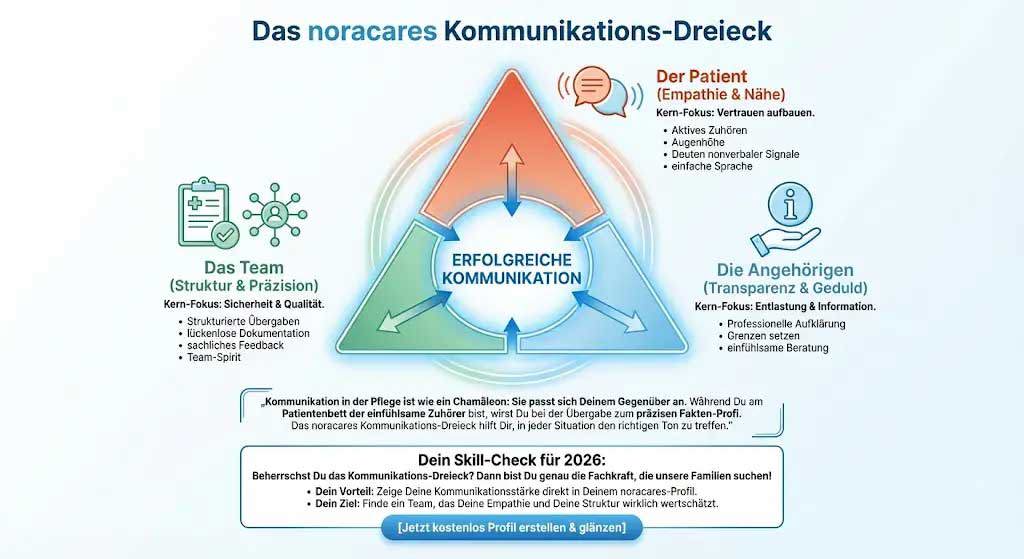
1. The Art of Meeting Patients
Patients are often in an exceptional situation. Here, your communication is the anchor:
- The language of the heart: Use simple, clear language without medical jargon.
- Show presence: Steady eye contact signals: “I am fully here with you.”
- Read between the lines: Pay attention to nonverbal signals. Often, a fearful look says more than a thousand words. Patience is your silent companion here.
2. The Bridge to Relatives
Relatives are partners in care, but often driven by concern. Here, you are the professional interface:
- Transparency builds trust: Provide honest and understandable information about the current situation.
- Empathy with backbone: Remain empathetic, but also learn to set friendly boundaries when expectations exceed everyday nursing practice. Calm explanations of procedures often work wonders against uncertainty.
3. The Heartbeat of the Team
A nursing team functions like clockwork – communication is the oil in the gears:
- Structured handovers: Information must flow, not seep away. Use clear facts instead of vague assumptions.
- Accurate documentation: Your written words provide legal and professional protection for everyone. Precise record-keeping is “silent communication” at its best.
- Growth culture: Provide appreciative feedback and address conflicts before they turn into storms.
Moving to a new country is like setting out for a new continent – it requires a good map and a clear compass. If you are starting your career in Germany, your professional certificate is your foundation, but your cultural adaptability is your tailwind.
- The formal bridge: In Germany, using “Sie” in a written application is a sign of respect and professionalism. Use polite, direct language.
- Your professional language: Language certificates (B1/B2) are your ticket of entry. In your cover letter, show that you are ready to acquire the specific medical terminology.
- Show recognition status: Clearly mention the stage your recognition process is currently in. This gives the employer planning security.
As an experienced nurse, you are not just applying for a position – you are offering your expertise as a solution. You are not a cog in the machine, but someone who keeps it running. Changing jobs is the ideal time to make your achievements of recent years visible.
- Show responsibility: Have you taken on shift leadership or optimized processes? That belongs prominently on your CV.
- Share knowledge: Mention your experience in mentoring trainees or new colleagues. This makes you indispensable as a “mentor.”
- The salary discussion: Present yourself confidently. Your salary is the value of your specialized knowledge.
Wording Joker: “Based on my X years of experience in intensive care and my additional qualification in wound management, I envision a gross salary of X euros.”
You do not come directly from nursing? No problem! Your CV is not a dead end, but a valuable toolbox. Many skills you learned in other professions are worth their weight in gold in nursing. They are called “transfer skills.”
- Customer contact & communication: Anyone who has worked in service or sales knows how to deal with difficult personalities and stay calm – exactly what nursing requires.
- Stress resistance: Have you worked under time pressure in gastronomy or project management? Then you are ready for everyday ward life.
- Organizational talent: Anyone who can coordinate complex processes will also master efficient care planning.
Your argument: “In my previous role in [your former field], I learned to maintain an overview even in stressful situations and to approach people with empathy. I would now like to combine this resilience and my communication skills with my passion for nursing.”
Even the best professional can stumble due to small carelessness in an application. Think of your application like a care documentation : if it is incomplete or messy, trust in your professional work suffers. Here are the most common mistakes you can easily avoid:
The “Copy-Paste” Cover Letter
A standard text sent to five different facilities looks like careless mass processing. Recruiters immediately sense whether you are truly interested in their institution or just sending out letters at random.
- The solution: Mention a specific detail about the institution that appeals to you.
Claims Without Evidence
Everyone writes that they are “resilient” or “empathetic.” Without examples, however, these remain empty phrases.
- The solution: Link your strengths to situations. Instead of “I am a team player,” write: “I value professional exchange during handovers to find the best solution for the patient.”
The “Diagnostic Error”: Spelling & Format
Careless mistakes in the cover letter look like sloppiness on duty. Anyone who is inaccurate with their own name or that of the institution is less likely to be trusted with accurate medication administration.
- The solution:Have a second person proofread it or use digital tools.
The Labyrinth: An Unstructured CV
A CV that jumps wildly between years or lacks clear structure costs the reader time and nerves.
- The solution:Use clear headings and a reverse chronological order (most recent first).
Silence at the End: No Questions of Your Own
“Do you have any questions?” – Anyone who answers “No” here signals disinterest. An interview is not an interrogation, but a meeting on equal footing.
- The solution: Ask about the team composition, the onboarding phase, or the documentation systems used.
Imagine that your job search no longer feels like a bureaucratic obstacle course, but like a perfectly organized duty roster. noracares is more than a job board – it is your personal assistant that scans the market for you while you focus on what matters most: people.
Why noracares is your game changer:
- No more searching for a needle in a haystack: Instead of browsing hundreds of ads, noracares filters precisely. Whether elderly care, disability support, or hospital – you only see what truly fits your life.
- Apply with one click: Forget the tedious formatting of attachments and endless typing of emails. Your profile is your business card. One click, and your application lands directly with the decision-maker.
- Smart preparation: noracares does not leave you alone after you apply. With exclusive guides and tools, you will be fit for the interview – so that you shine not only professionally, but also in your presence.
Guide: In 4 Steps to Your Dream Job
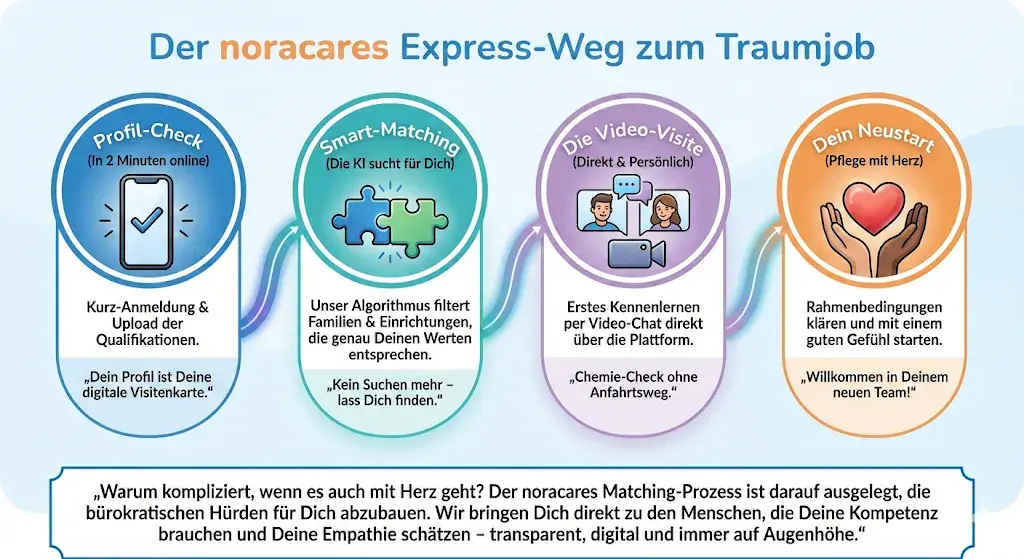
The path to your new employer with noracares is as simple as a structured handover. Here’s how you get started:

At the end of this journey, there is not just an application, but the first step toward a fulfilling future in the nursing profession. Like Annabell, you also have the opportunity to present your strengths and experience in the best possible way and tell your individual story. With the right tips for creating a compelling CV and cover letter, you open the doors to new opportunities and can stand out from the crowd.
Remember: you are not alone on this path. noracares is your loyal companion, supporting you not only in your job search, but also with valuable assistance throughout the entire application process. With every step you take, you get closer to your goal—your new dream job, which will allow you to live your passion for nursing while positively impacting the lives of other people.
So don’t hesitate any longer! Register with noracares today and start your journey to your dream job in nursing. Your future is waiting for you!

This whitepaper is a comprehensive resource that helps you create a strong nursing profile, write a compelling CV, and successfully master the application process. Whether you are new to nursing or want to advance your career—these tips will help you stand out from the competition and find your dream job in nursing.
Feel free to print out this guide and use it as a helpful reference throughout your entire application process. From creating your noracares profile to preparing for job interviews—this checklist ensures you are well equipped for success in your nursing career.


- Reverse recruiting: A trend that will be the standard in 2026. It’s no longer only you applying to the employer; instead, facilities must actively recruit skilled workers and offer attractive conditions (benefits).
- Digital nursing documentation: Recording all nursing services on a tablet or PC. Knowledge of software such as MediFox or DAN will be core competencies in 2026.
- Soft skills: Interpersonal skills such as empathy, teamwork, and stress resilience. In nursing, often more important than the grade on your certificate.
- STAR method: A technique for interviews (Situation, Task, Action, Result), used to substantiate competencies with real practical examples.
- Transfer skills: Skills you bring from other professions (e.g., organizational talent from hospitality) that are valuable in nursing.
- Recognition procedure (nostrification): The legal process for having foreign nursing qualifications officially recognized in Austria or Germany.
- Primary nursing: A nursing model in which you are assigned to specific patients. In 2026, this is often highlighted as a quality feature in job postings.
- One-Click-Apply: A job application process (like at noracares) in which you apply directly with your saved profile without a lengthy cover letter.
- Active sourcing: When employers approach you directly on platforms like noracares because your profile is a perfect match for their open position.
- Skilled staff ratio: Legal requirement for how many licensed professionals must work in a facility. This often influences your negotiating position on salary.

