Florian, 22, tells about his path into nursing

Are you ready for a profession that truly matters? It is the year 2026, and the healthcare sector is at a turning point. Never before has the demand for academically trained nursing experts been as high as it is today – and never before have the opportunities for young talents been so diverse. But behind the statistics about staffing needs and systemic importance are real people with real stories.
In this article, we take you behind the scenes of modern nursing education. We speak with Florian (22), who consciously chose against the classic desk job and for a life on the front line of humanity.

Florian reports exclusively on his bachelor’s degree in Health and Nursing Care. He speaks openly about the hard journey from civilian service to his first night shift on the stroke unit, about his dreams of intensive care medicine, and about those moments when he realized that his actions can decide between life and death.
Whether you are about to graduate from secondary school, thinking about changing careers, or simply want to know what everyday nursing feels like in 2026: Florian was exactly where you are now. His experiences are the compass for your own path into a career that is not only secure, but also deeply fulfilling.
Your entry into the care community
Are you interested in a career that creates meaning and offers flexibility? Find out how noracares brings together the next generation of nursing professionals and families in Austria as equals. Discover now which doors are open to you with us – from mobile care to specialized support.
Why this degree is important for you
Are you looking for a degree program that not only teaches academic knowledge, but also gives you the opportunity to support people in the decisive moments of their lives? Today, the Health and Nursing Care (GuK) degree is far more than just learning practical procedures – it is a highly modern, scientifically grounded education at the intersection of medicine, technology, and empathy.
In this practice-oriented bachelor’s degree at a university of applied sciences, you acquire solid knowledge in:
- Nursing science and research: So that you know why you apply which measure.
- Medical fundamentals: From anatomy to pharmacology.
- Health policy & ethics: To understand and help shape the system in which you work.
Your career guarantee in 2026 This degree is your ticket into a professional field that is more in demand than ever. Whether in Austria, Germany, or elsewhere in the EU: qualified nursing experts are the most important pillar of our society. Current forecasts from the Ministry of Social Affairs confirm: in Austria alone, around 75,000 to 100,000 positions will need to be filled by 2030. For you, that means: a 100% job guarantee, enormous opportunities for specialization, and a meaningful career.
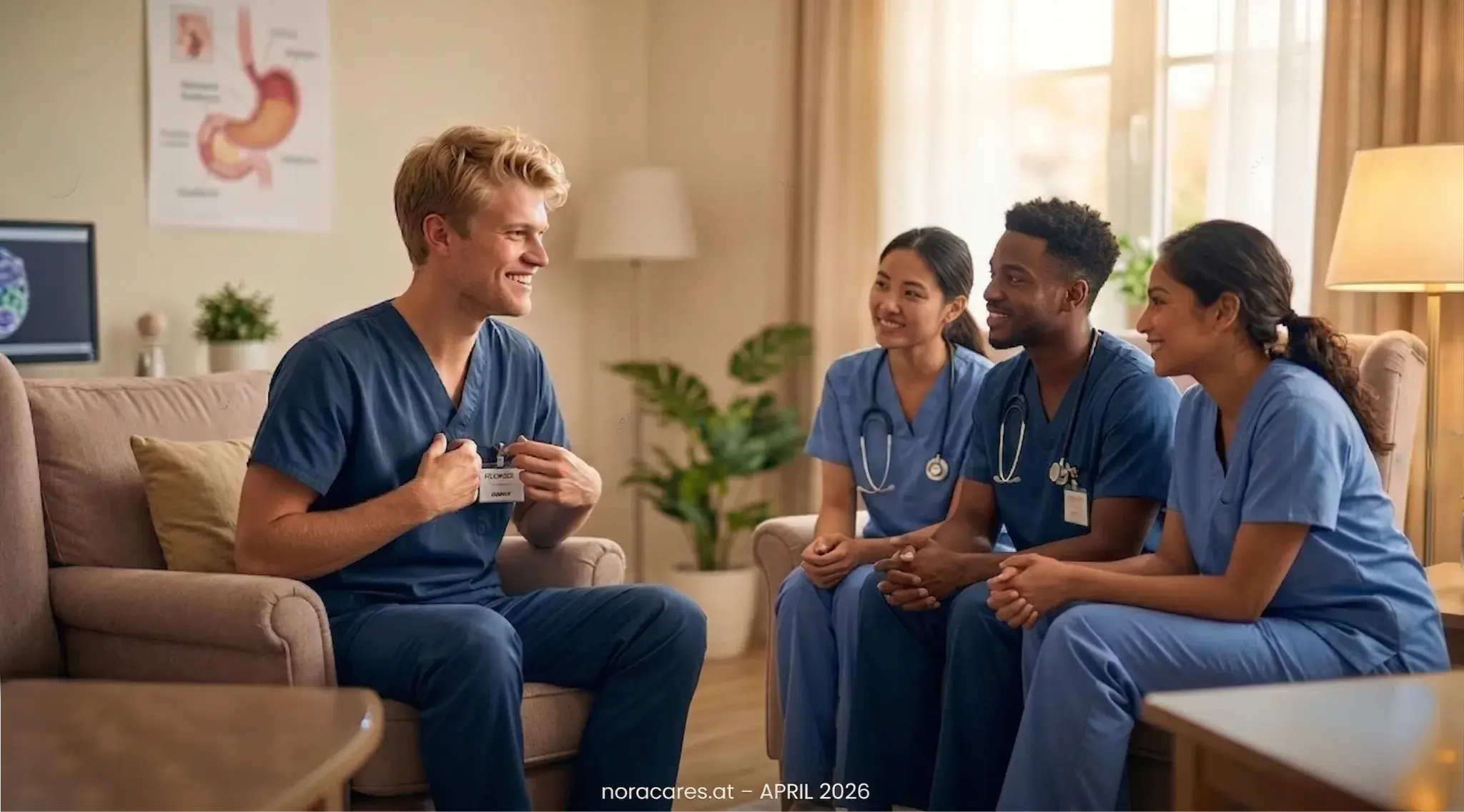
What did you want to be when you were a child?
“As a child, I didn’t have any specific career wishes. It was only in secondary school that I started thinking about my future. Journalism was one option, but classic childhood dream jobs like firefighter or police officer were not for me."
Florian’s story is typical for many young people: the path into nursing was not a straight one – but one that emerged through experience and openness.
How did you come up with the idea of studying Health and Nursing Care?
“That happened during my civilian service. Originally, I wanted to study physiotherapy, but after the admissions process didn’t work out twice, I reoriented myself. Then I realized that nursing is an incredibly important and underestimated professional field."
Florian’s path shows: sometimes a detour leads directly to the goal. Civilian service became the turning point for him.
What experiences did you have during civilian service?
“I was with the Arbeiter-Samariter-Bund in Linz and had contact there with nursing staff in various areas – from the hospital to the nursing home. That’s where I realized that I can interact well with older people and that I am very interested in medical and health-related topics."
Nora’s tip: Civilian service or a voluntary year in the care sector is one of the best ways to find out whether nursing is right for you – even before you decide on a degree. Many universities of applied sciences even view this experience positively in the admissions process.
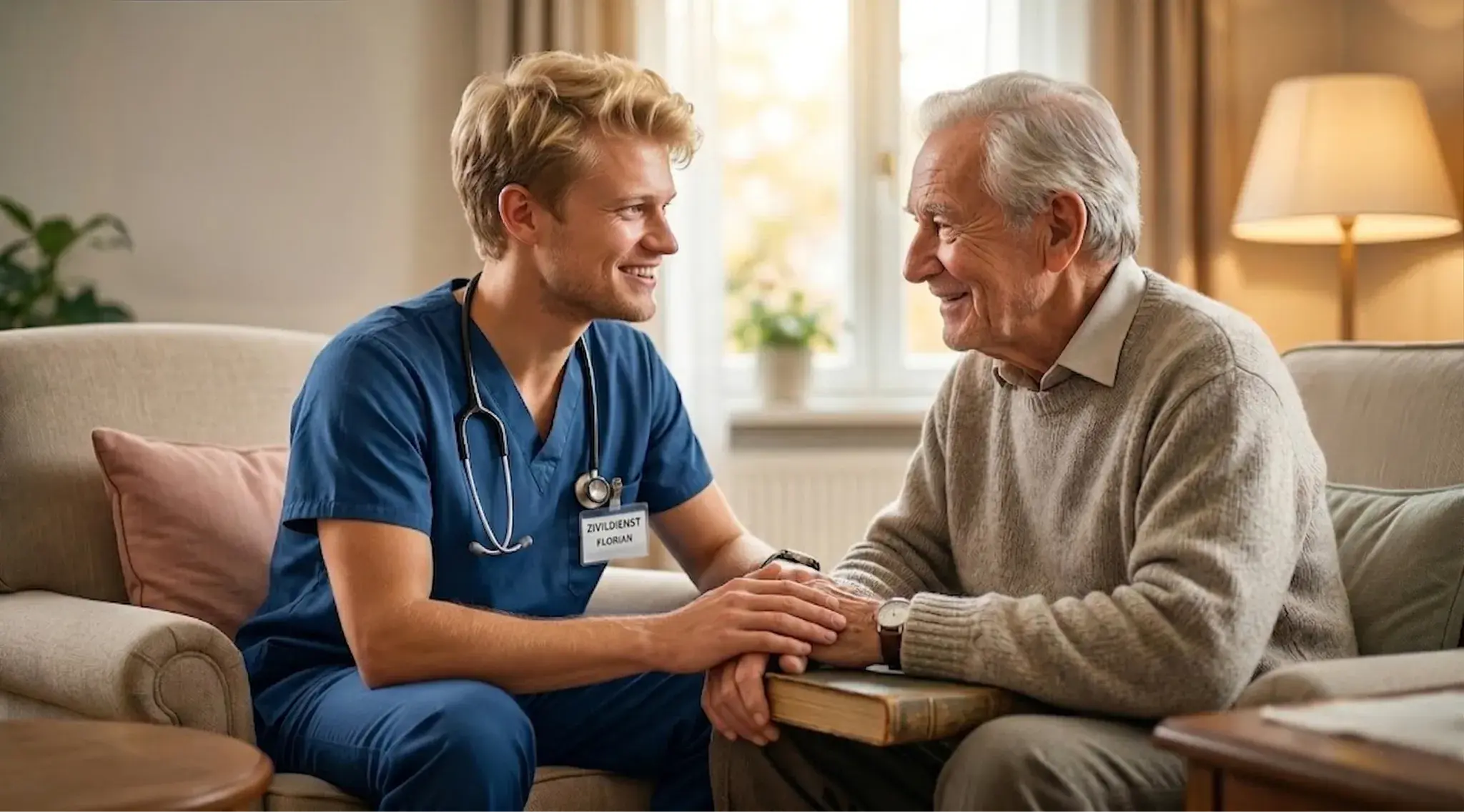
This is how your Health and Nursing Care degree is structured
How long does the degree take and what does it include?
“The bachelor’s degree takes three years and is a generalist education. That means we acquire fundamental skills in all areas of nursing. After graduation, you can further specialize in areas such as intensive care or psychiatry."
The degree concludes with a Bachelor of Science in Health Studies (BSc) – an academically recognized degree throughout the EU that opens doors for you in Austria, Germany, and internationally.
Program structure and organization
Source: gesundheit.gv.at
How much practical training is there in the degree?
“Around 51% of the degree consists of internships. Especially at the beginning there are limitations, but over time we become increasingly free in choosing our internship placements."
This is what makes the Health and Nursing Care degree special: you spend more than half of your training time directly in nursing practice – on real wards, with real patients.
Where can you study Health and Nursing Care?
In Austria, the bachelor’s degree is now firmly established nationwide at universities of applied sciences. In addition to pioneering locations such as FH Campus Wien, FH Salzburg, fh gesundheit Tirol, or FH Joanneum Graz, there are also excellent programs at other locations, often closely linked with regional hospitals:
- Vienna: FH Campus Wien – Health and Nursing Care
- Salzburg: FH Salzburg – Nursing bachelor’s degree
- Tyrol: fh gesundheit Tirol – GuK (Innsbruck)
- Styria: FH Joanneum (Graz) – Health and Nursing Care
- Upper Austria: FH Gesundheitsberufe Upper Austria (Linz, Wels, Steyr)
- Lower Austria: FH St. Pölten – GuK degree
- Carinthia: FH Carinthia (Klagenfurt) – Nursing bachelor’s degree
Financing: The nursing scholarship 2026
Thanks to government funding, studying is now also the first financial choice for many. The AMS care scholarship has secured a livelihood throughout the entire study period since the reform:
- Amount: In 2026, the minimum amount is around 1,650 euros per month (adjusted for inflation).
- Requirement: A successful completion of the admission process and a consultation with the AMS before the start of studies.
- Tip: Many federal states also pay an additional care training bonus (e.g. in Lower Austria or Upper Austria), which further increases your income during your studies.
In Germany, there are similar bachelor's programs at universities of health, for example at ASH Berlin, the HAW Hamburg or KSH Munich – however, with slightly different structures, as dual training and degree studies often still exist even more strongly in parallel here than in Austria.
What will you learn in the Health and Nursing Care degree program?
Nursing science fundamentals
Nursing science forms the theoretical foundation of the degree program. You learn nursing theories, nursing processes, and evidence-based methods – in other words, care that is based not on gut feeling, but on scientific foundations.
Clinical nursing and practical phases
“Among other things, I have worked in ear, nose, and throat medicine, on an admissions ward, and soon on the stroke ward of the Neuromed Campus. Every internship helps me narrow down my interests further."
Clinical nursing is the heart of the degree program. You will work in different care settings – from acute hospitals to rehabilitation centers and mobile care – and in the process learn how varied nursing practice can be.
Medical fundamentals and nursing processes
Anatomy, physiology, pathology – these medical fundamentals are indispensable for being able to act independently as a nursing professional. You also learn to plan, carry out, and document nursing processes.
Communication and teamwork in nursing
“I enjoy the practical relevance the most. In addition, the exchange with colleagues and the support from the lecturers are very valuable."
Communication is just as important in nursing as professional knowledge. You practice speaking empathetically with patients, but also communicating professionally within the interdisciplinary team of doctors, therapists, and nursing staff.
Important modules and course content
The first patient contact
“It was a very special moment. At first I had great respect for it, but over time you grow with the tasks."
The first patient contact is an emotional experience for almost all students. Respect is not a weakness here – it is proof that you understand how much trust patients place in you.
The moment that changed everything
“In the 4th semester, I had a young patient whose blood values indicated a serious cancer diagnosis. In that moment, you realize that nursing is not just theory – it is about real people and real destinies."
This moment is the emotional core of the article – and of the nursing profession. Nursing means accompanying people in the most vulnerable moments of their lives. This requires not only professional knowledge, but also emotional strength and empathy.
Are you already working in nursing or about to graduate? noracares connects qualified care workers directly with families in Austria – flexibly, fairly, and without agency fees.
How important are the practical phases?
With around 51% practical content, the Health and Nursing Care degree is one of the most practice-intensive degree programs of all. This is no coincidence – because nursing cannot be learned from books. The practical phases prepare you for real professional everyday life: with everything that comes with it.
Which specialization interests you the most?
“The intensive care field. It requires not only professional but also emotional and mental abilities. The next semester will show whether that is really my direction."
After completing your bachelor's degree, numerous specializations are open to you. Florian is drawn to intensive care nursing – others choose psychiatry, palliative care, operating room nursing, or nursing management.
Career opportunities after graduation
How much can I earn after graduation?
This is one of the most common questions – and a justified one. The good news: Salaries in nursing have risen significantly due to the latest reforms.
- In Austria: For qualified health and nursing professionals (DGKP), the starting salary in 2026 is between 3,300 and 3,600 euros gross per month (with 14 salaries), depending on the federal state and provider (e.g. SWÖ-KV or public service).
- Allowances make the difference: Due to night, Sunday, and public holiday shifts as well as hardship allowances, the actual gross salary often increases by an additional 400 to 600 euros.
- Specializations: In areas such as intensive care or anesthesia nursing, you often start in 2026 at over 3,800 euros gross.
Comparison with Germany: Here, salaries are strongly based on the TVöD-P (public service collective agreement). Since the increase in May 2026, the starting salary for nursing professionals has been around 3,500 to 3,900 euros gross. Shift allowances and annual special payments are added here as well.
What do you need to apply for the degree program?
Florian still remembers his admission procedure well: “The admission process for physiotherapy did not work out twice. "The process for the nursing degree program was more structured – but I still had to prepare well."
The most important requirements at a glance:
- Matura (high school diploma) or equivalent qualification
- Vocational matriculation examination as an alternative to the Matura
- German language skills at least at B2 level
- Aptitude test and/or interview depending on the university of applied sciences
- Health certificate – some universities require a medical certificate
Admission requirements for the degree program
How do you apply?
The application is usually submitted online through the respective university of applied sciences. Prepare the following documents:
- Matura or high school diploma certificate
- Résumé
- Letter of motivation
- Proof of practical experience (e.g. civilian service, internships)
- If applicable, letters of recommendation
Application and start of studies
Special information for applicants from Austria and Germany
In Austria, the nursing degree at universities of applied sciences is a fully recognized bachelor’s degree (BSc) with EU-wide recognition. In Germany, on the other hand, there are dual training paths alongside university studies, which are more strongly organized within companies. In both countries, the academic bachelor’s degree is the most direct path into managerial or specialized positions.
What is a dual study program?
The dual study program combines theoretical learning at the university of applied sciences with practical work experience in a care facility. You study and work at the same time – and usually receive compensation from the institution.
How does the dual study program differ from the traditional degree program?
A degree program in healthcare is financially more attractive in 2026 than ever before. Thanks to massive government support in Austria, you often do not have to worry about your living expenses.
Support options in Austria (as of 2026):
The nursing scholarship (AMS): The most important pillar of financial security.
- Amount: In 2026, you receive a minimum amount of 1,650 euros per month (daily rate approx. 55 euros).
- Requirement: A successful completion of the admission process and a consultation with the AMS before the start of studies are mandatory.
The training allowance (nursing training subsidy): If you do not receive a nursing scholarship (e.g. directly after completing your Matura), you are entitled to a monthly subsidy of at least 600 euros (tax-free), which is paid directly through the training institution or the federal state.
Regional bonuses from the federal states: Many federal states add even more on top.
- Upper Austria: The Upper Austria nursing scholarship currently amounts to approx. 658 euros per month for those who do not receive AMS benefits.
- Vienna & Lower Austria: There are similar bonus models here to make the training even more attractive in addition to the basic amount.
Student grant: This can be applied for under certain conditions in addition to the training allowance (not in addition to the nursing scholarship!).
Situation in Germany:
In Germany, financing usually takes place through two routes:
- Compensation in the dual study program: Many providers (hospitals) already pay monthly compensation during the study program, based on trainee pay (approx. 1,200 to 1,500 euros).
- BAföG: Since the 2026 reform, the maximum BAföG rate for students is up to 992 euros per month.
What are your plans after graduation?
“I would like to do an internship abroad, maybe in Scandinavia. After that, I want to specialize in intensive care in Austria.”
Florian’s plan shows: Studying health and nursing care opens doors far beyond Austria. Thanks to EU-wide recognition of the BSc degree, you can work in any EU country – from Sweden to Portugal.
Why did you choose nursing as a man?
“I think it’s a shame that this is even a question. Nursing should not be a gender-specific profession. Men bring an important perspective to the team, and diversity is very valuable in healthcare.”
Florian puts it perfectly: Nursing is a profession for everyone – regardless of gender, origin, or background. Nursing professions in Austria and Germany are becoming increasingly diverse, and that strengthens the quality of care.
How do you see the future of nursing?
“The reform of nursing education was an important step. But there needs to be more awareness about career opportunities and more financial incentives to counteract the staff shortage. I am curious to see whether the appreciation of nursing professions will continue.”
You have completed your nursing degree – or are about to? noracares connects you directly with families in Austria who are looking for professional support right now.

Florian’s story shows what studying health and nursing care really means: It is not a straight path, but an incredibly rewarding one. From civil service in Linz to the intensive care unit – every experience has brought him one step further.
What Florian learned applies to everyone who follows this path: Nursing is not a job you simply do. It is an attitude. A decision to be there for people – in the most difficult moments of their lives.
Studying health and nursing care opens doors to one of the most future-proof, meaningful, and diverse professional fields in healthcare – in Austria, Germany, and across Europe.
And if you are looking for a partner after your graduation to help you take the next step: At noracares you will find flexible opportunities in mobile care – directly connected with families, without complicated placement structures.
Your path into nursing starts now.


- Training content in health and nursing care – The entirety of theoretical and practical learning content in the program, consisting of nursing science, medical fundamentals, clinical practice, and communication.
- Bachelor of Science in Health Studies (BSc) – The academic degree of the nursing program, recognized across the EU and the basis for specializations and leadership roles.
- Professional authorization – The legal permission to work as a qualified health and nursing professional (DGKP) in Austria. It is granted after successful completion of the program.
- Dual study program – Combination of theoretical FH studies and a paid practical phase in a partner organization.
- Generalist training – Training that covers all areas of nursing without immediate specialization – the foundation of the Austrian nursing program.
- DGKP (Qualified health and nursing professional) – The highest qualification level in Austrian nursing, obtained through a bachelor’s degree at a university of applied sciences.
- Intensive care – Specialized nursing field for critically ill patients that requires particular professional and emotional competencies.
- Nursing professional – General term for qualified nursing staff with recognized training or degree.
- Nursing scholarship – Government funding for nursing students in Austria, awarded by the Ministry of Social Affairs.
- Practical phases (clinical practice) – Practical training components within the program, in which students work in hospitals, nursing homes, or outpatient services – approx. 51% of the program.

