24-hour care in Upper Austria – Professional home care for your loved ones

24-hour care in Upper Austria – How do I find trustworthy care for my relatives? What options are there for finding reliable caregivers? Find out everything here about care in Upper Austria and how noracares connects families and caregivers.
The care of a loved one is a journey full of emotions – beautiful, but often also challenging. Especially when support is needed around the clock. Many families in Upper Austria choose 24-hour care because it provides security, trust, and a dignified life in one’s own home.
Lisa, too, eventually faced this decision. Her parents were getting older, everyday life was becoming more difficult – and she asked herself: How do I find trustworthy care? What does it cost? Is there support available? She wanted to do everything right and find a solution that was fair for her parents and for the caregiver.
If you are in a similar situation, you are in exactly the right place. In this guide, you will learn:
- How 24-hour care works
- What round-the-clock care costs
- What financial support options are available
-
How to find the perfect caregiver for your family
Which legal requirements are important
noracares helps you take the right path – for your relatives and for a caregiver who supports you with heart and competence. This way, you can look to the future with peace of mind.


Lisa faced a difficult decision. Her parents, both advanced in years, could no longer manage everyday life on their own. Her father was forgetting things more and more often, and her mother felt unsteady on her feet after a fall.
A nursing home was out of the question for Lisa – her parents loved their home, the small garden where they had planted roses for decades, and the familiar scent of freshly baked bread in the kitchen.
The solution? 24-hour care in their own home.
A compassionate caregiver moved in, became part of the family, and lovingly supported Lisa’s parents in everyday life. Her father received help with taking his medication, and her mother felt safe again. Above all, they were able to keep what matters most: a life of dignity, security, and familiarity.
Advantages of 24-hour care at home
A home is more than four walls – it is the place where you feel safe and secure. 24-hour care ensures that Lisa’s parents, and your loved ones too, can keep this feeling:
- Comfort: They remain in their familiar surroundings – without the painful farewell to memories.
- Safety: A caregiver is always there when help is needed – whether for a nighttime trip to the toilet or a sudden dizzy spell.
- Quality of life: Walks, cooking together, little conversations – all of this remains and brings joy.
- Individual care: No rigid routines, but care that adapts to habits and needs.
Lisa also realized: The decision in favor of 24-hour care was not only a relief for her parents, but also for herself. She could be a daughter again instead of having to worry constantly.

Lisa still remembers well the moment when she realized that her parents needed support. But how was she supposed to finance 24-hour care? What costs would she face?
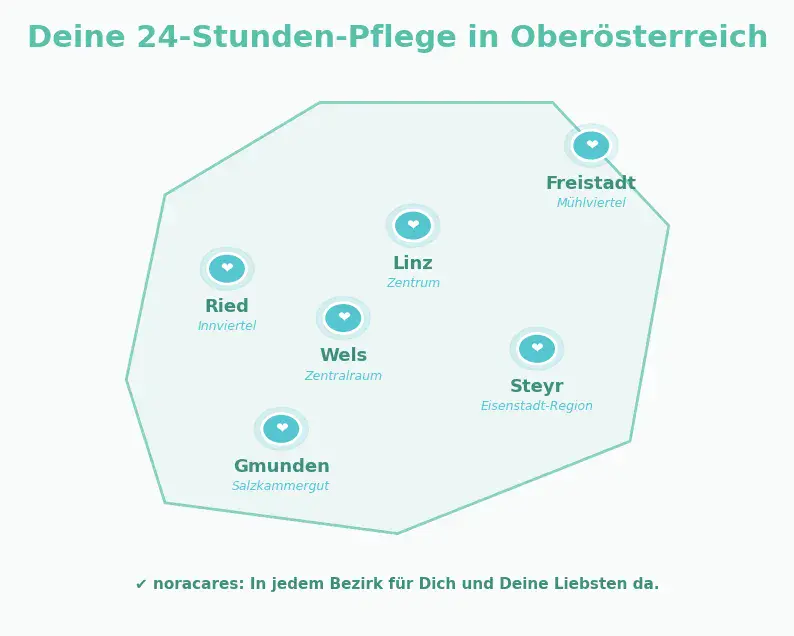
Many families in Linz, Wels, Steyr, or other areas face exactly these questions. But one thing is certain: The right care has immeasurable value, because it makes the lives of your loved ones easier and enables them to age with dignity in their own home. But that does not mean it is unaffordable – with good planning and the right subsidies, the costs can be managed.
Price overview and what influences the price
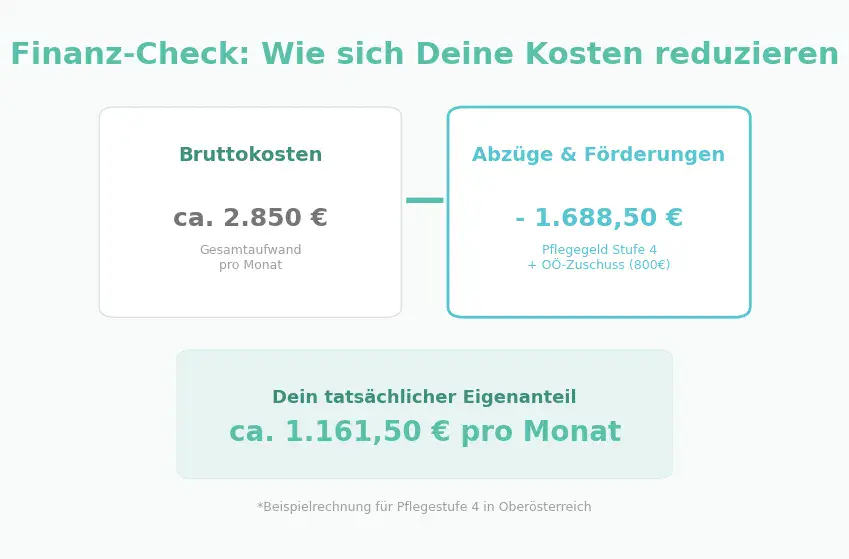
In 2026, the monthly expense for qualified care in Upper Austria averages between 1,900 and 2,650 euros. However, this amount is the gross sum – government subsidies significantly reduce the actual burden for your family.
The costs of 24-hour care in Upper Austria depend on various factors:
- Qualification of the caregiver: Do they have special training or experience with certain medical conditions?
- Care needs: Is only everyday assistance needed, or also medical support, for example for dementia- or palliative patients?
- Location: In rural regions, the costs are often lower than in the city.
- Additional needs: Are special skills required? Do you have a specific requirement?
Funding or subsidies for 24-hour care in Upper Austria
Lisa spent countless hours researching until she understood the jungle of subsidies. So that you can save yourself this effort, we have summarized the key funding options and subsidies for you.
Care allowance table 2026
The care allowance is one of the most important financial supports in Austria. It is paid regardless of income and is based solely on the individual care needs.
The care allowance was increased again for 2026 in order to offset rising living costs. Here are the current care allowance levels for Austria (as of 2026):
Source: pv.at/web/pflegegeld
Funding for 24-Hour Care in Upper Austria

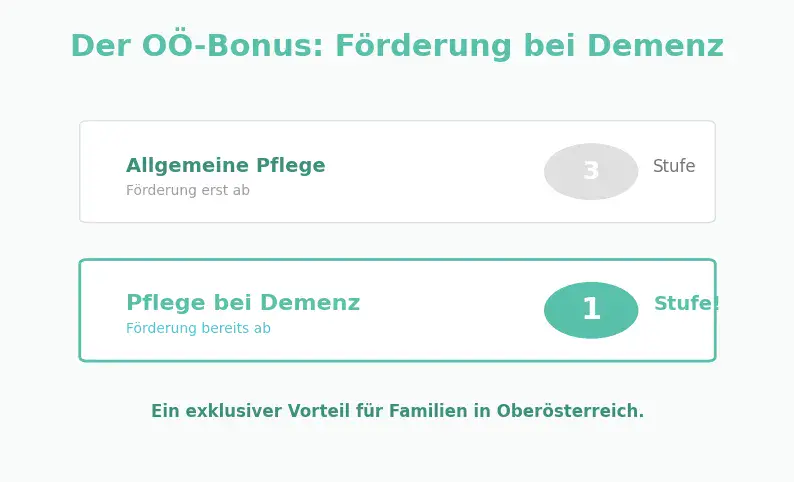
In Upper Austria, there is a special subsidy for 24-hour care, which relieves families like Lisa and her parents. It applies to people from care level 3 onward – in the case of a dementia illness support is even possible from care level 1.
The amount of this 24-hour care subsidy depends on whether the caregiver is self-employed or employed:
- Self-employed caregivers: 400 euros per month and caregiver, 800 euros for two caregivers.
- Employed caregivers: 800 euros per month and caregiver, 1,600 euros for two caregivers.
To be able to apply for this support, the monthly net income of the person in need of care must be below 2,500 euros. If there are additional dependents entitled to maintenance, these income limits are higher. It is also important that the caregiver is officially registered – either with a business license or as an employee.
Tax Relief and Other Financial Assistance
In addition to the care allowance and the subsidy for 24-hour care, there are other financial relief options:
- Tax deductibility: The costs of 24-hour care are considered extraordinary burdens and can be claimed for tax purposes.
- Subsidies for care aids: In certain cases, there is financial support for aids such as care beds or wheelchairs.
- Regional grants and care funds: Some municipalities offer additional subsidies for people in need of care.
When Lisa discovered all these options, a huge weight was lifted off her shoulders. 24-hour care is certainly a financial challenge, but she does not have to bear the costs alone.
Thanks to the care allowance, subsidies, and tax relief, she can provide her parents with the best possible care – and give them what they wish for most: security in their own home.
Lisa sat at her parents’ kitchen table with a notepad. Her father looked at her questioningly. “So how do we find someone who is really the right fit?” Lisa sighed.
That was exactly the question. A caregiver should not only provide support, but also fit into daily life, show understanding, and preserve the feeling of security. But what should you look out for?
Selection Criteria for Caregivers in Upper Austria
Not every caregiver is suitable for every family. Lisa quickly learned that certain qualifications and qualities are especially important:
- Experience in 24-hour care: Anyone who has accompanied older people over a longer period already knows what matters.
- Specialization in certain illnesses: Lisa’s mother needs support after her fall, her father suffers from early dementia – a caregiver with experience in these areas is essential.
- Good language skills: Communication is the key to trust. It helps enormously when the caregiver can communicate with her parents.
- Empathy and patience: Care means more than just help with everyday tasks – it is about warmth, patience, and the feeling of being understood.
- Qualifications: Training is not entirely unimportant. Make sure that the selected caregiver has the appropriate expertise.
Lisa wrote down everything that was important to her and her parents. But where can she now find a female or male caregiver who meets exactly these criteria?
Where Can I Find Reliable Care Agencies in Upper Austria?
Lisa did not want to leave anything to chance. She did not want to simply be assigned someone by an agency whom she and her parents had never seen before.
That is how she found noracares. A platform that helps families find suitable and vetted caregivers. And all with just a few clicks:
- Register: You simply sign up with noracares and create a profile for yourself or your relatives.
- Suitable suggestions: By specifying your wishes and needs and filtering the results using search criteria, only caregivers who are a good fit for you and your family will be suggested.
- Get to know caregivers: Choose the caregivers whose profiles appeal to you and exchange ideas with them via chat or video call. This way, you can find out whether the chemistry is right between everyone involved.
- Start of work: If it is a good fit for both sides and you have secured everything contractually, nothing stands in the way of working together.
With noracares, Lisa found a loving caregiver for her parents who not only supports them but also gives them back a piece of quality of life – someone who has become not just a caregiver, but part of the family.

Lisa still remembers exactly the moment when she suddenly found herself confronted with a mountain of forms and legal requirements. Is the caregiver even allowed to work for her parents? Which laws protect her family? And what if she overlooks something? She wanted to do everything right – for her parents and for the caregiver.
But don’t worry, it sounds more complicated than it really is. The most important points are easy to understand:
- Registration requirement: The caregiver must be officially registered with social insurance. This ensures that they are covered – and that Lisa’s parents are also legally protected in an emergency.
- Working hours and breaks: Even if it is called “24-hour care,” every caregiver needs rest periods. Lisa knows that only a well-rested caregiver can truly take good care of her parents. That is why she agrees on clear working hours and breaks with them.
- Qualifications: For basic care, experience is often enough, but when it comes to medication or special medical tasks, appropriate training is required. Lisa wants to ensure that her parents are also excellently cared for in this respect.
Fortunately, all of this can be regulated contractually. If Lisa records working hours, breaks, and important agreements, everyone is on the safe side – and her parents receive the best possible care.

The decision to choose 24-hour care is far more than just an organizational necessity – it is an expression of your wish to enable them to live with dignity and security.
Lisa has experienced this step herself and knows how challenging it can be to find the right solution and, above all, the right caregiver who offers more than just medical support. She wanted a caregiver who would look after her parents with heart and empathy and help them continue to lead a self-determined life in their own home.
We understand how important it is to find a reliable, competent, and compassionate care provider and female care providers. In Upper Austria, there are numerous ways to care for your loved ones in their familiar surroundings. In this way, quality of life can be preserved even when support is needed.
Sign up with noracares today and give your family the loving care they deserve – for greater safety, security, and quality of life.


- Tax deductibility: The costs of 24-hour care can be claimed as an “extraordinary burden” with the tax office to reduce your tax liability.
- Employed caregivers: A model in which the caregiver is directly employed by the family or an organization. Higher subsidies are available in Upper Austria (up to €1,600 for two caregivers).
- Caregiver: A person who lives in the household of the person in need of care and supports them with daily activities, household tasks, and basic care.
- Dementia care: A specialized form of care for people with memory loss. In Upper Austria, funding is available for this starting from care level 1.
- Subsidy (24-hour care): A purpose-bound grant from the state/federal government. Requirements include at least care level 3 (exception: dementia) and a net income of the person in need of care below €2,500.
- Trade license: Document required by self-employed caregivers to work legally in Austria.
- Basic care: Support with everyday activities such as eating, dressing and undressing, and personal hygiene.
- Registration requirement: The legal requirement that caregivers must be officially registered with social insurance in order to work legally and be protected.
- noracares: A digital platform that connects families in Upper Austria directly with verified caregivers, without the traditional “agency requirement”.
- Care allowance: An income-independent benefit in Austria (levels 1–7) based on the time required for care.
- Care situation: The individual needs of a patient, which significantly influence the cost of care (e.g. night standby, expertise).
- Self-employed caregivers: Caregivers who work on the basis of a freelance trade license. The subsidy here amounts to €400 per month per caregiver (€800 for two caregivers).
- Social insurance: The statutory insurance (health, accident, pension insurance) in which the caregiver must be registered.

